

h
C
i ω¼0
j
¼
X 1
p¼0
E
p
1
p!
h
p;0
ð Þ E 0
ð Þ
ð 1
À1
sin πs
ð Þ
p
cos iπs
ð Þds
¼ 0, iOdd
6 ¼ 0, iEven
&
ð171Þ
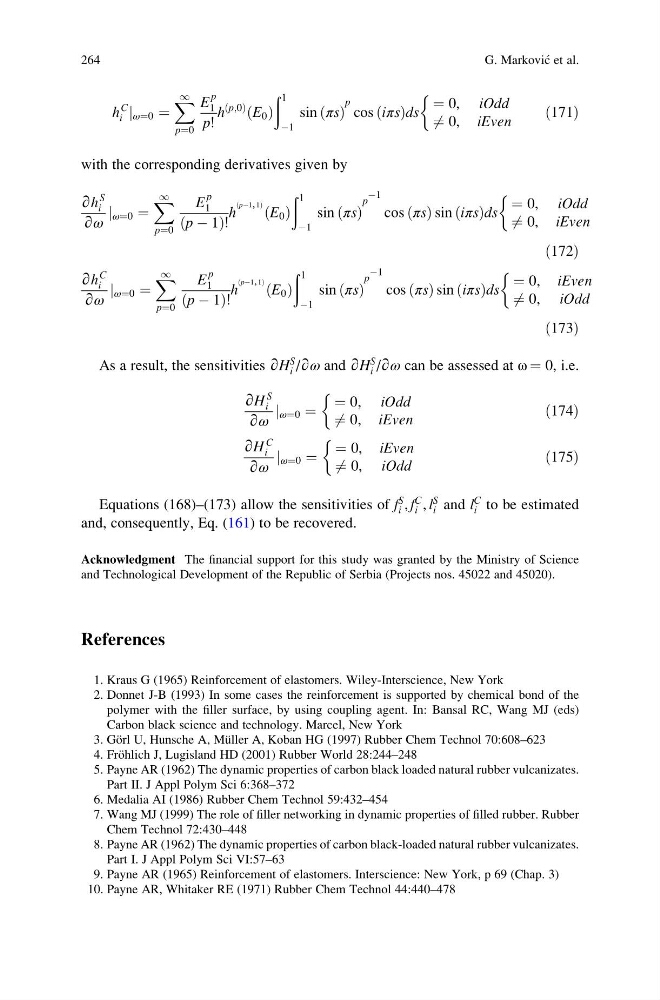
with the corresponding derivatives given by
∂h
S
i
∂ω
ω¼0
j
¼
X 1
p¼0
E
p
1
p À 1
ð
Þ!
h
pÀ1, 1
ð
Þ E 0
ð Þ
ð 1
À1
sin πs
ð Þ
p
À1
cos πs
ð Þsin iπs
ð Þds
¼ 0, iOdd
6 ¼ 0, iEven
&
ð172Þ
∂h
C
i
∂ω
ω¼0
j
¼
X 1
p¼0
E
p
1
p À 1
ð
Þ!
h
pÀ1, 1
ð
Þ E 0
ð Þ
ð 1
À1
sin πs
ð Þ
p
À1
cos πs
ð Þsin iπs
ð Þds
¼ 0, iEven
6 ¼ 0, iOdd
&
ð173Þ
As a result, the sensitivities ∂H
S
i /∂ω and ∂H
S
i /∂ω can be assessed at ω ¼ 0, i.e.
∂H
S
i
∂ω
ω¼0
j
¼
¼ 0, iOdd
6 ¼ 0, iEven
&
ð174Þ
∂H
C
i
∂ω
ω¼0
j
¼
¼ 0, iEven
6 ¼ 0, iOdd
&
ð175Þ
Equations (168)–(173) allow the sensitivities of f
S
i , f
C
i , l
S
i and l
C
i to be estimated
and, consequently, Eq. (161) to be recovered.
Acknowledgment The financial support for this study was granted by the Ministry of Science
and Technological Development of the Republic of Serbia (Projects nos. 45022 and 45020).
References
1. Kraus G (1965) Reinforcement of elastomers. Wiley-Interscience, New York
2. Donnet J-B (1993) In some cases the reinforcement is supported by chemical bond of the
polymer with the filler surface, by using coupling agent. In: Bansal RC, Wang MJ (eds)
Carbon black science and technology. Marcel, New York
3. Go ¨rl U, Hunsche A, Mu ¨ller A, Koban HG (1997) Rubber Chem Technol 70:608–623
4. Fro ¨hlich J, Lugisland HD (2001) Rubber World 28:244–248
5. Payne AR (1962) The dynamic properties of carbon black loaded natural rubber vulcanizates.
Part II. J Appl Polym Sci 6:368–372
6. Medalia AI (1986) Rubber Chem Technol 59:432–454
7. Wang MJ (1999) The role of filler networking in dynamic properties of filled rubber. Rubber
Chem Technol 72:430–448
8. Payne AR (1962) The dynamic properties of carbon black-loaded natural rubber vulcanizates.
Part I. J Appl Polym Sci VI:57–63
9. Payne AR (1965) Reinforcement of elastomers. Interscience: New York, p 69 (Chap. 3)
10. Payne AR, Whitaker RE (1971) Rubber Chem Technol 44:440–478
264
G. Markovic ´ et al.
C
i ω¼0
j
¼
X 1
p¼0
E
p
1
p!
h
p;0
ð Þ E 0
ð Þ
ð 1
À1
sin πs
ð Þ
p
cos iπs
ð Þds
¼ 0, iOdd
6 ¼ 0, iEven
&
ð171Þ
with the corresponding derivatives given by
∂h
S
i
∂ω
ω¼0
j
¼
X 1
p¼0
E
p
1
p À 1
ð
Þ!
h
pÀ1, 1
ð
Þ E 0
ð Þ
ð 1
À1
sin πs
ð Þ
p
À1
cos πs
ð Þsin iπs
ð Þds
¼ 0, iOdd
6 ¼ 0, iEven
&
ð172Þ
∂h
C
i
∂ω
ω¼0
j
¼
X 1
p¼0
E
p
1
p À 1
ð
Þ!
h
pÀ1, 1
ð
Þ E 0
ð Þ
ð 1
À1
sin πs
ð Þ
p
À1
cos πs
ð Þsin iπs
ð Þds
¼ 0, iEven
6 ¼ 0, iOdd
&
ð173Þ
As a result, the sensitivities ∂H
S
i /∂ω and ∂H
S
i /∂ω can be assessed at ω ¼ 0, i.e.
∂H
S
i
∂ω
ω¼0
j
¼
¼ 0, iOdd
6 ¼ 0, iEven
&
ð174Þ
∂H
C
i
∂ω
ω¼0
j
¼
¼ 0, iEven
6 ¼ 0, iOdd
&
ð175Þ
Equations (168)–(173) allow the sensitivities of f
S
i , f
C
i , l
S
i and l
C
i to be estimated
and, consequently, Eq. (161) to be recovered.
Acknowledgment The financial support for this study was granted by the Ministry of Science
and Technological Development of the Republic of Serbia (Projects nos. 45022 and 45020).
References
1. Kraus G (1965) Reinforcement of elastomers. Wiley-Interscience, New York
2. Donnet J-B (1993) In some cases the reinforcement is supported by chemical bond of the
polymer with the filler surface, by using coupling agent. In: Bansal RC, Wang MJ (eds)
Carbon black science and technology. Marcel, New York
3. Go ¨rl U, Hunsche A, Mu ¨ller A, Koban HG (1997) Rubber Chem Technol 70:608–623
4. Fro ¨hlich J, Lugisland HD (2001) Rubber World 28:244–248
5. Payne AR (1962) The dynamic properties of carbon black loaded natural rubber vulcanizates.
Part II. J Appl Polym Sci 6:368–372
6. Medalia AI (1986) Rubber Chem Technol 59:432–454
7. Wang MJ (1999) The role of filler networking in dynamic properties of filled rubber. Rubber
Chem Technol 72:430–448
8. Payne AR (1962) The dynamic properties of carbon black-loaded natural rubber vulcanizates.
Part I. J Appl Polym Sci VI:57–63
9. Payne AR (1965) Reinforcement of elastomers. Interscience: New York, p 69 (Chap. 3)
10. Payne AR, Whitaker RE (1971) Rubber Chem Technol 44:440–478
264
G. Markovic ´ et al.