

are typically associated with filled vulcanizates. This is explained by the effect of
chain disentanglements on straining. The model of variable network density has
been applied and the calculated activation energy for NR filled with 20 phr silica is
found to be within the range of Van der Waal’s interaction energy. Hence it is
concluded that the number of unstable fixed chains adsorbed on the filler surface is
also responsible for the reduction in modulus with increase in temperature. Finally,
it is concluded that in addition to the contribution from filler-filler network, there
are a lot of factors that affect the nonlinear viscoelastic behavior including the
breakdown of different networks, namely, filler-filler networks, weak polymer-filler
networks, chemical networks, and entanglement networks.
Dynamic Moduli of Nonlinear Viscoelastic Models
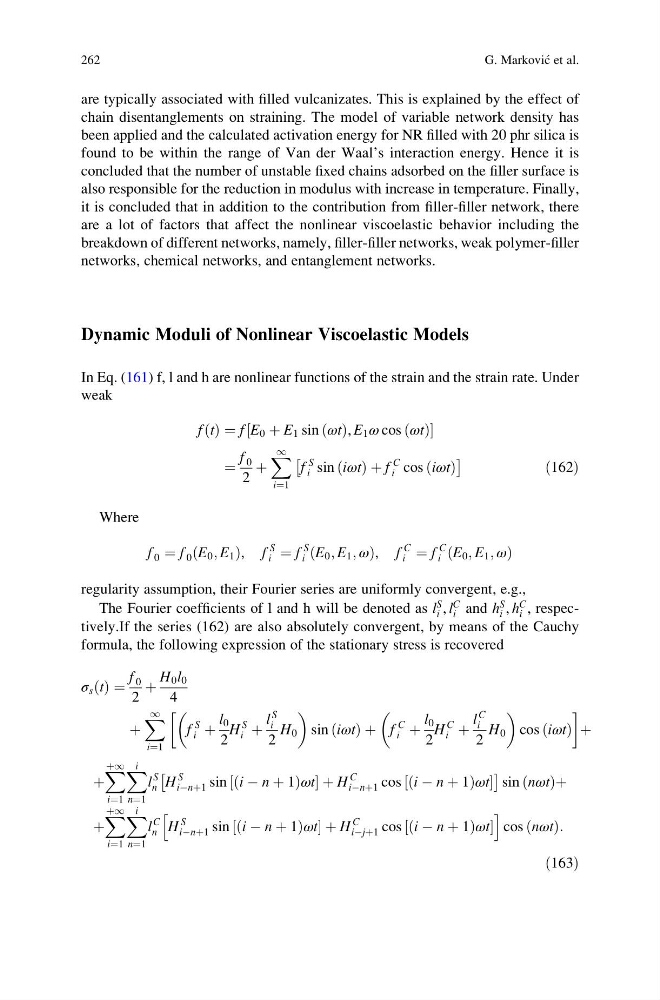
In Eq. (161) f, l and h are nonlinear functions of the strain and the strain rate. Under
weak
f t
ð Þ ¼ f E 0 þ E 1 sin ωt
ð Þ, E 1 ω cos ωt
ð Þ
½
¼
f 0
2
þ
X 1
i¼1
f
S
i sin iωt
ð Þþf
C
i cos iωt
ð Þ
Â
Ã
ð162Þ
Where
f 0 ¼ f 0 E 0 ; E 1
ð
Þ, f
S
i ¼ f
S
i E 0 ; E 1 ; ω
ð
Þ , f
C
i ¼ f
C
i E 0 ; E 1 ; ω
ð
Þ
regularity assumption, their Fourier series are uniformly convergent, e.g.,
The Fourier coefficients of l and h will be denoted as l
S
i , l
C
i and h
S
i , h
C
i , respectively.If the series (162) are also absolutely convergent, by means of the Cauchy
formula, the following expression of the stationary stress is recovered
σ s t
ð Þ ¼
f 0
2
þ
H 0 l 0
4
þ
X 1
i¼1
f
S
i þ
l 0
2
H
S
i þ
l
S
i
2
H 0
sin iωt
ð Þþ f
C
i þ
l 0
2
H
C
i þ
l
C
i
2
H 0
cos iωt
ð Þ
!
þ
þ
X þ1
i¼1
X i
n¼1
l
S
n H
S
iÀnþ1 sin i À n þ 1
ð
Þ ωt
½
þ H
C
iÀnþ1 cos i À n þ 1
ð
Þ ωt
½
Â
Ã
sin nωt
ð Þþ
þ
X þ1
i¼1
X i
n¼1
l
C
n H
S
iÀnþ1 sin i À n þ 1
ð
Þ ωt
½
þ H
C
iÀjþ1 cos i À n þ 1
ð
Þ ωt
½
h
i
cos nωt
ð Þ:
ð163Þ
262
G. Markovic ´ et al.
chain disentanglements on straining. The model of variable network density has
been applied and the calculated activation energy for NR filled with 20 phr silica is
found to be within the range of Van der Waal’s interaction energy. Hence it is
concluded that the number of unstable fixed chains adsorbed on the filler surface is
also responsible for the reduction in modulus with increase in temperature. Finally,
it is concluded that in addition to the contribution from filler-filler network, there
are a lot of factors that affect the nonlinear viscoelastic behavior including the
breakdown of different networks, namely, filler-filler networks, weak polymer-filler
networks, chemical networks, and entanglement networks.
Dynamic Moduli of Nonlinear Viscoelastic Models
In Eq. (161) f, l and h are nonlinear functions of the strain and the strain rate. Under
weak
f t
ð Þ ¼ f E 0 þ E 1 sin ωt
ð Þ, E 1 ω cos ωt
ð Þ
½
¼
f 0
2
þ
X 1
i¼1
f
S
i sin iωt
ð Þþf
C
i cos iωt
ð Þ
Â
Ã
ð162Þ
Where
f 0 ¼ f 0 E 0 ; E 1
ð
Þ, f
S
i ¼ f
S
i E 0 ; E 1 ; ω
ð
Þ , f
C
i ¼ f
C
i E 0 ; E 1 ; ω
ð
Þ
regularity assumption, their Fourier series are uniformly convergent, e.g.,
The Fourier coefficients of l and h will be denoted as l
S
i , l
C
i and h
S
i , h
C
i , respectively.If the series (162) are also absolutely convergent, by means of the Cauchy
formula, the following expression of the stationary stress is recovered
σ s t
ð Þ ¼
f 0
2
þ
H 0 l 0
4
þ
X 1
i¼1
f
S
i þ
l 0
2
H
S
i þ
l
S
i
2
H 0
sin iωt
ð Þþ f
C
i þ
l 0
2
H
C
i þ
l
C
i
2
H 0
cos iωt
ð Þ
!
þ
þ
X þ1
i¼1
X i
n¼1
l
S
n H
S
iÀnþ1 sin i À n þ 1
ð
Þ ωt
½
þ H
C
iÀnþ1 cos i À n þ 1
ð
Þ ωt
½
Â
Ã
sin nωt
ð Þþ
þ
X þ1
i¼1
X i
n¼1
l
C
n H
S
iÀnþ1 sin i À n þ 1
ð
Þ ωt
½
þ H
C
iÀjþ1 cos i À n þ 1
ð
Þ ωt
½
h
i
cos nωt
ð Þ:
ð163Þ
262
G. Markovic ´ et al.