

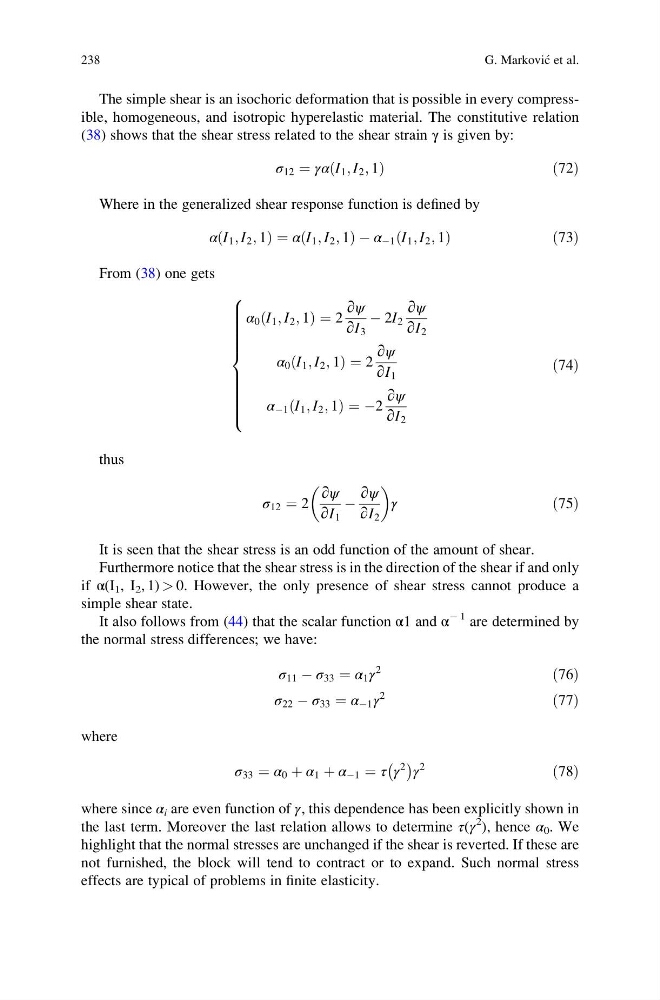
The simple shear is an isochoric deformation that is possible in every compressible, homogeneous, and isotropic hyperelastic material. The constitutive relation
(38) shows that the shear stress related to the shear strain γ is given by:
σ 12 ¼ γα I 1 ; I 2 ; 1
ð
Þ
ð72Þ
Where in the generalized shear response function is defined by
α I 1 ; I 2 ; 1
ð
Þ¼α I 1 ; I 2 ; 1
ð
ÞÀα À1 I 1 ; I 2 ; 1
ð
Þ
ð73Þ
From (38) one gets
α 0 I 1 ; I 2 ; 1
ð
Þ¼2
∂ψ
∂I 3
À 2I 2
∂ψ
∂I 2
α 0 I 1 ; I 2 ; 1
ð
Þ¼2
∂ψ
∂I 1
α À1 I 1 ; I 2 ; 1
ð
Þ¼À2
∂ψ
∂I 2
8
> > > > > > > > > <
> > > > > > > > > :
ð74Þ
thus
σ 12 ¼ 2
∂ψ
∂I 1
À
∂ψ
∂I 2
γ
ð75Þ
It is seen that the shear stress is an odd function of the amount of shear.
Furthermore notice that the shear stress is in the direction of the shear if and only
if α(I 1 , I 2 , 1) > 0. However, the only presence of shear stress cannot produce a
simple shear state.
It also follows from (44) that the scalar function α1 and α
À 1 are determined by
the normal stress differences; we have:
σ 11 À σ 33 ¼ α 1 γ
2
ð76Þ
σ 22 À σ 33 ¼ α À1 γ
2
ð77Þ
where
σ 33 ¼ α 0 þ α 1 þ α À1 ¼ τ γ
2
À Á
γ
2
ð78Þ
where since α i are even function of γ, this dependence has been explicitly shown in
the last term. Moreover the last relation allows to determine τ(γ
2 ), hence α 0 . We
highlight that the normal stresses are unchanged if the shear is reverted. If these are
not furnished, the block will tend to contract or to expand. Such normal stress
effects are typical of problems in finite elasticity.
238
G. Markovic ´ et al.
(38) shows that the shear stress related to the shear strain γ is given by:
σ 12 ¼ γα I 1 ; I 2 ; 1
ð
Þ
ð72Þ
Where in the generalized shear response function is defined by
α I 1 ; I 2 ; 1
ð
Þ¼α I 1 ; I 2 ; 1
ð
ÞÀα À1 I 1 ; I 2 ; 1
ð
Þ
ð73Þ
From (38) one gets
α 0 I 1 ; I 2 ; 1
ð
Þ¼2
∂ψ
∂I 3
À 2I 2
∂ψ
∂I 2
α 0 I 1 ; I 2 ; 1
ð
Þ¼2
∂ψ
∂I 1
α À1 I 1 ; I 2 ; 1
ð
Þ¼À2
∂ψ
∂I 2
8
> > > > > > > > > <
> > > > > > > > > :
ð74Þ
thus
σ 12 ¼ 2
∂ψ
∂I 1
À
∂ψ
∂I 2
γ
ð75Þ
It is seen that the shear stress is an odd function of the amount of shear.
Furthermore notice that the shear stress is in the direction of the shear if and only
if α(I 1 , I 2 , 1) > 0. However, the only presence of shear stress cannot produce a
simple shear state.
It also follows from (44) that the scalar function α1 and α
À 1 are determined by
the normal stress differences; we have:
σ 11 À σ 33 ¼ α 1 γ
2
ð76Þ
σ 22 À σ 33 ¼ α À1 γ
2
ð77Þ
where
σ 33 ¼ α 0 þ α 1 þ α À1 ¼ τ γ
2
À Á
γ
2
ð78Þ
where since α i are even function of γ, this dependence has been explicitly shown in
the last term. Moreover the last relation allows to determine τ(γ
2 ), hence α 0 . We
highlight that the normal stresses are unchanged if the shear is reverted. If these are
not furnished, the block will tend to contract or to expand. Such normal stress
effects are typical of problems in finite elasticity.
238
G. Markovic ´ et al.