

in the dissipated energy. One contribution comes from the rubbery matrix and is
mainly independent from the filler content. A second one comes from the shearing
of the glassy layers around the filler particles. Another contribution may be ascribed
to the mechanism responsible for the collapse of the storage modulus. Within the
frame of the Kraus model, this extra contribution to the energy dissipation comes
from the friction between the filler particles. For models involving bound rubber, it
might be related to the friction of the chains, either on the surface of the filler
particles or within the glassy layer during its softening under the effect of the
applied stress. In those two former mechanisms, the amount of energy dissipated
scales the total surface of the particles. The maximum comes from the competition
between the breaking and the reformation of the network whatever the nature is
(filler-filler, entanglement, glassy bridges, etc.). When the strain increases, the
destruction of the network starts and increases the dissipated energy. For higher
value of the strain, the rate of destruction is higher than the rate of the reconstruction of the network. As a consequence, the dissipation energy associated with the
breaking of the network decreases and the loss modulus goes through a maximum
with the strain.
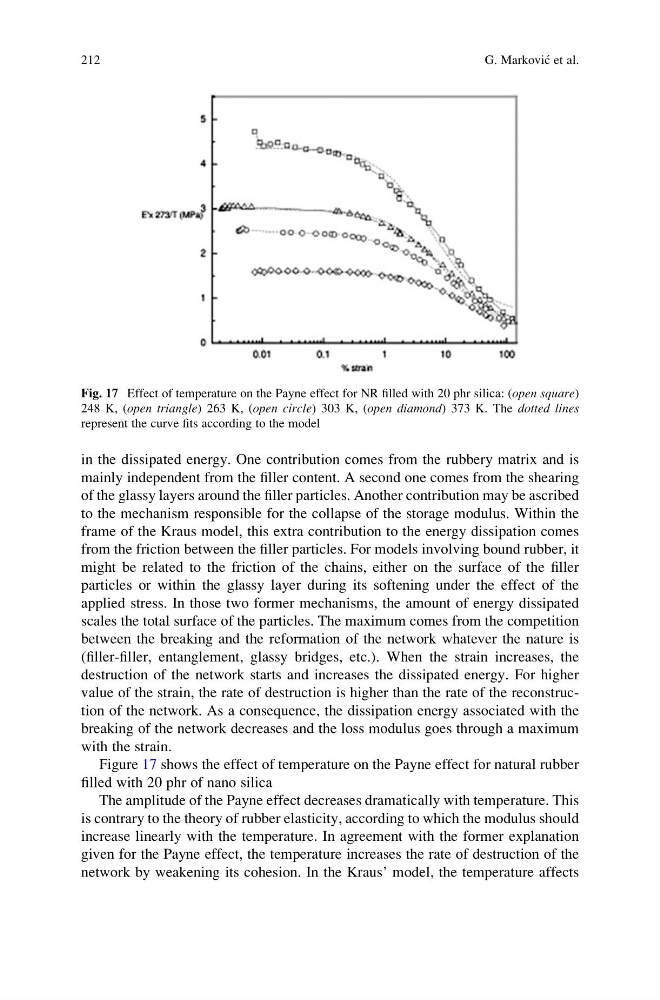
Figure 17 shows the effect of temperature on the Payne effect for natural rubber
filled with 20 phr of nano silica
The amplitude of the Payne effect decreases dramatically with temperature. This
is contrary to the theory of rubber elasticity, according to which the modulus should
increase linearly with the temperature. In agreement with the former explanation
given for the Payne effect, the temperature increases the rate of destruction of the
network by weakening its cohesion. In the Kraus’ model, the temperature affects
Fig. 17 Effect of temperature on the Payne effect for NR filled with 20 phr silica: (open square)
248 K, (open triangle) 263 K, (open circle) 303 K, (open diamond) 373 K. The dotted lines
represent the curve fits according to the model
212
G. Markovic ´ et al.
mainly independent from the filler content. A second one comes from the shearing
of the glassy layers around the filler particles. Another contribution may be ascribed
to the mechanism responsible for the collapse of the storage modulus. Within the
frame of the Kraus model, this extra contribution to the energy dissipation comes
from the friction between the filler particles. For models involving bound rubber, it
might be related to the friction of the chains, either on the surface of the filler
particles or within the glassy layer during its softening under the effect of the
applied stress. In those two former mechanisms, the amount of energy dissipated
scales the total surface of the particles. The maximum comes from the competition
between the breaking and the reformation of the network whatever the nature is
(filler-filler, entanglement, glassy bridges, etc.). When the strain increases, the
destruction of the network starts and increases the dissipated energy. For higher
value of the strain, the rate of destruction is higher than the rate of the reconstruction of the network. As a consequence, the dissipation energy associated with the
breaking of the network decreases and the loss modulus goes through a maximum
with the strain.
Figure 17 shows the effect of temperature on the Payne effect for natural rubber
filled with 20 phr of nano silica
The amplitude of the Payne effect decreases dramatically with temperature. This
is contrary to the theory of rubber elasticity, according to which the modulus should
increase linearly with the temperature. In agreement with the former explanation
given for the Payne effect, the temperature increases the rate of destruction of the
network by weakening its cohesion. In the Kraus’ model, the temperature affects
Fig. 17 Effect of temperature on the Payne effect for NR filled with 20 phr silica: (open square)
248 K, (open triangle) 263 K, (open circle) 303 K, (open diamond) 373 K. The dotted lines
represent the curve fits according to the model
212
G. Markovic ´ et al.