

A detailed study of the low frequency dynamic properties of filled natural rubber
was carried out by Fletcher and Gent [46] and was later extended by Payne [47]. In
cyclic strain tests the shear modulus can be simply expressed as a complex modulus
G* ¼ G
0 + iG
00 where G
0 is the in-phase modulus and G
00 the out-of-phase modulus.
The phase angle δ is given by tan δ ¼ G
00 /G
0 .
The addition of fillers to rubber compounds has a strong impact on the static and
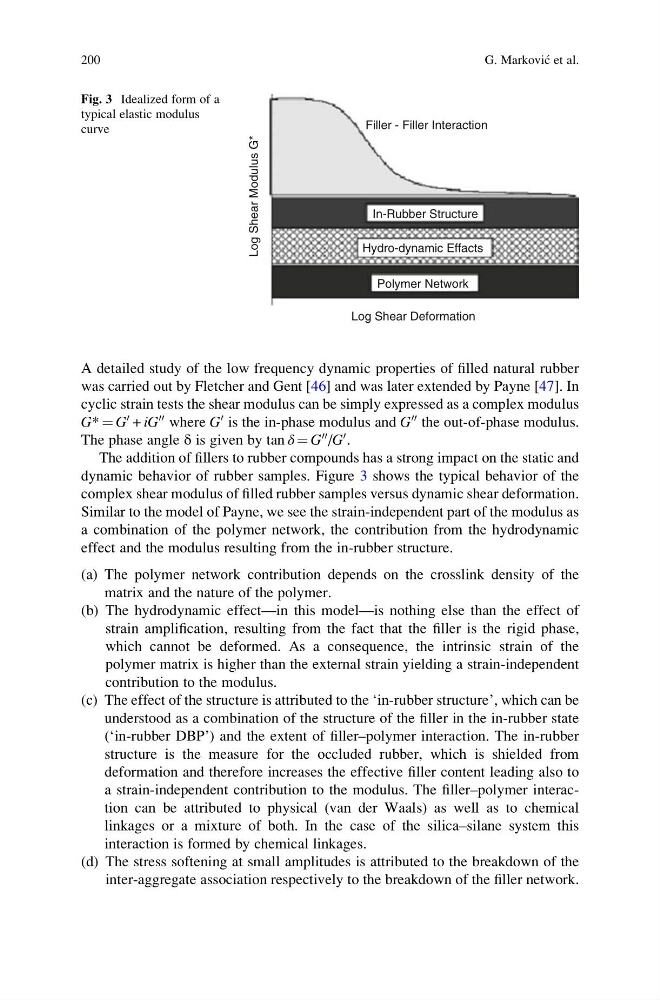
dynamic behavior of rubber samples. Figure 3 shows the typical behavior of the
complex shear modulus of filled rubber samples versus dynamic shear deformation.
Similar to the model of Payne, we see the strain-independent part of the modulus as
a combination of the polymer network, the contribution from the hydrodynamic
effect and the modulus resulting from the in-rubber structure.
(a) The polymer network contribution depends on the crosslink density of the
matrix and the nature of the polymer.
(b) The hydrodynamic effect—in this model—is nothing else than the effect of
strain amplification, resulting from the fact that the filler is the rigid phase,
which cannot be deformed. As a consequence, the intrinsic strain of the
polymer matrix is higher than the external strain yielding a strain-independent
contribution to the modulus.
(c) The effect of the structure is attributed to the ‘in-rubber structure’, which can be
understood as a combination of the structure of the filler in the in-rubber state
(‘in-rubber DBP’) and the extent of filler–polymer interaction. The in-rubber
structure is the measure for the occluded rubber, which is shielded from
deformation and therefore increases the effective filler content leading also to
a strain-independent contribution to the modulus. The filler–polymer interaction can be attributed to physical (van der Waals) as well as to chemical
linkages or a mixture of both. In the case of the silica–silane system this
interaction is formed by chemical linkages.
(d) The stress softening at small amplitudes is attributed to the breakdown of the
inter-aggregate association respectively to the breakdown of the filler network.
Log Shear Deformation
Polymer Network
Filler - Filler Interaction
Log Shear Modulus G*
In-Rubber Structure
Hydro-dynamic Effacts
Fig. 3 Idealized form of a
typical elastic modulus
curve
200
G. Markovic ´ et al.
was carried out by Fletcher and Gent [46] and was later extended by Payne [47]. In
cyclic strain tests the shear modulus can be simply expressed as a complex modulus
G* ¼ G
0 + iG
00 where G
0 is the in-phase modulus and G
00 the out-of-phase modulus.
The phase angle δ is given by tan δ ¼ G
00 /G
0 .
The addition of fillers to rubber compounds has a strong impact on the static and
dynamic behavior of rubber samples. Figure 3 shows the typical behavior of the
complex shear modulus of filled rubber samples versus dynamic shear deformation.
Similar to the model of Payne, we see the strain-independent part of the modulus as
a combination of the polymer network, the contribution from the hydrodynamic
effect and the modulus resulting from the in-rubber structure.
(a) The polymer network contribution depends on the crosslink density of the
matrix and the nature of the polymer.
(b) The hydrodynamic effect—in this model—is nothing else than the effect of
strain amplification, resulting from the fact that the filler is the rigid phase,
which cannot be deformed. As a consequence, the intrinsic strain of the
polymer matrix is higher than the external strain yielding a strain-independent
contribution to the modulus.
(c) The effect of the structure is attributed to the ‘in-rubber structure’, which can be
understood as a combination of the structure of the filler in the in-rubber state
(‘in-rubber DBP’) and the extent of filler–polymer interaction. The in-rubber
structure is the measure for the occluded rubber, which is shielded from
deformation and therefore increases the effective filler content leading also to
a strain-independent contribution to the modulus. The filler–polymer interaction can be attributed to physical (van der Waals) as well as to chemical
linkages or a mixture of both. In the case of the silica–silane system this
interaction is formed by chemical linkages.
(d) The stress softening at small amplitudes is attributed to the breakdown of the
inter-aggregate association respectively to the breakdown of the filler network.
Log Shear Deformation
Polymer Network
Filler - Filler Interaction
Log Shear Modulus G*
In-Rubber Structure
Hydro-dynamic Effacts
Fig. 3 Idealized form of a
typical elastic modulus
curve
200
G. Markovic ´ et al.