

non-hydrodynamic interactions of particles is not sensitive to the deformation rates.
A dynamic equi1ibrium state will be achieved between the stress and the force of
non-hydrodynamic interactions of particles, then the number of particles and
A-constituent chains have a given dynamic equilibrium value, and display a weak
yielding property on the flowing curve. Song [8] also gives the kinetic equation (9)
as
n ia t
ð Þ ¼ n ia o
ð Þe
_
γ =Dγ
ð
Þ
¼ n ia o
ð Þe
P e ¼ n ia o
ð Þe
τ γ _
γ
ð9Þ
where, P e is Peclet number [9] of the particles, D r is a coefficient [9] of diffusion
rotation, τ γ is rotation relaxation time, _
γ is the rate constant of deformation. Above
forces of non-hydrodynamic interactions are also related to physical and chemical
properties (shape, size and composition) of particles, interfacial properties between
the particle and matrix, etc.
2.2.3 Flow Curve Properties in Steady Shear Flow [8]
There are four characteristic regions in the flow curve as given in Winter’s work
[10]: (1) low shear rate plateau; (2) apparent yielding; (3) intermediate rate plateau;
and (4) shear thinning characteristic regions. The shapes and sizes of the regions
change with changing physical and chemical properties of the particles, properties
of interface between the particle and matrix, and polymer structure.
2.3 Statistical Conformation of Entangled and Adsorbed
Chains [8]
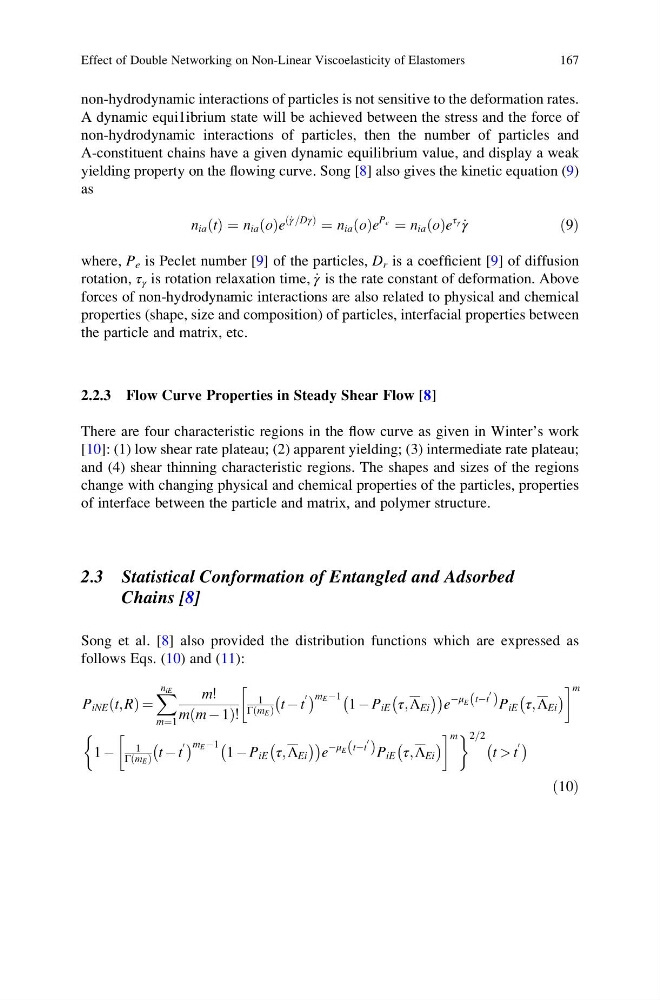
Song et al. [8] also provided the distribution functions which are expressed as
follows Eqs. (10) and (11):
P iNE t;R
ð Þ¼
X n iE
m¼1
m!
m mÀ 1
ð
Þ!
1
Γ m E
ð Þ t À t
0
À
Á m E À1 1 À P iE τ;Λ Ei
À
Á
À
Á
e
Àμ E tÀt
0
ð Þ P iE τ; Λ Ei
À
Á
! m
1 À
1
Γ m E
ð Þ t À t
0
À
Á m E À1 1 À P iE τ;Λ Ei
À
Á
À
Á
e
Àμ E tÀt
0
ð Þ P iE τ; Λ Ei
À
Á
! m
&
' 2=2
t > t
0
À
Á
ð10Þ
Effect of Double Networking on Non-Linear Viscoelasticity of Elastomers
167
A dynamic equi1ibrium state will be achieved between the stress and the force of
non-hydrodynamic interactions of particles, then the number of particles and
A-constituent chains have a given dynamic equilibrium value, and display a weak
yielding property on the flowing curve. Song [8] also gives the kinetic equation (9)
as
n ia t
ð Þ ¼ n ia o
ð Þe
_
γ =Dγ
ð
Þ
¼ n ia o
ð Þe
P e ¼ n ia o
ð Þe
τ γ _
γ
ð9Þ
where, P e is Peclet number [9] of the particles, D r is a coefficient [9] of diffusion
rotation, τ γ is rotation relaxation time, _
γ is the rate constant of deformation. Above
forces of non-hydrodynamic interactions are also related to physical and chemical
properties (shape, size and composition) of particles, interfacial properties between
the particle and matrix, etc.
2.2.3 Flow Curve Properties in Steady Shear Flow [8]
There are four characteristic regions in the flow curve as given in Winter’s work
[10]: (1) low shear rate plateau; (2) apparent yielding; (3) intermediate rate plateau;
and (4) shear thinning characteristic regions. The shapes and sizes of the regions
change with changing physical and chemical properties of the particles, properties
of interface between the particle and matrix, and polymer structure.
2.3 Statistical Conformation of Entangled and Adsorbed
Chains [8]
Song et al. [8] also provided the distribution functions which are expressed as
follows Eqs. (10) and (11):
P iNE t;R
ð Þ¼
X n iE
m¼1
m!
m mÀ 1
ð
Þ!
1
Γ m E
ð Þ t À t
0
À
Á m E À1 1 À P iE τ;Λ Ei
À
Á
À
Á
e
Àμ E tÀt
0
ð Þ P iE τ; Λ Ei
À
Á
! m
1 À
1
Γ m E
ð Þ t À t
0
À
Á m E À1 1 À P iE τ;Λ Ei
À
Á
À
Á
e
Àμ E tÀt
0
ð Þ P iE τ; Λ Ei
À
Á
! m
&
' 2=2
t > t
0
À
Á
ð10Þ
Effect of Double Networking on Non-Linear Viscoelasticity of Elastomers
167