

freedom for disentanglement per loop and terminal E-constituent chain), where
4 is the number of trapped segments in each loop E-constituent chain, 2 is the
number of polymer chains sharing a loop E-constituent chain; 3 is the number of
trapped segments in each terminal E-constituent chain, À À
N 1kE and À À
N tmE are the
fractions of the kth loop E-constituent chain in the total loop E-constituent
chains and of the mth terminal E-constituent chain in the total terminal
E-constituent chains.
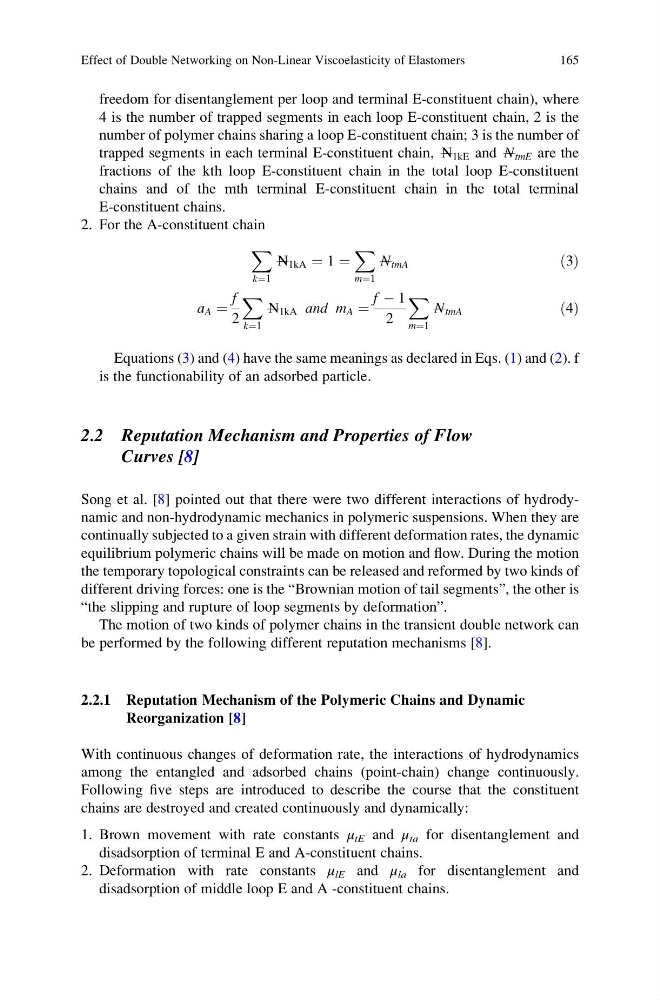
2. For the A-constituent chain
X
k¼1
À À
N 1kA ¼ 1 ¼
X
m¼1
À À
N tmA
ð3Þ
a A ¼
f
2
X
k¼1
À À
N 1kA and m A ¼
f À 1
2
X
m¼1
À À
N tmA
ð4Þ
Equations (3) and (4) have the same meanings as declared in Eqs. (1) and (2). f
is the functionability of an adsorbed particle.
2.2 Reputation Mechanism and Properties of Flow
Curves [8]
Song et al. [8] pointed out that there were two different interactions of hydrodynamic and non-hydrodynamic mechanics in polymeric suspensions. When they are
continually subjected to a given strain with different deformation rates, the dynamic
equilibrium polymeric chains will be made on motion and flow. During the motion
the temporary topological constraints can be released and reformed by two kinds of
different driving forces: one is the “Brownian motion of tail segments”, the other is
“the slipping and rupture of loop segments by deformation”.
The motion of two kinds of polymer chains in the transient double network can
be performed by the following different reputation mechanisms [8].
2.2.1 Reputation Mechanism of the Polymeric Chains and Dynamic
Reorganization [8]
With continuous changes of deformation rate, the interactions of hydrodynamics
among the entangled and adsorbed chains (point-chain) change continuously.
Following five steps are introduced to describe the course that the constituent
chains are destroyed and created continuously and dynamically:
1. Brown movement with rate constants μ tE and μ ta for disentanglement and
disadsorption of terminal E and A-constituent chains.
2. Deformation with rate constants μ lE and μ la for disentanglement and
disadsorption of middle loop E and A -constituent chains.
Effect of Double Networking on Non-Linear Viscoelasticity of Elastomers
165
4 is the number of trapped segments in each loop E-constituent chain, 2 is the
number of polymer chains sharing a loop E-constituent chain; 3 is the number of
trapped segments in each terminal E-constituent chain, À À
N 1kE and À À
N tmE are the
fractions of the kth loop E-constituent chain in the total loop E-constituent
chains and of the mth terminal E-constituent chain in the total terminal
E-constituent chains.
2. For the A-constituent chain
X
k¼1
À À
N 1kA ¼ 1 ¼
X
m¼1
À À
N tmA
ð3Þ
a A ¼
f
2
X
k¼1
À À
N 1kA and m A ¼
f À 1
2
X
m¼1
À À
N tmA
ð4Þ
Equations (3) and (4) have the same meanings as declared in Eqs. (1) and (2). f
is the functionability of an adsorbed particle.
2.2 Reputation Mechanism and Properties of Flow
Curves [8]
Song et al. [8] pointed out that there were two different interactions of hydrodynamic and non-hydrodynamic mechanics in polymeric suspensions. When they are
continually subjected to a given strain with different deformation rates, the dynamic
equilibrium polymeric chains will be made on motion and flow. During the motion
the temporary topological constraints can be released and reformed by two kinds of
different driving forces: one is the “Brownian motion of tail segments”, the other is
“the slipping and rupture of loop segments by deformation”.
The motion of two kinds of polymer chains in the transient double network can
be performed by the following different reputation mechanisms [8].
2.2.1 Reputation Mechanism of the Polymeric Chains and Dynamic
Reorganization [8]
With continuous changes of deformation rate, the interactions of hydrodynamics
among the entangled and adsorbed chains (point-chain) change continuously.
Following five steps are introduced to describe the course that the constituent
chains are destroyed and created continuously and dynamically:
1. Brown movement with rate constants μ tE and μ ta for disentanglement and
disadsorption of terminal E and A-constituent chains.
2. Deformation with rate constants μ lE and μ la for disentanglement and
disadsorption of middle loop E and A -constituent chains.
Effect of Double Networking on Non-Linear Viscoelasticity of Elastomers
165