

whole temperature region whereas the increment is more prominent in the rubbery
region [28]. This indicates that carbon black has a strong effect on the elastic
properties of pristine AEM due to the restricted movement of AEM molecular
chains. The increment in storage modulus throughout the temperature region is due
to the enhancement in crosslink density with increase in the CCB loading. The
sharp fall in storage modulus after À30
C confirmed the glass transition (T g ) region
as modulus decreased drastically in going from glassy state to rubbery state. The
magnitude of the E
00 is noticeably less at ambient temperature that signifies low
plastic deformation for AEM-CCB vulcanizates than the unfilled AEM vulcanizate.
The linear and nonlinear viscoelastic behavior of poly(butylenes terephthalate)/
multi-walled carbon nanotube composites (PCTs) have been studied by D. Wu
et al. They have used small amplitude oscillatory shear (SAOS) for the linear
viscoelastic measurements whereas large amplitude oscillatory shear (LAOS) for
the nonlinear viscoelastic measurements. The dynamic strain sweep measurement
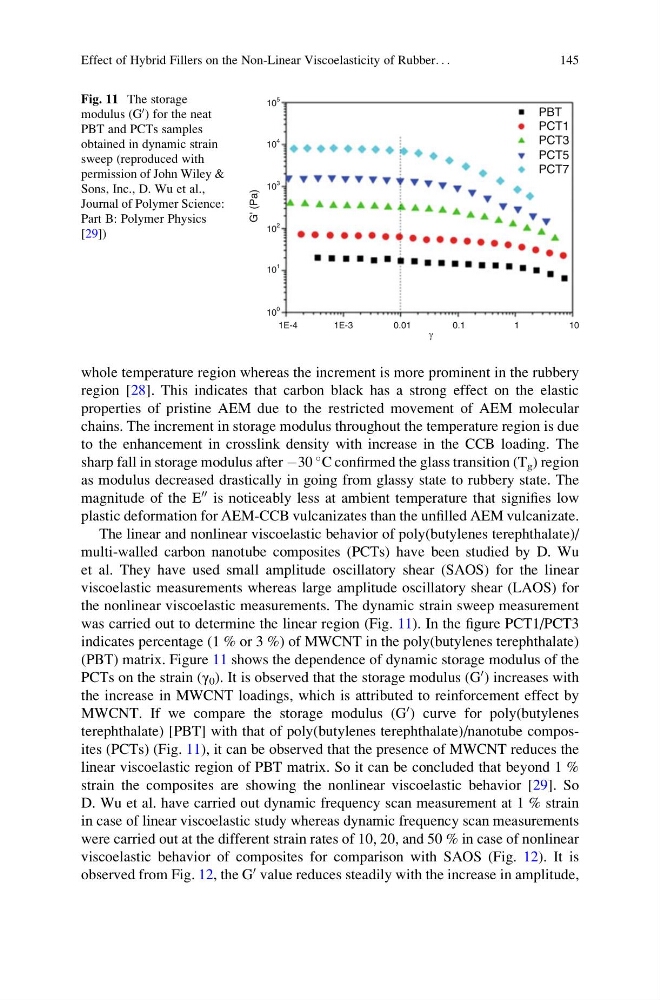
was carried out to determine the linear region (Fig. 11). In the figure PCT1/PCT3
indicates percentage (1 % or 3 %) of MWCNT in the poly(butylenes terephthalate)
(PBT) matrix. Figure 11 shows the dependence of dynamic storage modulus of the
PCTs on the strain (γ 0 ). It is observed that the storage modulus (G
0 ) increases with
the increase in MWCNT loadings, which is attributed to reinforcement effect by
MWCNT. If we compare the storage modulus (G
0 ) curve for poly(butylenes
terephthalate) [PBT] with that of poly(butylenes terephthalate)/nanotube composites (PCTs) (Fig. 11), it can be observed that the presence of MWCNT reduces the
linear viscoelastic region of PBT matrix. So it can be concluded that beyond 1 %
strain the composites are showing the nonlinear viscoelastic behavior [29]. So
D. Wu et al. have carried out dynamic frequency scan measurement at 1 % strain
in case of linear viscoelastic study whereas dynamic frequency scan measurements
were carried out at the different strain rates of 10, 20, and 50 % in case of nonlinear
viscoelastic behavior of composites for comparison with SAOS (Fig. 12). It is
observed from Fig. 12, the G
0 value reduces steadily with the increase in amplitude,
γ
10
PCT7
PCT5
PCT3
PCT1
PBT
1
0.1
0.01
1E-3
1E-4
G' (Pa)
10
2
10
3
10
5
10
4
10
1
10
0
Fig. 11 The storage
modulus (G
0 ) for the neat
PBT and PCTs samples
obtained in dynamic strain
sweep (reproduced with
permission of John Wiley &
Sons, Inc., D. Wu et al.,
Journal of Polymer Science:
Part B: Polymer Physics
[29])
Effect of Hybrid Fillers on the Non-Linear Viscoelasticity of Rubber. . .
145
region [28]. This indicates that carbon black has a strong effect on the elastic
properties of pristine AEM due to the restricted movement of AEM molecular
chains. The increment in storage modulus throughout the temperature region is due
to the enhancement in crosslink density with increase in the CCB loading. The
sharp fall in storage modulus after À30
C confirmed the glass transition (T g ) region
as modulus decreased drastically in going from glassy state to rubbery state. The
magnitude of the E
00 is noticeably less at ambient temperature that signifies low
plastic deformation for AEM-CCB vulcanizates than the unfilled AEM vulcanizate.
The linear and nonlinear viscoelastic behavior of poly(butylenes terephthalate)/
multi-walled carbon nanotube composites (PCTs) have been studied by D. Wu
et al. They have used small amplitude oscillatory shear (SAOS) for the linear
viscoelastic measurements whereas large amplitude oscillatory shear (LAOS) for
the nonlinear viscoelastic measurements. The dynamic strain sweep measurement
was carried out to determine the linear region (Fig. 11). In the figure PCT1/PCT3
indicates percentage (1 % or 3 %) of MWCNT in the poly(butylenes terephthalate)
(PBT) matrix. Figure 11 shows the dependence of dynamic storage modulus of the
PCTs on the strain (γ 0 ). It is observed that the storage modulus (G
0 ) increases with
the increase in MWCNT loadings, which is attributed to reinforcement effect by
MWCNT. If we compare the storage modulus (G
0 ) curve for poly(butylenes
terephthalate) [PBT] with that of poly(butylenes terephthalate)/nanotube composites (PCTs) (Fig. 11), it can be observed that the presence of MWCNT reduces the
linear viscoelastic region of PBT matrix. So it can be concluded that beyond 1 %
strain the composites are showing the nonlinear viscoelastic behavior [29]. So
D. Wu et al. have carried out dynamic frequency scan measurement at 1 % strain
in case of linear viscoelastic study whereas dynamic frequency scan measurements
were carried out at the different strain rates of 10, 20, and 50 % in case of nonlinear
viscoelastic behavior of composites for comparison with SAOS (Fig. 12). It is
observed from Fig. 12, the G
0 value reduces steadily with the increase in amplitude,
γ
10
PCT7
PCT5
PCT3
PCT1
PBT
1
0.1
0.01
1E-3
1E-4
G' (Pa)
10
2
10
3
10
5
10
4
10
1
10
0
Fig. 11 The storage
modulus (G
0 ) for the neat
PBT and PCTs samples
obtained in dynamic strain
sweep (reproduced with
permission of John Wiley &
Sons, Inc., D. Wu et al.,
Journal of Polymer Science:
Part B: Polymer Physics
[29])
Effect of Hybrid Fillers on the Non-Linear Viscoelasticity of Rubber. . .
145