

in toluene is obtained upon brief heating (a “sol”), which upon cooling to room
temperature over $20 min develops into an immobilized viscoelastic mass (a “gel”)
which does not flow under the influence of gravity (Fig. 8b). The above step leading
to spontaneous gelation is hastened when repeated in the presence of 0.2 mg (3.2 wt
%) of BNNTs [26].
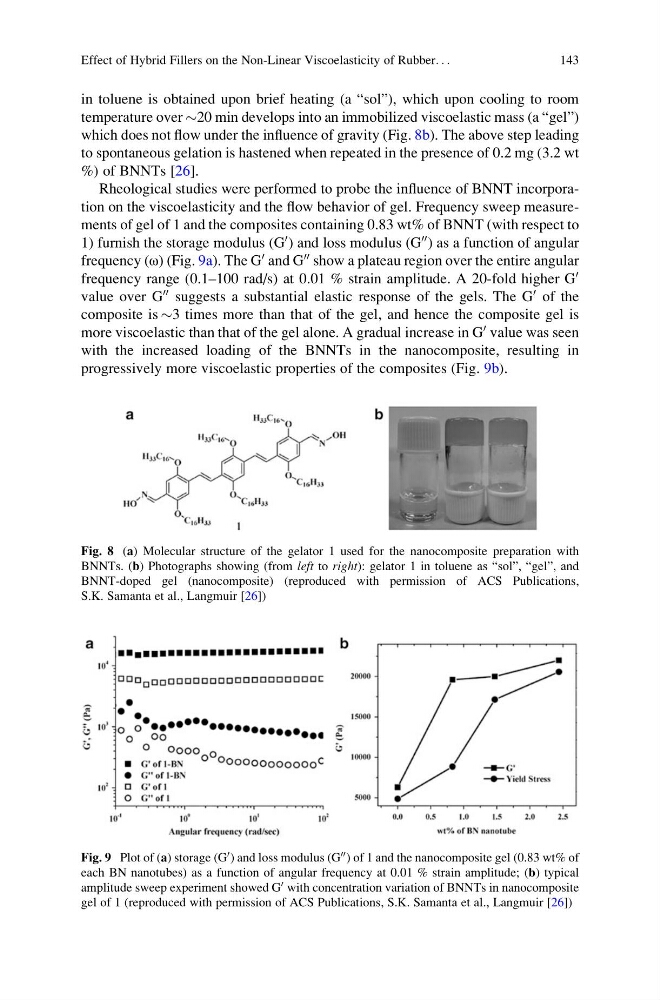
Rheological studies were performed to probe the influence of BNNT incorporation on the viscoelasticity and the flow behavior of gel. Frequency sweep measurements of gel of 1 and the composites containing 0.83 wt% of BNNT (with respect to
1) furnish the storage modulus (G
0 ) and loss modulus (G
00 ) as a function of angular
frequency (ω) (Fig. 9a). The G
0 and G
00 show a plateau region over the entire angular
frequency range (0.1–100 rad/s) at 0.01 % strain amplitude. A 20-fold higher G
0
value over G
00 suggests a substantial elastic response of the gels. The G
0 of the
composite is $3 times more than that of the gel, and hence the composite gel is
more viscoelastic than that of the gel alone. A gradual increase in G
0 value was seen
with the increased loading of the BNNTs in the nanocomposite, resulting in
progressively more viscoelastic properties of the composites (Fig. 9b).
Fig. 9 Plot of (a) storage (G
0 ) and loss modulus (G
00 ) of 1 and the nanocomposite gel (0.83 wt% of
each BN nanotubes) as a function of angular frequency at 0.01 % strain amplitude; (b) typical
amplitude sweep experiment showed G
0 with concentration variation of BNNTs in nanocomposite
gel of 1 (reproduced with permission of ACS Publications, S.K. Samanta et al., Langmuir [26])
Fig. 8 (a) Molecular structure of the gelator 1 used for the nanocomposite preparation with
BNNTs. (b) Photographs showing (from left to right): gelator 1 in toluene as “sol”, “gel”, and
BNNT-doped gel (nanocomposite) (reproduced with permission of ACS Publications,
S.K. Samanta et al., Langmuir [26])
Effect of Hybrid Fillers on the Non-Linear Viscoelasticity of Rubber. . .
143
temperature over $20 min develops into an immobilized viscoelastic mass (a “gel”)
which does not flow under the influence of gravity (Fig. 8b). The above step leading
to spontaneous gelation is hastened when repeated in the presence of 0.2 mg (3.2 wt
%) of BNNTs [26].
Rheological studies were performed to probe the influence of BNNT incorporation on the viscoelasticity and the flow behavior of gel. Frequency sweep measurements of gel of 1 and the composites containing 0.83 wt% of BNNT (with respect to
1) furnish the storage modulus (G
0 ) and loss modulus (G
00 ) as a function of angular
frequency (ω) (Fig. 9a). The G
0 and G
00 show a plateau region over the entire angular
frequency range (0.1–100 rad/s) at 0.01 % strain amplitude. A 20-fold higher G
0
value over G
00 suggests a substantial elastic response of the gels. The G
0 of the
composite is $3 times more than that of the gel, and hence the composite gel is
more viscoelastic than that of the gel alone. A gradual increase in G
0 value was seen
with the increased loading of the BNNTs in the nanocomposite, resulting in
progressively more viscoelastic properties of the composites (Fig. 9b).
Fig. 9 Plot of (a) storage (G
0 ) and loss modulus (G
00 ) of 1 and the nanocomposite gel (0.83 wt% of
each BN nanotubes) as a function of angular frequency at 0.01 % strain amplitude; (b) typical
amplitude sweep experiment showed G
0 with concentration variation of BNNTs in nanocomposite
gel of 1 (reproduced with permission of ACS Publications, S.K. Samanta et al., Langmuir [26])
Fig. 8 (a) Molecular structure of the gelator 1 used for the nanocomposite preparation with
BNNTs. (b) Photographs showing (from left to right): gelator 1 in toluene as “sol”, “gel”, and
BNNT-doped gel (nanocomposite) (reproduced with permission of ACS Publications,
S.K. Samanta et al., Langmuir [26])
Effect of Hybrid Fillers on the Non-Linear Viscoelasticity of Rubber. . .
143