

changing the material’s composition, it can exhibit new properties such as electrical
conductivity, insulating behavior, elasticity, greater strength, different color, and
greater reactivity characteristics that the very same substances do not exhibit at the
micro- or macroscale. Polymer-based nanocomposites have attracted great attention of many researchers for their novel properties [2–5]. These nanocomposites are
promising class of hybrid nanostructured materials with emerging applications
ranging from packaging to bio-medical [1, 6–8]. Polymer nanocomposites are
fabricated by dispersing inorganic/organic fillers, with at least one dimension in
the nanometer scale, in both inorganic/organic polymers [9, 10].
Polymer/rubber nanocomposites exhibit enhanced mechanical, thermal stability,
toughness, stiffness, and gas-barrier properties compared to those of conventional
composites at same filler volume fraction [11–15]. The interaction between the filler
and polymer matrix of nanocomposites at the nanometer scale enables the formation of
molecular bridges in the polymer matrix. This is the basis for the enhanced mechanical
properties of nanocomposite as compared to conventional microcomposites [16,
17]. Nanocomposites containing hybrid fillers add a new dimension to the above
enhanced properties. These composites show more advantages to composites
containing single filler as the property of the hybrid filler composite depends upon
the combined effect of individual filler. The nonlinear viscoelastic behavior of
nanocomposites can be influenced differently by hybrid fillers than single filler.
Viscoelasticity is the property of materials that exhibit both viscous and elastic
characteristics when undergoing deformation (http://en.wikipedia.org/wiki/Viscoelasticity). Linear viscoelastic behavior is exhibited by a material when it is subjected
to a very small or very slow deformation. So when a viscoelastic material is subjected
to a deformation that is neither very small nor very slow, its behavior in no longer
linear, and there is no universal rheological constitutive equation that can predict the
response of the material to such a deformation [18]. Nonlinear viscoelastic behavior is
more important than linear properties of rubber/polymer nanocomposites as the
industrial processing of viscoelastic materials (rubbers/polymers) always involves
large and rapid deformations in which the behavior is nonlinear.
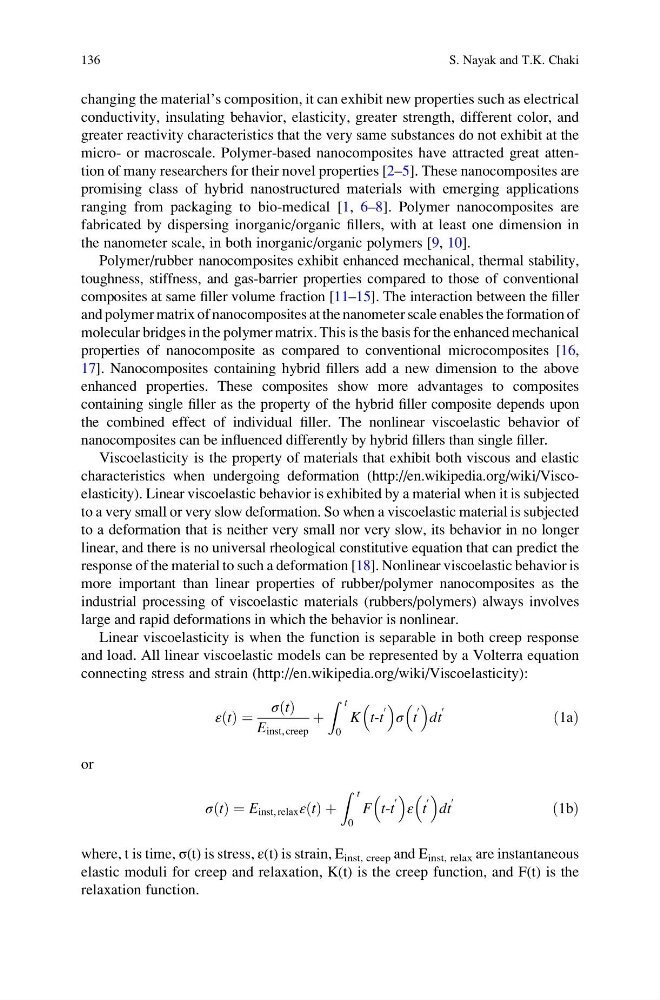
Linear viscoelasticity is when the function is separable in both creep response
and load. All linear viscoelastic models can be represented by a Volterra equation
connecting stress and strain (http://en.wikipedia.org/wiki/Viscoelasticity):
ε t
ð Þ ¼
σ t
ð Þ
E inst, creep
þ
Z t
0
K t-t
0
σ t
0
dt
0
ð1aÞ
or
σ t
ð Þ ¼ E inst, relax ε t
ð Þ þ
Z t
0
F t-t
0
ε t
0
dt
0
ð1bÞ
where, t is time, σ(t) is stress, ε(t) is strain, E inst, creep and E inst, relax are instantaneous
elastic moduli for creep and relaxation, K(t) is the creep function, and F(t) is the
relaxation function.
136
S. Nayak and T.K. Chaki
conductivity, insulating behavior, elasticity, greater strength, different color, and
greater reactivity characteristics that the very same substances do not exhibit at the
micro- or macroscale. Polymer-based nanocomposites have attracted great attention of many researchers for their novel properties [2–5]. These nanocomposites are
promising class of hybrid nanostructured materials with emerging applications
ranging from packaging to bio-medical [1, 6–8]. Polymer nanocomposites are
fabricated by dispersing inorganic/organic fillers, with at least one dimension in
the nanometer scale, in both inorganic/organic polymers [9, 10].
Polymer/rubber nanocomposites exhibit enhanced mechanical, thermal stability,
toughness, stiffness, and gas-barrier properties compared to those of conventional
composites at same filler volume fraction [11–15]. The interaction between the filler
and polymer matrix of nanocomposites at the nanometer scale enables the formation of
molecular bridges in the polymer matrix. This is the basis for the enhanced mechanical
properties of nanocomposite as compared to conventional microcomposites [16,
17]. Nanocomposites containing hybrid fillers add a new dimension to the above
enhanced properties. These composites show more advantages to composites
containing single filler as the property of the hybrid filler composite depends upon
the combined effect of individual filler. The nonlinear viscoelastic behavior of
nanocomposites can be influenced differently by hybrid fillers than single filler.
Viscoelasticity is the property of materials that exhibit both viscous and elastic
characteristics when undergoing deformation (http://en.wikipedia.org/wiki/Viscoelasticity). Linear viscoelastic behavior is exhibited by a material when it is subjected
to a very small or very slow deformation. So when a viscoelastic material is subjected
to a deformation that is neither very small nor very slow, its behavior in no longer
linear, and there is no universal rheological constitutive equation that can predict the
response of the material to such a deformation [18]. Nonlinear viscoelastic behavior is
more important than linear properties of rubber/polymer nanocomposites as the
industrial processing of viscoelastic materials (rubbers/polymers) always involves
large and rapid deformations in which the behavior is nonlinear.
Linear viscoelasticity is when the function is separable in both creep response
and load. All linear viscoelastic models can be represented by a Volterra equation
connecting stress and strain (http://en.wikipedia.org/wiki/Viscoelasticity):
ε t
ð Þ ¼
σ t
ð Þ
E inst, creep
þ
Z t
0
K t-t
0
σ t
0
dt
0
ð1aÞ
or
σ t
ð Þ ¼ E inst, relax ε t
ð Þ þ
Z t
0
F t-t
0
ε t
0
dt
0
ð1bÞ
where, t is time, σ(t) is stress, ε(t) is strain, E inst, creep and E inst, relax are instantaneous
elastic moduli for creep and relaxation, K(t) is the creep function, and F(t) is the
relaxation function.
136
S. Nayak and T.K. Chaki