

Toward a Low-Carbon Economy: The Clim’Foot Project Approach …
87
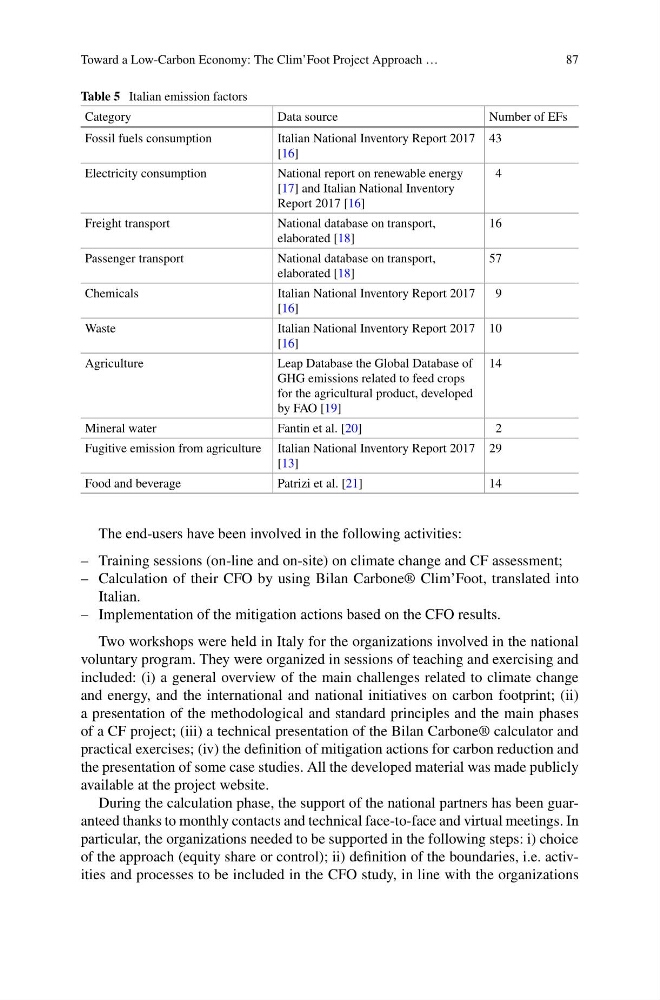
Table 5 Italian emission factors
Category
Data source
Number of EFs
Fossil fuels consumption
Italian National Inventory Report 2017
[16]
43
Electricity consumption
National report on renewable energy
[17] and Italian National Inventory
Report 2017 [16]
4
Freight transport
National database on transport,
elaborated [18]
16
Passenger transport
National database on transport,
elaborated [18]
57
Chemicals
Italian National Inventory Report 2017
[16]
9
Waste
Italian National Inventory Report 2017
[16]
10
Agriculture
Leap Database the Global Database of
GHG emissions related to feed crops
for the agricultural product, developed
by FAO [19]
14
Mineral water
Fantin et al. [20]
2
Fugitive emission from agriculture Italian National Inventory Report 2017
[13]
29
Food and beverage
Patrizi et al. [21]
14
The end-users have been involved in the following activities:
– Training sessions (on-line and on-site) on climate change and CF assessment;
– Calculation of their CFO by using Bilan Carbone® Clim’Foot, translated into
Italian.
– Implementation of the mitigation actions based on the CFO results.
Two workshops were held in Italy for the organizations involved in the national
voluntary program. They were organized in sessions of teaching and exercising and
included: (i) a general overview of the main challenges related to climate change
and energy, and the international and national initiatives on carbon footprint; (ii)
a presentation of the methodological and standard principles and the main phases
of a CF project; (iii) a technical presentation of the Bilan Carbone® calculator and
practical exercises; (iv) the definition of mitigation actions for carbon reduction and
the presentation of some case studies. All the developed material was made publicly
available at the project website.
During the calculation phase, the support of the national partners has been guaranteed thanks to monthly contacts and technical face-to-face and virtual meetings. In
particular, the organizations needed to be supported in the following steps: i) choice
of the approach (equity share or control); ii) definition of the boundaries, i.e. activities and processes to be included in the CFO study, in line with the organizations
87
Table 5 Italian emission factors
Category
Data source
Number of EFs
Fossil fuels consumption
Italian National Inventory Report 2017
[16]
43
Electricity consumption
National report on renewable energy
[17] and Italian National Inventory
Report 2017 [16]
4
Freight transport
National database on transport,
elaborated [18]
16
Passenger transport
National database on transport,
elaborated [18]
57
Chemicals
Italian National Inventory Report 2017
[16]
9
Waste
Italian National Inventory Report 2017
[16]
10
Agriculture
Leap Database the Global Database of
GHG emissions related to feed crops
for the agricultural product, developed
by FAO [19]
14
Mineral water
Fantin et al. [20]
2
Fugitive emission from agriculture Italian National Inventory Report 2017
[13]
29
Food and beverage
Patrizi et al. [21]
14
The end-users have been involved in the following activities:
– Training sessions (on-line and on-site) on climate change and CF assessment;
– Calculation of their CFO by using Bilan Carbone® Clim’Foot, translated into
Italian.
– Implementation of the mitigation actions based on the CFO results.
Two workshops were held in Italy for the organizations involved in the national
voluntary program. They were organized in sessions of teaching and exercising and
included: (i) a general overview of the main challenges related to climate change
and energy, and the international and national initiatives on carbon footprint; (ii)
a presentation of the methodological and standard principles and the main phases
of a CF project; (iii) a technical presentation of the Bilan Carbone® calculator and
practical exercises; (iv) the definition of mitigation actions for carbon reduction and
the presentation of some case studies. All the developed material was made publicly
available at the project website.
During the calculation phase, the support of the national partners has been guaranteed thanks to monthly contacts and technical face-to-face and virtual meetings. In
particular, the organizations needed to be supported in the following steps: i) choice
of the approach (equity share or control); ii) definition of the boundaries, i.e. activities and processes to be included in the CFO study, in line with the organizations