

Carbon Footprint Estimation for Academic Building in India
61
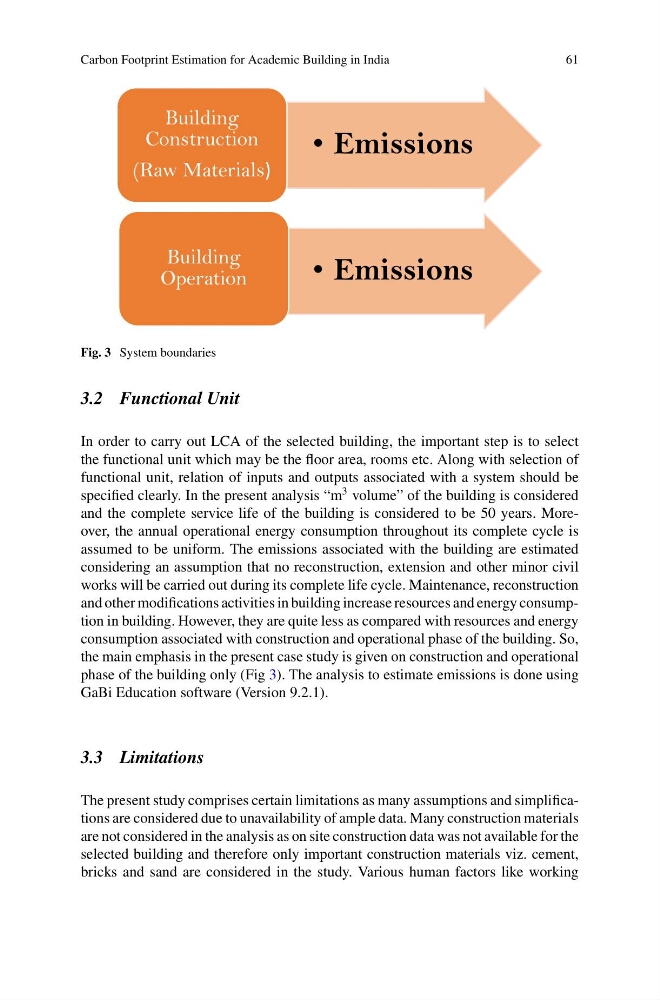
Fig. 3 System boundaries
3.2 Functional Unit
In order to carry out LCA of the selected building, the important step is to select
the functional unit which may be the floor area, rooms etc. Along with selection of
functional unit, relation of inputs and outputs associated with a system should be
specified clearly. In the present analysis “m
3 volume” of the building is considered
and the complete service life of the building is considered to be 50 years. Moreover, the annual operational energy consumption throughout its complete cycle is
assumed to be uniform. The emissions associated with the building are estimated
considering an assumption that no reconstruction, extension and other minor civil
works will be carried out during its complete life cycle. Maintenance, reconstruction
and other modifications activities in building increase resources and energy consumption in building. However, they are quite less as compared with resources and energy
consumption associated with construction and operational phase of the building. So,
the main emphasis in the present case study is given on construction and operational
phase of the building only (Fig 3). The analysis to estimate emissions is done using
GaBi Education software (Version 9.2.1).
3.3 Limitations
The present study comprises certain limitations as many assumptions and simplifications are considered due to unavailability of ample data. Many construction materials
are not considered in the analysis as on site construction data was not available for the
selected building and therefore only important construction materials viz. cement,
bricks and sand are considered in the study. Various human factors like working
61
Fig. 3 System boundaries
3.2 Functional Unit
In order to carry out LCA of the selected building, the important step is to select
the functional unit which may be the floor area, rooms etc. Along with selection of
functional unit, relation of inputs and outputs associated with a system should be
specified clearly. In the present analysis “m
3 volume” of the building is considered
and the complete service life of the building is considered to be 50 years. Moreover, the annual operational energy consumption throughout its complete cycle is
assumed to be uniform. The emissions associated with the building are estimated
considering an assumption that no reconstruction, extension and other minor civil
works will be carried out during its complete life cycle. Maintenance, reconstruction
and other modifications activities in building increase resources and energy consumption in building. However, they are quite less as compared with resources and energy
consumption associated with construction and operational phase of the building. So,
the main emphasis in the present case study is given on construction and operational
phase of the building only (Fig 3). The analysis to estimate emissions is done using
GaBi Education software (Version 9.2.1).
3.3 Limitations
The present study comprises certain limitations as many assumptions and simplifications are considered due to unavailability of ample data. Many construction materials
are not considered in the analysis as on site construction data was not available for the
selected building and therefore only important construction materials viz. cement,
bricks and sand are considered in the study. Various human factors like working