

Carbon Footprint Assessment with LCA Methodology
29
8.7 Carbon Footprint of a Windmill [38, 54, 55]
Renewable energy sources gained significance with time due to their low carbon
economies and eco-friendly nature and ensured a low pollution environment and
a lesser carbon footprint. One of them is wind energy that possesses remarkable
energy potential. Wind energy is basically the energy generated from the conversion
of wind’s kinetic energy into mechanical power. The turbines convert the energy in
the wind with the help of propellers.
Dependency over wind energy has witnessed drastic growth from the last two
decades and it is the highest among all the other renewable energy sources. China,
which is also the highest wind energy producer in the world, has grown its wind energy
potential by 61.8% during 2004 and 2013 (US DOE 2014). China has succeeded in
installing a total capacity of 221 GW by 2019, followed by the USA and Germany
with 96.4 GW and 59.3 GW.
These sources are undoubtedly significant renewable sources, Albeit, unwillingly
contributes to the carbon footprint. As per the statistics, in China, a windmill generates
0.15 million tonnes of CO 2 in its lifetime of 21 years. The majority is due to the metal
and steel construction of the mills. The major contributing sources are construction,
operation, and dismantling with a share of 76.74%, 15.32%, and 7.94%, respectively.
Objective: To assess the carbon footprint associated with the lifecycle of a windmill.
Goal and scope: The study focuses on the windmill lifecycle that how the lifecycle
is contributing to the footprint and their distribution.
Inventory generation: Inventory shows the share of carbon emission being released
during the entire lifecycle of windmill operation. Life is typically considered around
21 years. The construction phase of the windmill imposes the highest carbon footprint
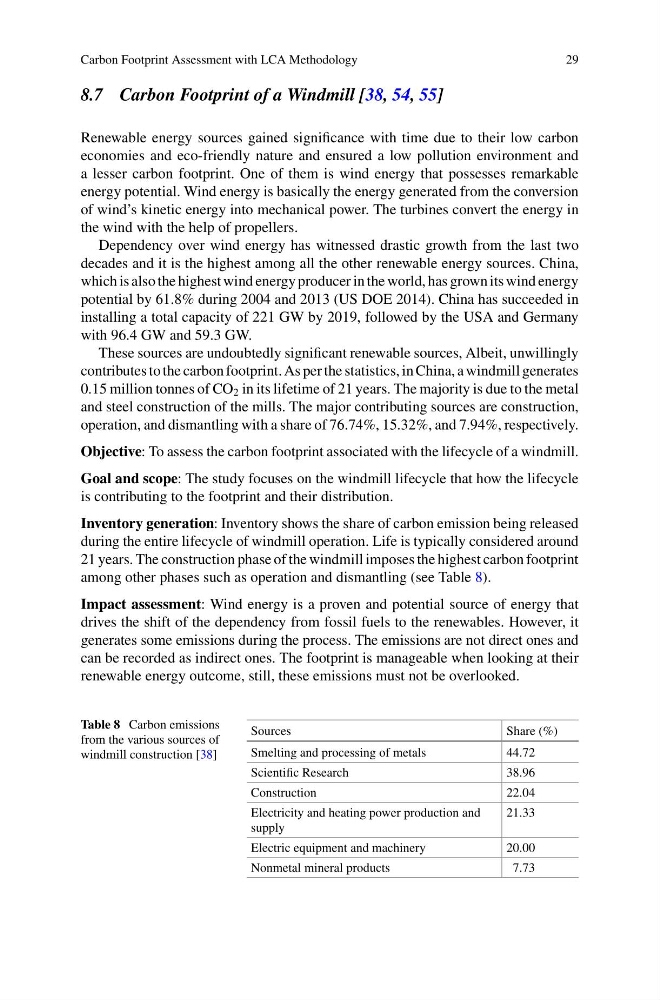
among other phases such as operation and dismantling (see Table 8).
Impact assessment: Wind energy is a proven and potential source of energy that
drives the shift of the dependency from fossil fuels to the renewables. However, it
generates some emissions during the process. The emissions are not direct ones and
can be recorded as indirect ones. The footprint is manageable when looking at their
renewable energy outcome, still, these emissions must not be overlooked.
Table 8 Carbon emissions
from the various sources of
windmill construction [38]
Sources
Share (%)
Smelting and processing of metals
44.72
Scientific Research
38.96
Construction
22.04
Electricity and heating power production and
supply
21.33
Electric equipment and machinery
20.00
Nonmetal mineral products
7.73
29
8.7 Carbon Footprint of a Windmill [38, 54, 55]
Renewable energy sources gained significance with time due to their low carbon
economies and eco-friendly nature and ensured a low pollution environment and
a lesser carbon footprint. One of them is wind energy that possesses remarkable
energy potential. Wind energy is basically the energy generated from the conversion
of wind’s kinetic energy into mechanical power. The turbines convert the energy in
the wind with the help of propellers.
Dependency over wind energy has witnessed drastic growth from the last two
decades and it is the highest among all the other renewable energy sources. China,
which is also the highest wind energy producer in the world, has grown its wind energy
potential by 61.8% during 2004 and 2013 (US DOE 2014). China has succeeded in
installing a total capacity of 221 GW by 2019, followed by the USA and Germany
with 96.4 GW and 59.3 GW.
These sources are undoubtedly significant renewable sources, Albeit, unwillingly
contributes to the carbon footprint. As per the statistics, in China, a windmill generates
0.15 million tonnes of CO 2 in its lifetime of 21 years. The majority is due to the metal
and steel construction of the mills. The major contributing sources are construction,
operation, and dismantling with a share of 76.74%, 15.32%, and 7.94%, respectively.
Objective: To assess the carbon footprint associated with the lifecycle of a windmill.
Goal and scope: The study focuses on the windmill lifecycle that how the lifecycle
is contributing to the footprint and their distribution.
Inventory generation: Inventory shows the share of carbon emission being released
during the entire lifecycle of windmill operation. Life is typically considered around
21 years. The construction phase of the windmill imposes the highest carbon footprint
among other phases such as operation and dismantling (see Table 8).
Impact assessment: Wind energy is a proven and potential source of energy that
drives the shift of the dependency from fossil fuels to the renewables. However, it
generates some emissions during the process. The emissions are not direct ones and
can be recorded as indirect ones. The footprint is manageable when looking at their
renewable energy outcome, still, these emissions must not be overlooked.
Table 8 Carbon emissions
from the various sources of
windmill construction [38]
Sources
Share (%)
Smelting and processing of metals
44.72
Scientific Research
38.96
Construction
22.04
Electricity and heating power production and
supply
21.33
Electric equipment and machinery
20.00
Nonmetal mineral products
7.73