

the negative pole of the molecular dipole moment. The authors evaluated the free
energy of interaction minima at around À9 kT (where k is the Boltzmann constant
and T the temperature) at low ionic strength and neutral pH. When apo α-La binds
calcium, the dipole moment decreases significantly from 400 to 330 D. Such a
decrease, in combination with a screening of negative charges by calcium and the
reduction in α-La flexibility, could explain the absence of oligomerisation
subsequent to the protein cross-assembly observed experimentally. According to
the developed model, the presence of calcium on α-La reduces the orientation with
positively charged LYS. This would explain the experimentally observed absence
of supramolecular structures between LYS and holo form of α-La. The model also
simulates the effectiveness of divalent ions in destabilising the supramolecular
structures in agreement with experimental finding. These data underline the crucial
role of protein charge anisotropy for orientational assembly, as also described for
other systems such as protein/cationic polyelectrolyte coacervation [140]. In that
work, a clear relationship between protein charge anisotropy (BSA versus β-Lg),
binding affinity to polyelectrolyte and selective coacervation was found experimentally and using computer modelling.
The formation of the original microspheres in dual protein systems was
investigated by mixing various proteins in a pH range where the two proteins
carry opposite net charge. The work carried out has shown that it is possible to
generate spherical structures in other binary protein mixtures, providing the experimental conditions were adapted [5]. Microspheres are obtained at low ionic strength
in dual systems such as Ova/LYS, BSA/LYS and Ova/avidin. In the case of Ova/
LYS, spherical particles were formed between pH 7.4 and pH 8.6 with an optimum
cross-assembly yield at pH 8. The formed microspheres contained twofold excess
of LYS, i.e. the protein molar ratio LYS:Ova was 2. When Ova is mixed with
avidin, microspheres with an equimolar ratio of the two proteins are obtained in the
pH range between 6.4 and 8. In addition, the total protein needed to form Ova/
avidin microspheres is then fold lower than that required to detect Ova/LYS
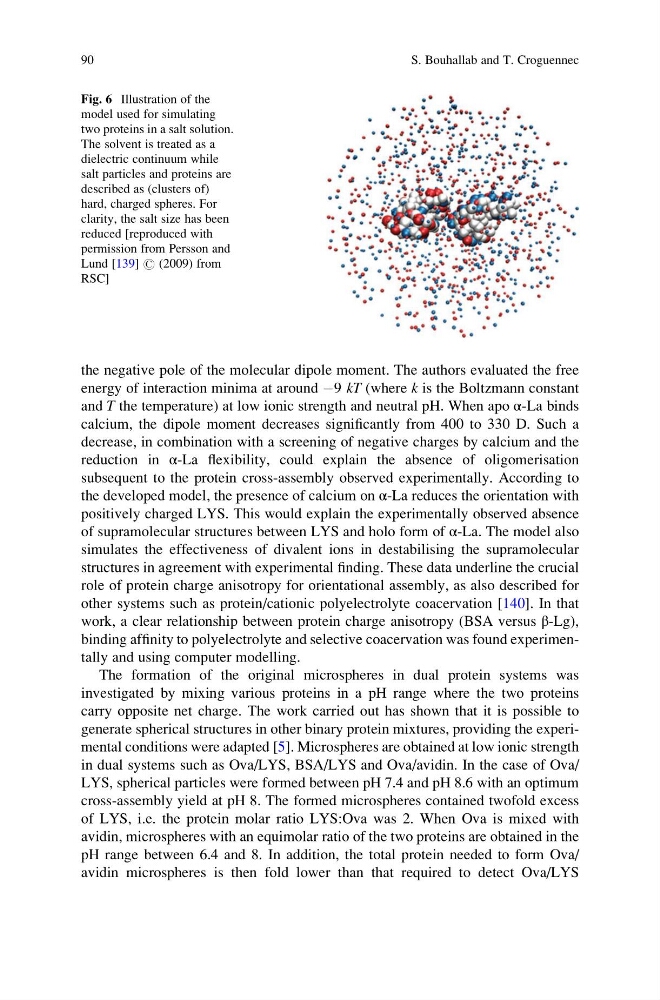
Fig. 6 Illustration of the
model used for simulating
two proteins in a salt solution.
The solvent is treated as a
dielectric continuum while
salt particles and proteins are
described as (clusters of)
hard, charged spheres. For
clarity, the salt size has been
reduced [reproduced with
permission from Persson and
Lund [139] # (2009) from
RSC]
90
S. Bouhallab and T. Croguennec
energy of interaction minima at around À9 kT (where k is the Boltzmann constant
and T the temperature) at low ionic strength and neutral pH. When apo α-La binds
calcium, the dipole moment decreases significantly from 400 to 330 D. Such a
decrease, in combination with a screening of negative charges by calcium and the
reduction in α-La flexibility, could explain the absence of oligomerisation
subsequent to the protein cross-assembly observed experimentally. According to
the developed model, the presence of calcium on α-La reduces the orientation with
positively charged LYS. This would explain the experimentally observed absence
of supramolecular structures between LYS and holo form of α-La. The model also
simulates the effectiveness of divalent ions in destabilising the supramolecular
structures in agreement with experimental finding. These data underline the crucial
role of protein charge anisotropy for orientational assembly, as also described for
other systems such as protein/cationic polyelectrolyte coacervation [140]. In that
work, a clear relationship between protein charge anisotropy (BSA versus β-Lg),
binding affinity to polyelectrolyte and selective coacervation was found experimentally and using computer modelling.
The formation of the original microspheres in dual protein systems was
investigated by mixing various proteins in a pH range where the two proteins
carry opposite net charge. The work carried out has shown that it is possible to
generate spherical structures in other binary protein mixtures, providing the experimental conditions were adapted [5]. Microspheres are obtained at low ionic strength
in dual systems such as Ova/LYS, BSA/LYS and Ova/avidin. In the case of Ova/
LYS, spherical particles were formed between pH 7.4 and pH 8.6 with an optimum
cross-assembly yield at pH 8. The formed microspheres contained twofold excess
of LYS, i.e. the protein molar ratio LYS:Ova was 2. When Ova is mixed with
avidin, microspheres with an equimolar ratio of the two proteins are obtained in the
pH range between 6.4 and 8. In addition, the total protein needed to form Ova/
avidin microspheres is then fold lower than that required to detect Ova/LYS
Fig. 6 Illustration of the
model used for simulating
two proteins in a salt solution.
The solvent is treated as a
dielectric continuum while
salt particles and proteins are
described as (clusters of)
hard, charged spheres. For
clarity, the salt size has been
reduced [reproduced with
permission from Persson and
Lund [139] # (2009) from
RSC]
90
S. Bouhallab and T. Croguennec