

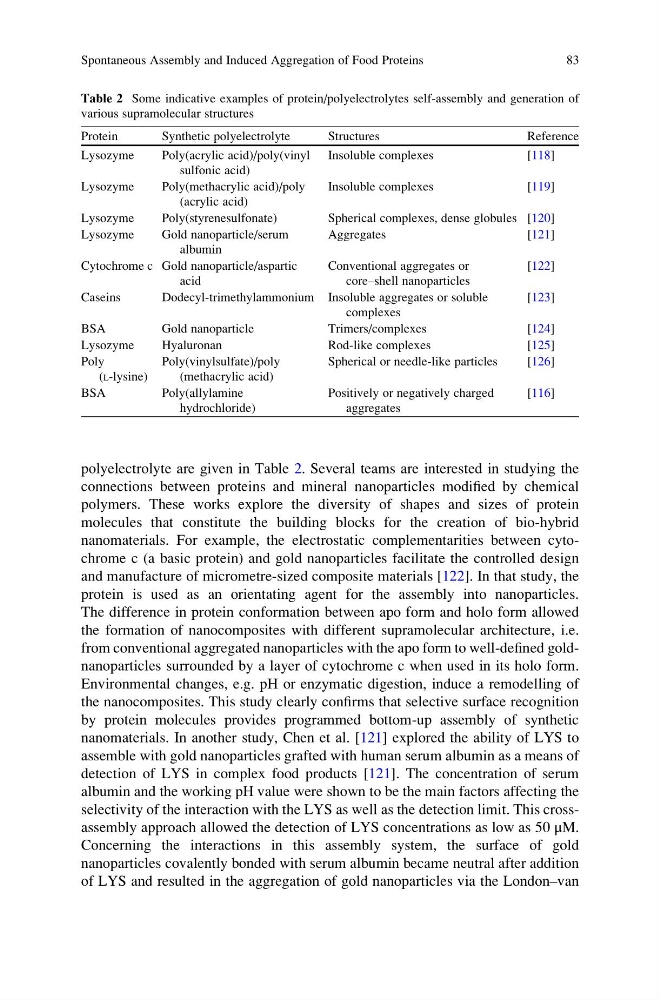
polyelectrolyte are given in Table 2. Several teams are interested in studying the
connections between proteins and mineral nanoparticles modified by chemical
polymers. These works explore the diversity of shapes and sizes of protein
molecules that constitute the building blocks for the creation of bio-hybrid
nanomaterials. For example, the electrostatic complementarities between cytochrome c (a basic protein) and gold nanoparticles facilitate the controlled design
and manufacture of micrometre-sized composite materials [122]. In that study, the
protein is used as an orientating agent for the assembly into nanoparticles.
The difference in protein conformation between apo form and holo form allowed
the formation of nanocomposites with different supramolecular architecture, i.e.
from conventional aggregated nanoparticles with the apo form to well-defined goldnanoparticles surrounded by a layer of cytochrome c when used in its holo form.
Environmental changes, e.g. pH or enzymatic digestion, induce a remodelling of
the nanocomposites. This study clearly confirms that selective surface recognition
by protein molecules provides programmed bottom-up assembly of synthetic
nanomaterials. In another study, Chen et al. [121] explored the ability of LYS to
assemble with gold nanoparticles grafted with human serum albumin as a means of
detection of LYS in complex food products [121]. The concentration of serum
albumin and the working pH value were shown to be the main factors affecting the
selectivity of the interaction with the LYS as well as the detection limit. This crossassembly approach allowed the detection of LYS concentrations as low as 50 μM.
Concerning the interactions in this assembly system, the surface of gold
nanoparticles covalently bonded with serum albumin became neutral after addition
of LYS and resulted in the aggregation of gold nanoparticles via the London–van
Table 2 Some indicative examples of protein/polyelectrolytes self-assembly and generation of
various supramolecular structures
Protein
Synthetic polyelectrolyte
Structures
Reference
Lysozyme
Poly(acrylic acid)/poly(vinyl
sulfonic acid)
Insoluble complexes
[118]
Lysozyme
Poly(methacrylic acid)/poly
(acrylic acid)
Insoluble complexes
[119]
Lysozyme
Poly(styrenesulfonate)
Spherical complexes, dense globules [120]
Lysozyme
Gold nanoparticle/serum
albumin
Aggregates
[121]
Cytochrome c Gold nanoparticle/aspartic
acid
Conventional aggregates or
core–shell nanoparticles
[122]
Caseins
Dodecyl-trimethylammonium Insoluble aggregates or soluble
complexes
[123]
BSA
Gold nanoparticle
Trimers/complexes
[124]
Lysozyme
Hyaluronan
Rod-like complexes
[125]
Poly
(L-lysine)
Poly(vinylsulfate)/poly
(methacrylic acid)
Spherical or needle-like particles
[126]
BSA
Poly(allylamine
hydrochloride)
Positively or negatively charged
aggregates
[116]
Spontaneous Assembly and Induced Aggregation of Food Proteins
83
connections between proteins and mineral nanoparticles modified by chemical
polymers. These works explore the diversity of shapes and sizes of protein
molecules that constitute the building blocks for the creation of bio-hybrid
nanomaterials. For example, the electrostatic complementarities between cytochrome c (a basic protein) and gold nanoparticles facilitate the controlled design
and manufacture of micrometre-sized composite materials [122]. In that study, the
protein is used as an orientating agent for the assembly into nanoparticles.
The difference in protein conformation between apo form and holo form allowed
the formation of nanocomposites with different supramolecular architecture, i.e.
from conventional aggregated nanoparticles with the apo form to well-defined goldnanoparticles surrounded by a layer of cytochrome c when used in its holo form.
Environmental changes, e.g. pH or enzymatic digestion, induce a remodelling of
the nanocomposites. This study clearly confirms that selective surface recognition
by protein molecules provides programmed bottom-up assembly of synthetic
nanomaterials. In another study, Chen et al. [121] explored the ability of LYS to
assemble with gold nanoparticles grafted with human serum albumin as a means of
detection of LYS in complex food products [121]. The concentration of serum
albumin and the working pH value were shown to be the main factors affecting the
selectivity of the interaction with the LYS as well as the detection limit. This crossassembly approach allowed the detection of LYS concentrations as low as 50 μM.
Concerning the interactions in this assembly system, the surface of gold
nanoparticles covalently bonded with serum albumin became neutral after addition
of LYS and resulted in the aggregation of gold nanoparticles via the London–van
Table 2 Some indicative examples of protein/polyelectrolytes self-assembly and generation of
various supramolecular structures
Protein
Synthetic polyelectrolyte
Structures
Reference
Lysozyme
Poly(acrylic acid)/poly(vinyl
sulfonic acid)
Insoluble complexes
[118]
Lysozyme
Poly(methacrylic acid)/poly
(acrylic acid)
Insoluble complexes
[119]
Lysozyme
Poly(styrenesulfonate)
Spherical complexes, dense globules [120]
Lysozyme
Gold nanoparticle/serum
albumin
Aggregates
[121]
Cytochrome c Gold nanoparticle/aspartic
acid
Conventional aggregates or
core–shell nanoparticles
[122]
Caseins
Dodecyl-trimethylammonium Insoluble aggregates or soluble
complexes
[123]
BSA
Gold nanoparticle
Trimers/complexes
[124]
Lysozyme
Hyaluronan
Rod-like complexes
[125]
Poly
(L-lysine)
Poly(vinylsulfate)/poly
(methacrylic acid)
Spherical or needle-like particles
[126]
BSA
Poly(allylamine
hydrochloride)
Positively or negatively charged
aggregates
[116]
Spontaneous Assembly and Induced Aggregation of Food Proteins
83