

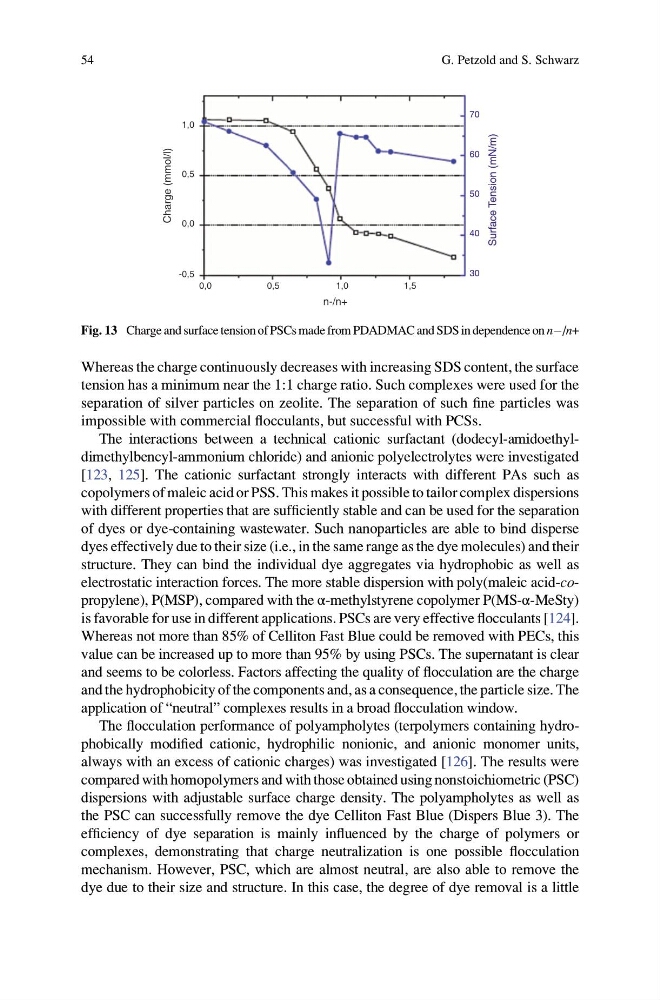
Whereas the charge continuously decreases with increasing SDS content, the surface
tension has a minimum near the 1:1 charge ratio. Such complexes were used for the
separation of silver particles on zeolite. The separation of such fine particles was
impossible with commercial flocculants, but successful with PCSs.
The interactions between a technical cationic surfactant (dodecyl-amidoethyldimethylbencyl-ammonium chloride) and anionic polyelectrolytes were investigated
[123, 125]. The cationic surfactant strongly interacts with different PAs such as
copolymers of maleic acid or PSS. This makes it possible to tailor complex dispersions
with different properties that are sufficiently stable and can be used for the separation
of dyes or dye-containing wastewater. Such nanoparticles are able to bind disperse
dyes effectively due to their size (i.e., in the same range as the dye molecules) and their
structure. They can bind the individual dye aggregates via hydrophobic as well as
electrostatic interaction forces. The more stable dispersion with poly(maleic acid-copropylene), P(MSP), compared with the α-methylstyrene copolymer P(MS-α-MeSty)
is favorable for use in different applications. PSCs are very effective flocculants [124].
Whereas not more than 85% of Celliton Fast Blue could be removed with PECs, this
value can be increased up to more than 95% by using PSCs. The supernatant is clear
and seems to be colorless. Factors affecting the quality of flocculation are the charge
and the hydrophobicity of the components and, as a consequence, the particle size. The
application of “neutral” complexes results in a broad flocculation window.
The flocculation performance of polyampholytes (terpolymers containing hydrophobically modified cationic, hydrophilic nonionic, and anionic monomer units,
always with an excess of cationic charges) was investigated [126]. The results were
compared with homopolymers and with those obtained using nonstoichiometric (PSC)
dispersions with adjustable surface charge density. The polyampholytes as well as
the PSC can successfully remove the dye Celliton Fast Blue (Dispers Blue 3). The
efficiency of dye separation is mainly influenced by the charge of polymers or
complexes, demonstrating that charge neutralization is one possible flocculation
mechanism. However, PSC, which are almost neutral, are also able to remove the
dye due to their size and structure. In this case, the degree of dye removal is a little
1,0
1,0
n-/n+
1,5
0,5
0,5
0,0
Charge (mmol/l)
Surface Tension (mN/m)
0,0
-0,5
70
60
50
40
30
Fig. 13 Charge and surface tension of PSCs made from PDADMAC and SDS in dependence on nÀ/n+
54
G. Petzold and S. Schwarz
tension has a minimum near the 1:1 charge ratio. Such complexes were used for the
separation of silver particles on zeolite. The separation of such fine particles was
impossible with commercial flocculants, but successful with PCSs.
The interactions between a technical cationic surfactant (dodecyl-amidoethyldimethylbencyl-ammonium chloride) and anionic polyelectrolytes were investigated
[123, 125]. The cationic surfactant strongly interacts with different PAs such as
copolymers of maleic acid or PSS. This makes it possible to tailor complex dispersions
with different properties that are sufficiently stable and can be used for the separation
of dyes or dye-containing wastewater. Such nanoparticles are able to bind disperse
dyes effectively due to their size (i.e., in the same range as the dye molecules) and their
structure. They can bind the individual dye aggregates via hydrophobic as well as
electrostatic interaction forces. The more stable dispersion with poly(maleic acid-copropylene), P(MSP), compared with the α-methylstyrene copolymer P(MS-α-MeSty)
is favorable for use in different applications. PSCs are very effective flocculants [124].
Whereas not more than 85% of Celliton Fast Blue could be removed with PECs, this
value can be increased up to more than 95% by using PSCs. The supernatant is clear
and seems to be colorless. Factors affecting the quality of flocculation are the charge
and the hydrophobicity of the components and, as a consequence, the particle size. The
application of “neutral” complexes results in a broad flocculation window.
The flocculation performance of polyampholytes (terpolymers containing hydrophobically modified cationic, hydrophilic nonionic, and anionic monomer units,
always with an excess of cationic charges) was investigated [126]. The results were
compared with homopolymers and with those obtained using nonstoichiometric (PSC)
dispersions with adjustable surface charge density. The polyampholytes as well as
the PSC can successfully remove the dye Celliton Fast Blue (Dispers Blue 3). The
efficiency of dye separation is mainly influenced by the charge of polymers or
complexes, demonstrating that charge neutralization is one possible flocculation
mechanism. However, PSC, which are almost neutral, are also able to remove the
dye due to their size and structure. In this case, the degree of dye removal is a little
1,0
1,0
n-/n+
1,5
0,5
0,5
0,0
Charge (mmol/l)
Surface Tension (mN/m)
0,0
-0,5
70
60
50
40
30
Fig. 13 Charge and surface tension of PSCs made from PDADMAC and SDS in dependence on nÀ/n+
54
G. Petzold and S. Schwarz