

the minor the swelling of the PEC particles. Hence, the most compact particles were
formed with the very hydrophobic copolymers.
4.2 Influence of Polymer Type on Complex Properties
From basic research on PECs, we can summarize the following important points.
There are many parameters that can influence the formation of PECs:
Charge density of the polyelectrolytes
– Strong polyelectrolytes (the charge does not depend on pH) with high charge
density have a rod-like structure; they form complexes with a ladder-like-structure.
– In strong polyelectrolytes with low charge density, the polymer is coiled. In the
case of a weak PEL such as PEI, PAC, or chitosan as a natural polymer, the
complex formation is influenced by the pH dependence of the polymer charge.
In such cases, the complexes are formed between coils of PC and coils of PA.
Molar mass
Complexes made from polyelectrolytes with low and medium molar mass (such as
PDADMAC, PSS, PEI, PAC) are studied very often and are used in different
fields of application.
Complexes made from PEL with very high molar masses (more than 10
6 g/mol) are
used in paper production; such complexes are formed from big polymer coils
and therefore such PECs are very large.
Polyelectrolytes with big differences in their molar mass form PECs that are watersoluble.
Substances bearing hydrophobic parts such as PSS, PMBQ, styrene or surfactants
and micelles form complexes that are very dense or compact. The stability is
often low.
Other parameters that can influence complex formation are the mixing conditions
such as mixing speed, order of addition, ionic strength, and pH.
GPE
HPE
+
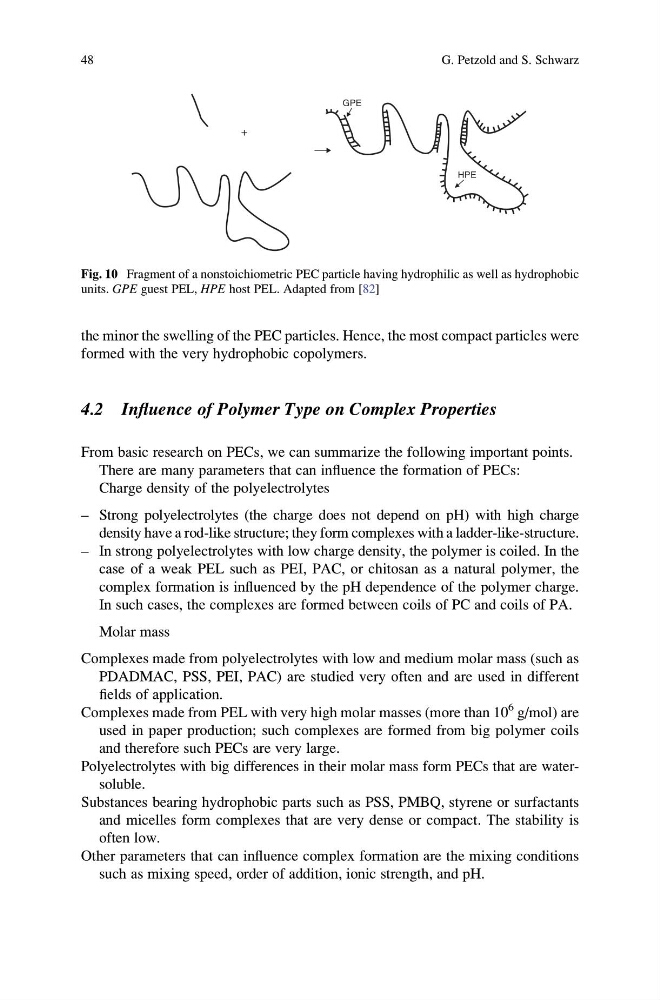
Fig. 10 Fragment of a nonstoichiometric PEC particle having hydrophilic as well as hydrophobic
units. GPE guest PEL, HPE host PEL. Adapted from [82]
48
G. Petzold and S. Schwarz
formed with the very hydrophobic copolymers.
4.2 Influence of Polymer Type on Complex Properties
From basic research on PECs, we can summarize the following important points.
There are many parameters that can influence the formation of PECs:
Charge density of the polyelectrolytes
– Strong polyelectrolytes (the charge does not depend on pH) with high charge
density have a rod-like structure; they form complexes with a ladder-like-structure.
– In strong polyelectrolytes with low charge density, the polymer is coiled. In the
case of a weak PEL such as PEI, PAC, or chitosan as a natural polymer, the
complex formation is influenced by the pH dependence of the polymer charge.
In such cases, the complexes are formed between coils of PC and coils of PA.
Molar mass
Complexes made from polyelectrolytes with low and medium molar mass (such as
PDADMAC, PSS, PEI, PAC) are studied very often and are used in different
fields of application.
Complexes made from PEL with very high molar masses (more than 10
6 g/mol) are
used in paper production; such complexes are formed from big polymer coils
and therefore such PECs are very large.
Polyelectrolytes with big differences in their molar mass form PECs that are watersoluble.
Substances bearing hydrophobic parts such as PSS, PMBQ, styrene or surfactants
and micelles form complexes that are very dense or compact. The stability is
often low.
Other parameters that can influence complex formation are the mixing conditions
such as mixing speed, order of addition, ionic strength, and pH.
GPE
HPE
+
Fig. 10 Fragment of a nonstoichiometric PEC particle having hydrophilic as well as hydrophobic
units. GPE guest PEL, HPE host PEL. Adapted from [82]
48
G. Petzold and S. Schwarz