

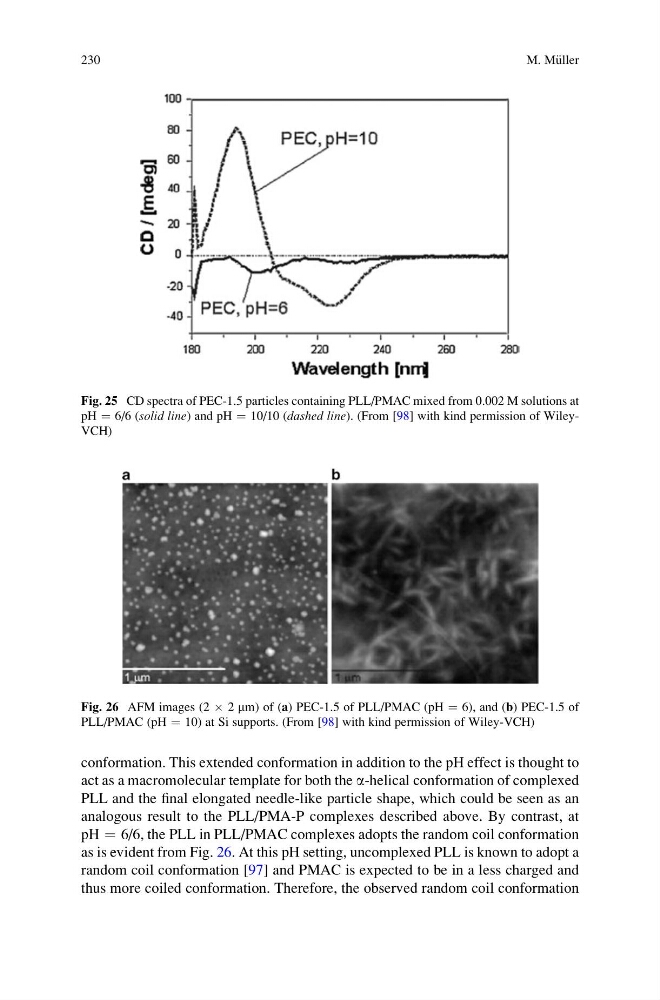
conformation. This extended conformation in addition to the pH effect is thought to
act as a macromolecular template for both the a-helical conformation of complexed
PLL and the final elongated needle-like particle shape, which could be seen as an
analogous result to the PLL/PMA-P complexes described above. By contrast, at
pH ¼ 6/6, the PLL in PLL/PMAC complexes adopts the random coil conformation
as is evident from Fig. 26. At this pH setting, uncomplexed PLL is known to adopt a
random coil conformation [97] and PMAC is expected to be in a less charged and
thus more coiled conformation. Therefore, the observed random coil conformation
Fig. 26 AFM images (2 Â 2 mm) of (a) PEC-1.5 of PLL/PMAC (pH ¼ 6), and (b) PEC-1.5 of
PLL/PMAC (pH ¼ 10) at Si supports. (From [98] with kind permission of Wiley-VCH)
Fig. 25 CD spectra of PEC-1.5 particles containing PLL/PMAC mixed from 0.002 M solutions at
pH ¼ 6/6 (solid line) and pH ¼ 10/10 (dashed line). (From [98] with kind permission of WileyVCH)
230
M. M€ uller
act as a macromolecular template for both the a-helical conformation of complexed
PLL and the final elongated needle-like particle shape, which could be seen as an
analogous result to the PLL/PMA-P complexes described above. By contrast, at
pH ¼ 6/6, the PLL in PLL/PMAC complexes adopts the random coil conformation
as is evident from Fig. 26. At this pH setting, uncomplexed PLL is known to adopt a
random coil conformation [97] and PMAC is expected to be in a less charged and
thus more coiled conformation. Therefore, the observed random coil conformation
Fig. 26 AFM images (2 Â 2 mm) of (a) PEC-1.5 of PLL/PMAC (pH ¼ 6), and (b) PEC-1.5 of
PLL/PMAC (pH ¼ 10) at Si supports. (From [98] with kind permission of Wiley-VCH)
Fig. 25 CD spectra of PEC-1.5 particles containing PLL/PMAC mixed from 0.002 M solutions at
pH ¼ 6/6 (solid line) and pH ¼ 10/10 (dashed line). (From [98] with kind permission of WileyVCH)
230
M. M€ uller