

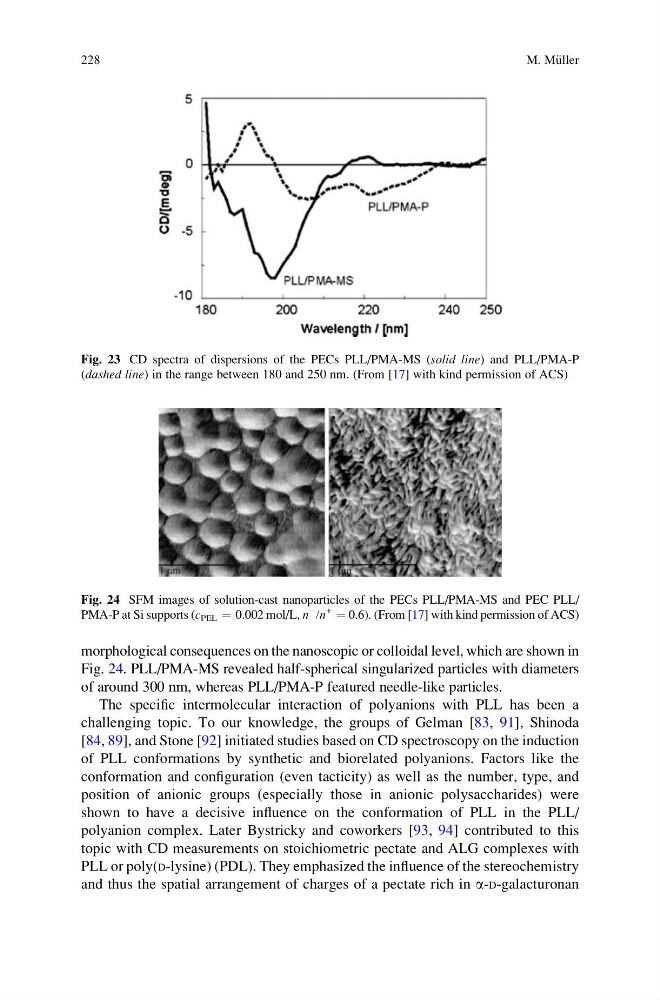
morphological consequences on the nanoscopic or colloidal level, which are shown in
Fig. 24. PLL/PMA-MS revealed half-spherical singularized particles with diameters
of around 300 nm, whereas PLL/PMA-P featured needle-like particles.
The specific intermolecular interaction of polyanions with PLL has been a
challenging topic. To our knowledge, the groups of Gelman [83, 91], Shinoda
[84, 89], and Stone [92] initiated studies based on CD spectroscopy on the induction
of PLL conformations by synthetic and biorelated polyanions. Factors like the
conformation and configuration (even tacticity) as well as the number, type, and
position of anionic groups (especially those in anionic polysaccharides) were
shown to have a decisive influence on the conformation of PLL in the PLL/
polyanion complex. Later Bystricky and coworkers [93, 94] contributed to this
topic with CD measurements on stoichiometric pectate and ALG complexes with
PLL or poly(D-lysine) (PDL). They emphasized the influence of the stereochemistry
and thus the spatial arrangement of charges of a pectate rich in a-D-galacturonan
Fig. 24 SFM images of solution-cast nanoparticles of the PECs PLL/PMA-MS and PEC PLL/
PMA-P at Si supports (c PEL ¼ 0.002 mol/L, n
À
/n
+ ¼ 0.6). (From [17] with kind permission of ACS)
Fig. 23 CD spectra of dispersions of the PECs PLL/PMA-MS (solid line) and PLL/PMA-P
(dashed line) in the range between 180 and 250 nm. (From [17] with kind permission of ACS)
228
M. M€ uller
Fig. 24. PLL/PMA-MS revealed half-spherical singularized particles with diameters
of around 300 nm, whereas PLL/PMA-P featured needle-like particles.
The specific intermolecular interaction of polyanions with PLL has been a
challenging topic. To our knowledge, the groups of Gelman [83, 91], Shinoda
[84, 89], and Stone [92] initiated studies based on CD spectroscopy on the induction
of PLL conformations by synthetic and biorelated polyanions. Factors like the
conformation and configuration (even tacticity) as well as the number, type, and
position of anionic groups (especially those in anionic polysaccharides) were
shown to have a decisive influence on the conformation of PLL in the PLL/
polyanion complex. Later Bystricky and coworkers [93, 94] contributed to this
topic with CD measurements on stoichiometric pectate and ALG complexes with
PLL or poly(D-lysine) (PDL). They emphasized the influence of the stereochemistry
and thus the spatial arrangement of charges of a pectate rich in a-D-galacturonan
Fig. 24 SFM images of solution-cast nanoparticles of the PECs PLL/PMA-MS and PEC PLL/
PMA-P at Si supports (c PEL ¼ 0.002 mol/L, n
À
/n
+ ¼ 0.6). (From [17] with kind permission of ACS)
Fig. 23 CD spectra of dispersions of the PECs PLL/PMA-MS (solid line) and PLL/PMA-P
(dashed line) in the range between 180 and 250 nm. (From [17] with kind permission of ACS)
228
M. M€ uller