

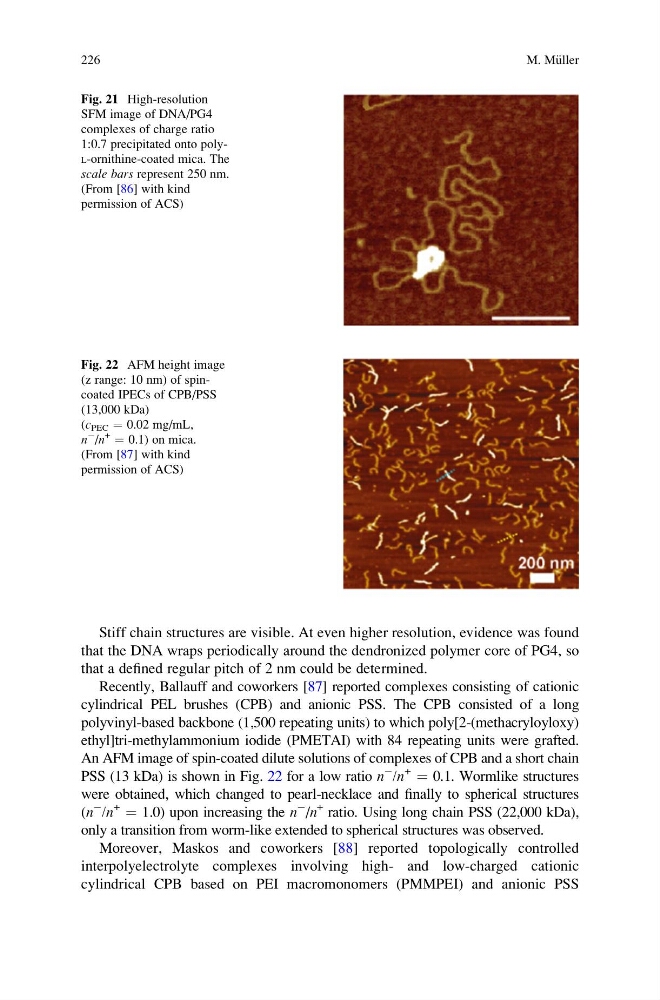
Stiff chain structures are visible. At even higher resolution, evidence was found
that the DNA wraps periodically around the dendronized polymer core of PG4, so
that a defined regular pitch of 2 nm could be determined.
Recently, Ballauff and coworkers [87] reported complexes consisting of cationic
cylindrical PEL brushes (CPB) and anionic PSS. The CPB consisted of a long
polyvinyl-based backbone (1,500 repeating units) to which poly[2-(methacryloyloxy)
ethyl]tri-methylammonium iodide (PMETAI) with 84 repeating units were grafted.
An AFM image of spin-coated dilute solutions of complexes of CPB and a short chain
PSS (13 kDa) is shown in Fig. 22 for a low ratio n
À /n
+
¼ 0.1. Wormlike structures
were obtained, which changed to pearl-necklace and finally to spherical structures
(n
À /n
+
¼ 1.0) upon increasing the n
À /n
+ ratio. Using long chain PSS (22,000 kDa),
only a transition from worm-like extended to spherical structures was observed.
Moreover, Maskos and coworkers [88] reported topologically controlled
interpolyelectrolyte complexes involving high- and low-charged cationic
cylindrical CPB based on PEI macromonomers (PMMPEI) and anionic PSS
Fig. 21 High-resolution
SFM image of DNA/PG4
complexes of charge ratio
1:0.7 precipitated onto polyL-ornithine-coated mica. The
scale bars represent 250 nm.
(From [86] with kind
permission of ACS)
Fig. 22 AFM height image
(z range: 10 nm) of spincoated IPECs of CPB/PSS
(13,000 kDa)
(c PEC ¼ 0.02 mg/mL,
n
À
/n
+ ¼ 0.1) on mica.
(From [87] with kind
permission of ACS)
226
M. M€ uller
that the DNA wraps periodically around the dendronized polymer core of PG4, so
that a defined regular pitch of 2 nm could be determined.
Recently, Ballauff and coworkers [87] reported complexes consisting of cationic
cylindrical PEL brushes (CPB) and anionic PSS. The CPB consisted of a long
polyvinyl-based backbone (1,500 repeating units) to which poly[2-(methacryloyloxy)
ethyl]tri-methylammonium iodide (PMETAI) with 84 repeating units were grafted.
An AFM image of spin-coated dilute solutions of complexes of CPB and a short chain
PSS (13 kDa) is shown in Fig. 22 for a low ratio n
À /n
+
¼ 0.1. Wormlike structures
were obtained, which changed to pearl-necklace and finally to spherical structures
(n
À /n
+
¼ 1.0) upon increasing the n
À /n
+ ratio. Using long chain PSS (22,000 kDa),
only a transition from worm-like extended to spherical structures was observed.
Moreover, Maskos and coworkers [88] reported topologically controlled
interpolyelectrolyte complexes involving high- and low-charged cationic
cylindrical CPB based on PEI macromonomers (PMMPEI) and anionic PSS
Fig. 21 High-resolution
SFM image of DNA/PG4
complexes of charge ratio
1:0.7 precipitated onto polyL-ornithine-coated mica. The
scale bars represent 250 nm.
(From [86] with kind
permission of ACS)
Fig. 22 AFM height image
(z range: 10 nm) of spincoated IPECs of CPB/PSS
(13,000 kDa)
(c PEC ¼ 0.02 mg/mL,
n
À
/n
+ ¼ 0.1) on mica.
(From [87] with kind
permission of ACS)
226
M. M€ uller