

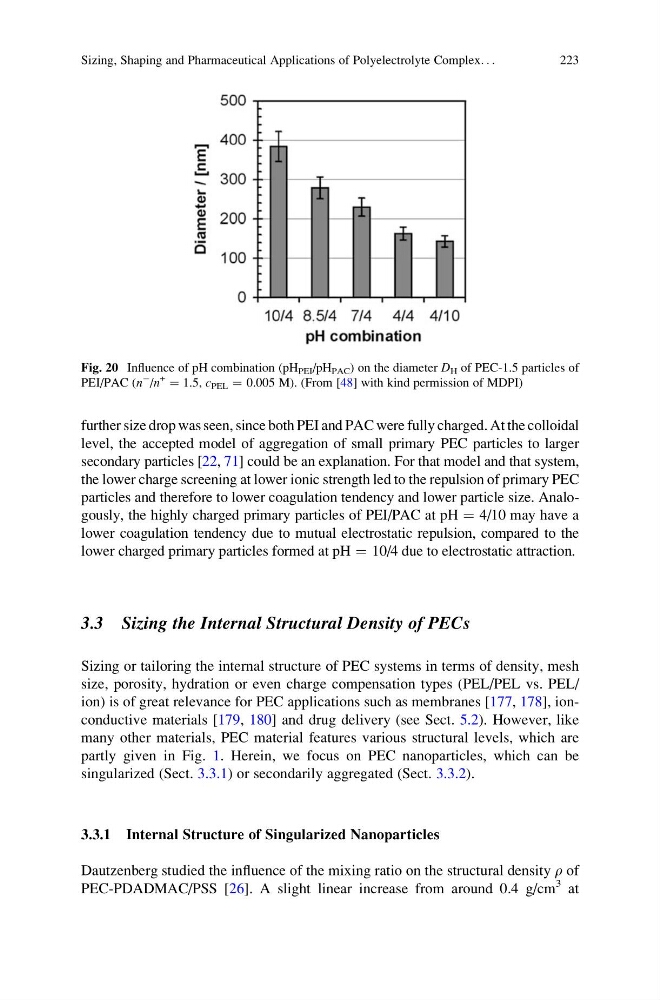
further size drop was seen, since both PEI and PAC were fully charged. At the colloidal
level, the accepted model of aggregation of small primary PEC particles to larger
secondary particles [22, 71] could be an explanation. For that model and that system,
the lower charge screening at lower ionic strength led to the repulsion of primary PEC
particles and therefore to lower coagulation tendency and lower particle size. Analogously, the highly charged primary particles of PEI/PAC at pH ¼ 4/10 may have a
lower coagulation tendency due to mutual electrostatic repulsion, compared to the
lower charged primary particles formed at pH ¼ 10/4 due to electrostatic attraction.
3.3 Sizing the Internal Structural Density of PECs
Sizing or tailoring the internal structure of PEC systems in terms of density, mesh
size, porosity, hydration or even charge compensation types (PEL/PEL vs. PEL/
ion) is of great relevance for PEC applications such as membranes [177, 178], ionconductive materials [179, 180] and drug delivery (see Sect. 5.2). However, like
many other materials, PEC material features various structural levels, which are
partly given in Fig. 1. Herein, we focus on PEC nanoparticles, which can be
singularized (Sect. 3.3.1) or secondarily aggregated (Sect. 3.3.2).
3.3.1 Internal Structure of Singularized Nanoparticles
Dautzenberg studied the influence of the mixing ratio on the structural density r of
PEC-PDADMAC/PSS [26]. A slight linear increase from around 0.4 g/cm
3 at
Fig. 20 Influence of pH combination (pH PEI /pH PAC ) on the diameter D H of PEC-1.5 particles of
PEI/PAC (n
À
/n
+ ¼ 1.5, c PEL ¼ 0.005 M). (From [48] with kind permission of MDPI)
Sizing, Shaping and Pharmaceutical Applications of Polyelectrolyte Complex. . .
223
level, the accepted model of aggregation of small primary PEC particles to larger
secondary particles [22, 71] could be an explanation. For that model and that system,
the lower charge screening at lower ionic strength led to the repulsion of primary PEC
particles and therefore to lower coagulation tendency and lower particle size. Analogously, the highly charged primary particles of PEI/PAC at pH ¼ 4/10 may have a
lower coagulation tendency due to mutual electrostatic repulsion, compared to the
lower charged primary particles formed at pH ¼ 10/4 due to electrostatic attraction.
3.3 Sizing the Internal Structural Density of PECs
Sizing or tailoring the internal structure of PEC systems in terms of density, mesh
size, porosity, hydration or even charge compensation types (PEL/PEL vs. PEL/
ion) is of great relevance for PEC applications such as membranes [177, 178], ionconductive materials [179, 180] and drug delivery (see Sect. 5.2). However, like
many other materials, PEC material features various structural levels, which are
partly given in Fig. 1. Herein, we focus on PEC nanoparticles, which can be
singularized (Sect. 3.3.1) or secondarily aggregated (Sect. 3.3.2).
3.3.1 Internal Structure of Singularized Nanoparticles
Dautzenberg studied the influence of the mixing ratio on the structural density r of
PEC-PDADMAC/PSS [26]. A slight linear increase from around 0.4 g/cm
3 at
Fig. 20 Influence of pH combination (pH PEI /pH PAC ) on the diameter D H of PEC-1.5 particles of
PEI/PAC (n
À
/n
+ ¼ 1.5, c PEL ¼ 0.005 M). (From [48] with kind permission of MDPI)
Sizing, Shaping and Pharmaceutical Applications of Polyelectrolyte Complex. . .
223