

chains, the tails are of nearly the same length, different scenarios were observed for
long chains. At very low temperatures two tails of equal length are preferred,
whereas at intermediate temperatures a long and a short tail are formed, and at
higher temperatures random fluctuations of tail length prevail. Tails of longer
chains in the complex are stretched at certain temperatures due to repulsion
between their beads and shrink further as temperature decreases due to multipole
attraction between the tails caused by chain counterion condensation.
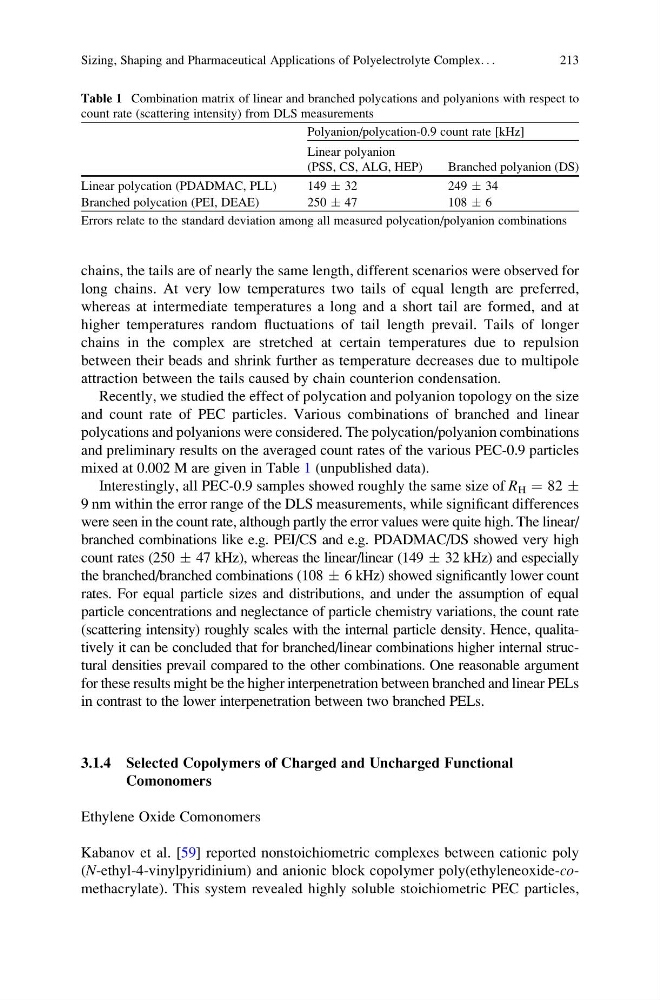
Recently, we studied the effect of polycation and polyanion topology on the size
and count rate of PEC particles. Various combinations of branched and linear
polycations and polyanions were considered. The polycation/polyanion combinations
and preliminary results on the averaged count rates of the various PEC-0.9 particles
mixed at 0.002 M are given in Table 1 (unpublished data).
Interestingly, all PEC-0.9 samples showed roughly the same size of R H ¼ 82 Æ
9 nm within the error range of the DLS measurements, while significant differences
were seen in the count rate, although partly the error values were quite high. The linear/
branched combinations like e.g. PEI/CS and e.g. PDADMAC/DS showed very high
count rates (250 Æ 47 kHz), whereas the linear/linear (149 Æ 32 kHz) and especially
the branched/branched combinations (108 Æ 6 kHz) showed significantly lower count
rates. For equal particle sizes and distributions, and under the assumption of equal
particle concentrations and neglectance of particle chemistry variations, the count rate
(scattering intensity) roughly scales with the internal particle density. Hence, qualitatively it can be concluded that for branched/linear combinations higher internal structural densities prevail compared to the other combinations. One reasonable argument
for these results might be the higher interpenetration between branched and linear PELs
in contrast to the lower interpenetration between two branched PELs.
3.1.4 Selected Copolymers of Charged and Uncharged Functional
Comonomers
Ethylene Oxide Comonomers
Kabanov et al. [59] reported nonstoichiometric complexes between cationic poly
(N-ethyl-4-vinylpyridinium) and anionic block copolymer poly(ethyleneoxide-comethacrylate). This system revealed highly soluble stoichiometric PEC particles,
Table 1 Combination matrix of linear and branched polycations and polyanions with respect to
count rate (scattering intensity) from DLS measurements
Polyanion/polycation-0.9 count rate [kHz]
Linear polyanion
(PSS, CS, ALG, HEP)
Branched polyanion (DS)
Linear polycation (PDADMAC, PLL)
149 Æ 32
249 Æ 34
Branched polycation (PEI, DEAE)
250 Æ 47
108 Æ 6
Errors relate to the standard deviation among all measured polycation/polyanion combinations
Sizing, Shaping and Pharmaceutical Applications of Polyelectrolyte Complex. . .
213
long chains. At very low temperatures two tails of equal length are preferred,
whereas at intermediate temperatures a long and a short tail are formed, and at
higher temperatures random fluctuations of tail length prevail. Tails of longer
chains in the complex are stretched at certain temperatures due to repulsion
between their beads and shrink further as temperature decreases due to multipole
attraction between the tails caused by chain counterion condensation.
Recently, we studied the effect of polycation and polyanion topology on the size
and count rate of PEC particles. Various combinations of branched and linear
polycations and polyanions were considered. The polycation/polyanion combinations
and preliminary results on the averaged count rates of the various PEC-0.9 particles
mixed at 0.002 M are given in Table 1 (unpublished data).
Interestingly, all PEC-0.9 samples showed roughly the same size of R H ¼ 82 Æ
9 nm within the error range of the DLS measurements, while significant differences
were seen in the count rate, although partly the error values were quite high. The linear/
branched combinations like e.g. PEI/CS and e.g. PDADMAC/DS showed very high
count rates (250 Æ 47 kHz), whereas the linear/linear (149 Æ 32 kHz) and especially
the branched/branched combinations (108 Æ 6 kHz) showed significantly lower count
rates. For equal particle sizes and distributions, and under the assumption of equal
particle concentrations and neglectance of particle chemistry variations, the count rate
(scattering intensity) roughly scales with the internal particle density. Hence, qualitatively it can be concluded that for branched/linear combinations higher internal structural densities prevail compared to the other combinations. One reasonable argument
for these results might be the higher interpenetration between branched and linear PELs
in contrast to the lower interpenetration between two branched PELs.
3.1.4 Selected Copolymers of Charged and Uncharged Functional
Comonomers
Ethylene Oxide Comonomers
Kabanov et al. [59] reported nonstoichiometric complexes between cationic poly
(N-ethyl-4-vinylpyridinium) and anionic block copolymer poly(ethyleneoxide-comethacrylate). This system revealed highly soluble stoichiometric PEC particles,
Table 1 Combination matrix of linear and branched polycations and polyanions with respect to
count rate (scattering intensity) from DLS measurements
Polyanion/polycation-0.9 count rate [kHz]
Linear polyanion
(PSS, CS, ALG, HEP)
Branched polyanion (DS)
Linear polycation (PDADMAC, PLL)
149 Æ 32
249 Æ 34
Branched polycation (PEI, DEAE)
250 Æ 47
108 Æ 6
Errors relate to the standard deviation among all measured polycation/polyanion combinations
Sizing, Shaping and Pharmaceutical Applications of Polyelectrolyte Complex. . .
213