

As well as PEL structural parameters, important parameters were found to be the
molar mixing ratio of charged units (n
À /n
+
), concentration, pH, and ionic strength.
These parameters can regulate particle size [16], distribution, and shape [17] and
the interaction with surfaces [18–21]. Dynamic light scattering (DLS) and colloid
titration were applied to study the dispersions as well as scanning force microscopy
(SFM) and attenuated total reflection (ATR) Fourier transform infrared (FTIR)
spectroscopy for particle layers. Recently, the monomodality of PEC dispersions
was significantly improved by applying consecutive centrifugation, separation, and
redispersion steps of the coacervate phase. The improvement was explained by
“accelerated ripening” due to Ostwald ripening of the raw dispersion [16]. This
experimental finding was confirmed by recent simulation studies [22], which will
be commented on in Sect. 3.2.3 and in an article by Lebovka in this volume [23].
This contribution reviews the sizing and shaping of PEC particles and showcases
applications for pharmacy and biomedicine. Additional topics emerging at several
places in this contribution are the hierarchical aspect of PECs as aggregates of
primary particles (particles of particles), aspects related to the stoichiometric core
and nonstoichiometric shell, the softness and rather emulsive appearance, and the
compartmentation and porosity of the PEC internal structure (which opens
applications for loading and release of functional life science cargo such as proteins
or drugs). Although individually these single aspects seem to be understood,
together they are not completely consistent and even contradictory. Hence, this
review, phenomenologically rather than theoretically oriented, illustrating some
principles of manageable preparation and controllable properties and outlining
some usable life science applications of PEC nanoparticles, might be of value for
those sharing an interest in this field.
2 PEC Characterization and Preparation: Critical
Experimental Aspects
Mixing two oppositely charged PELs usually results in the separation of a milky
polymer-rich phase from a clear polymer-depleted phase. Given the task of preparing a PEL complex from standard PELs like poly(diallyldimethylammonium chloride) (PDADMAC) and poly(styrenesulfonate) (PSS), one would expect a similar
+
Molecular
Colloidal
Macroscopic
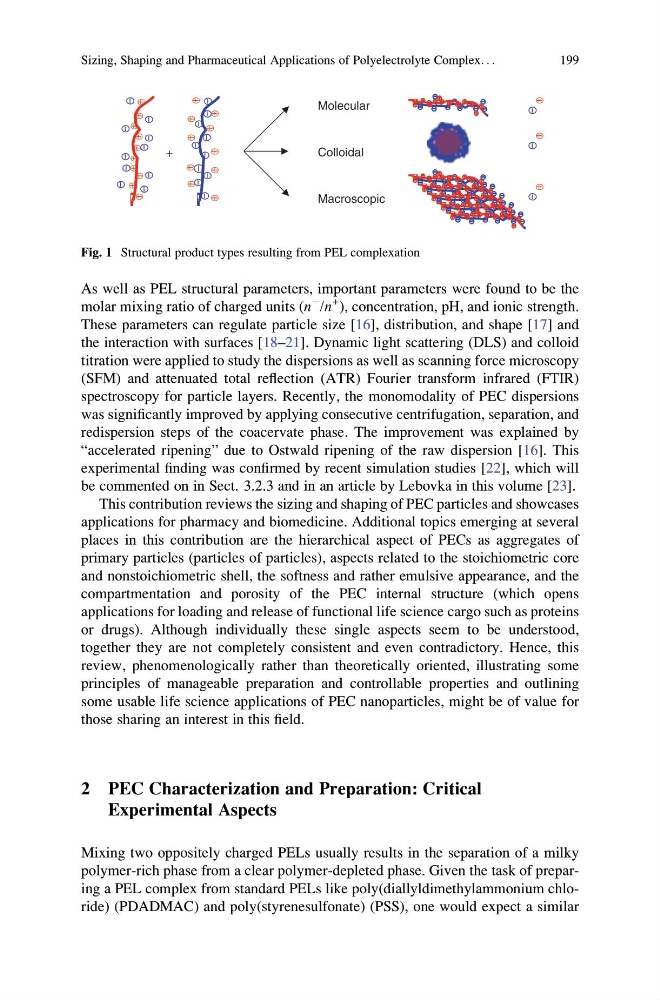
Fig. 1 Structural product types resulting from PEL complexation
Sizing, Shaping and Pharmaceutical Applications of Polyelectrolyte Complex. . .
199
molar mixing ratio of charged units (n
À /n
+
), concentration, pH, and ionic strength.
These parameters can regulate particle size [16], distribution, and shape [17] and
the interaction with surfaces [18–21]. Dynamic light scattering (DLS) and colloid
titration were applied to study the dispersions as well as scanning force microscopy
(SFM) and attenuated total reflection (ATR) Fourier transform infrared (FTIR)
spectroscopy for particle layers. Recently, the monomodality of PEC dispersions
was significantly improved by applying consecutive centrifugation, separation, and
redispersion steps of the coacervate phase. The improvement was explained by
“accelerated ripening” due to Ostwald ripening of the raw dispersion [16]. This
experimental finding was confirmed by recent simulation studies [22], which will
be commented on in Sect. 3.2.3 and in an article by Lebovka in this volume [23].
This contribution reviews the sizing and shaping of PEC particles and showcases
applications for pharmacy and biomedicine. Additional topics emerging at several
places in this contribution are the hierarchical aspect of PECs as aggregates of
primary particles (particles of particles), aspects related to the stoichiometric core
and nonstoichiometric shell, the softness and rather emulsive appearance, and the
compartmentation and porosity of the PEC internal structure (which opens
applications for loading and release of functional life science cargo such as proteins
or drugs). Although individually these single aspects seem to be understood,
together they are not completely consistent and even contradictory. Hence, this
review, phenomenologically rather than theoretically oriented, illustrating some
principles of manageable preparation and controllable properties and outlining
some usable life science applications of PEC nanoparticles, might be of value for
those sharing an interest in this field.
2 PEC Characterization and Preparation: Critical
Experimental Aspects
Mixing two oppositely charged PELs usually results in the separation of a milky
polymer-rich phase from a clear polymer-depleted phase. Given the task of preparing a PEL complex from standard PELs like poly(diallyldimethylammonium chloride) (PDADMAC) and poly(styrenesulfonate) (PSS), one would expect a similar
+
Molecular
Colloidal
Macroscopic
Fig. 1 Structural product types resulting from PEL complexation
Sizing, Shaping and Pharmaceutical Applications of Polyelectrolyte Complex. . .
199