

higher (as shown by gel electrophoresis). According to zeta potential
measurements, the polyplexes reached neutrality at N:P ratio of ~3, where aggregation took place (>1 μm); at N:P ratio of 5, the polyplexes had a size of 250 nm
and zeta potential of 10 mV, which reached a plateau of 25 mV at N:P ratio of 25.
The transfection efficiency increased with the N:P ratio, reaching maximal transfection efficiency at N:P ratio between 15 and 20, where the transfection was
30 times higher than PLL-mediated transfection, but still 40 times lower than
TransFast™–DNA complexes. Interestingly, the transfection efficiency of the
PPA-g-SP/DNA complexes was a function (but not linear) of DNA dose and
transfection time, as previously seen in other examples. The conditions of preparation (ionic strength) were also important: a fourfold increase in the DNA dose
resulted in a 50-fold increase in transfection efficiency, while extension of the
incubation time from 30 min to 2 h resulted in a two orders of magnitude increase in
the transfection efficiency, but further incubation time did not show further
improvement. Preparation of the complexes in 1 M NaCl resulted in substantially
larger particles (>1.3 μm), which showed a threefold increase in luciferase expression compared to complexes prepared in water (no explanation). With a similar
polymer, poly(1,2-propylene H-phosphonate) modified with dipropyltriamine
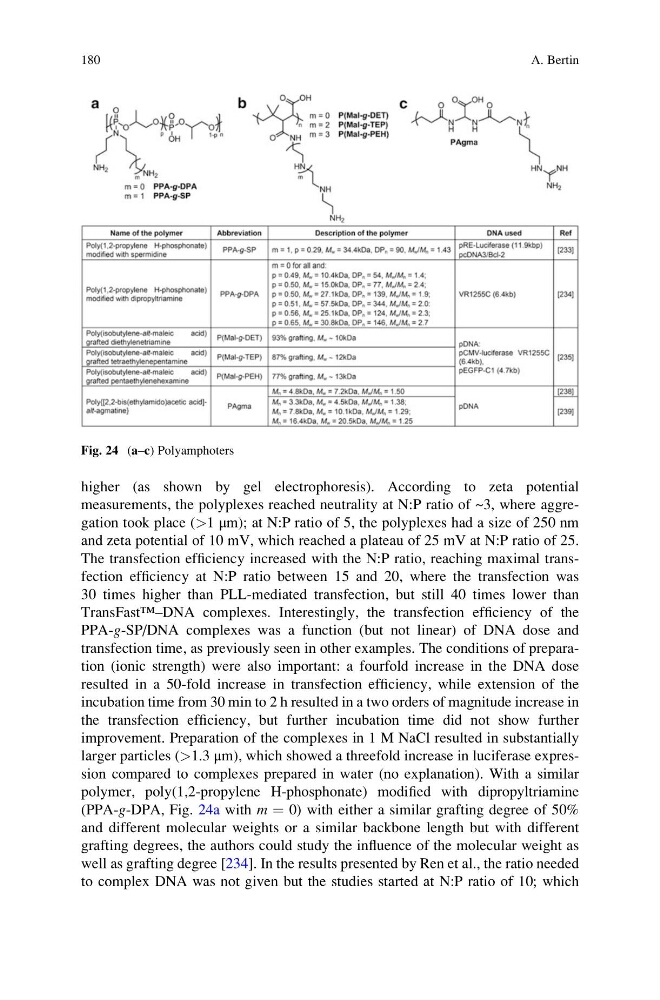
(PPA-g-DPA, Fig. 24a with m ¼ 0) with either a similar grafting degree of 50%
and different molecular weights or a similar backbone length but with different
grafting degrees, the authors could study the influence of the molecular weight as
well as grafting degree [234]. In the results presented by Ren et al., the ratio needed
to complex DNA was not given but the studies started at N:P ratio of 10; which
Fig. 24 (a–c) Polyamphoters
180
A. Bertin
measurements, the polyplexes reached neutrality at N:P ratio of ~3, where aggregation took place (>1 μm); at N:P ratio of 5, the polyplexes had a size of 250 nm
and zeta potential of 10 mV, which reached a plateau of 25 mV at N:P ratio of 25.
The transfection efficiency increased with the N:P ratio, reaching maximal transfection efficiency at N:P ratio between 15 and 20, where the transfection was
30 times higher than PLL-mediated transfection, but still 40 times lower than
TransFast™–DNA complexes. Interestingly, the transfection efficiency of the
PPA-g-SP/DNA complexes was a function (but not linear) of DNA dose and
transfection time, as previously seen in other examples. The conditions of preparation (ionic strength) were also important: a fourfold increase in the DNA dose
resulted in a 50-fold increase in transfection efficiency, while extension of the
incubation time from 30 min to 2 h resulted in a two orders of magnitude increase in
the transfection efficiency, but further incubation time did not show further
improvement. Preparation of the complexes in 1 M NaCl resulted in substantially
larger particles (>1.3 μm), which showed a threefold increase in luciferase expression compared to complexes prepared in water (no explanation). With a similar
polymer, poly(1,2-propylene H-phosphonate) modified with dipropyltriamine
(PPA-g-DPA, Fig. 24a with m ¼ 0) with either a similar grafting degree of 50%
and different molecular weights or a similar backbone length but with different
grafting degrees, the authors could study the influence of the molecular weight as
well as grafting degree [234]. In the results presented by Ren et al., the ratio needed
to complex DNA was not given but the studies started at N:P ratio of 10; which
Fig. 24 (a–c) Polyamphoters
180
A. Bertin