

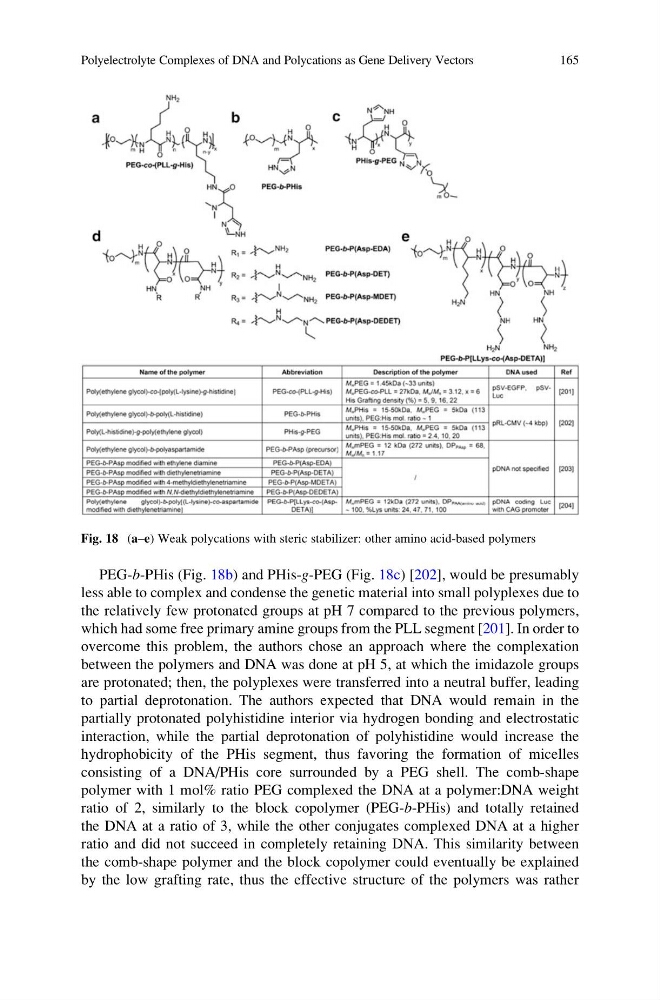
PEG-b-PHis (Fig. 18b) and PHis-g-PEG (Fig. 18c) [202], would be presumably
less able to complex and condense the genetic material into small polyplexes due to
the relatively few protonated groups at pH 7 compared to the previous polymers,
which had some free primary amine groups from the PLL segment [201]. In order to
overcome this problem, the authors chose an approach where the complexation
between the polymers and DNA was done at pH 5, at which the imidazole groups
are protonated; then, the polyplexes were transferred into a neutral buffer, leading
to partial deprotonation. The authors expected that DNA would remain in the
partially protonated polyhistidine interior via hydrogen bonding and electrostatic
interaction, while the partial deprotonation of polyhistidine would increase the
hydrophobicity of the PHis segment, thus favoring the formation of micelles
consisting of a DNA/PHis core surrounded by a PEG shell. The comb-shape
polymer with 1 mol% ratio PEG complexed the DNA at a polymer:DNA weight
ratio of 2, similarly to the block copolymer (PEG-b-PHis) and totally retained
the DNA at a ratio of 3, while the other conjugates complexed DNA at a higher
ratio and did not succeed in completely retaining DNA. This similarity between
the comb-shape polymer and the block copolymer could eventually be explained
by the low grafting rate, thus the effective structure of the polymers was rather
Fig. 18 (a–e) Weak polycations with steric stabilizer: other amino acid-based polymers
Polyelectrolyte Complexes of DNA and Polycations as Gene Delivery Vectors
165
less able to complex and condense the genetic material into small polyplexes due to
the relatively few protonated groups at pH 7 compared to the previous polymers,
which had some free primary amine groups from the PLL segment [201]. In order to
overcome this problem, the authors chose an approach where the complexation
between the polymers and DNA was done at pH 5, at which the imidazole groups
are protonated; then, the polyplexes were transferred into a neutral buffer, leading
to partial deprotonation. The authors expected that DNA would remain in the
partially protonated polyhistidine interior via hydrogen bonding and electrostatic
interaction, while the partial deprotonation of polyhistidine would increase the
hydrophobicity of the PHis segment, thus favoring the formation of micelles
consisting of a DNA/PHis core surrounded by a PEG shell. The comb-shape
polymer with 1 mol% ratio PEG complexed the DNA at a polymer:DNA weight
ratio of 2, similarly to the block copolymer (PEG-b-PHis) and totally retained
the DNA at a ratio of 3, while the other conjugates complexed DNA at a higher
ratio and did not succeed in completely retaining DNA. This similarity between
the comb-shape polymer and the block copolymer could eventually be explained
by the low grafting rate, thus the effective structure of the polymers was rather
Fig. 18 (a–e) Weak polycations with steric stabilizer: other amino acid-based polymers
Polyelectrolyte Complexes of DNA and Polycations as Gene Delivery Vectors
165