

diameter of the polyplexes was dependent both on molecular weight and structure
of the copolymers but in general decreased with increasing N:P ratio for all
polymers. Of the polymers with similar molecular weight but with different nature
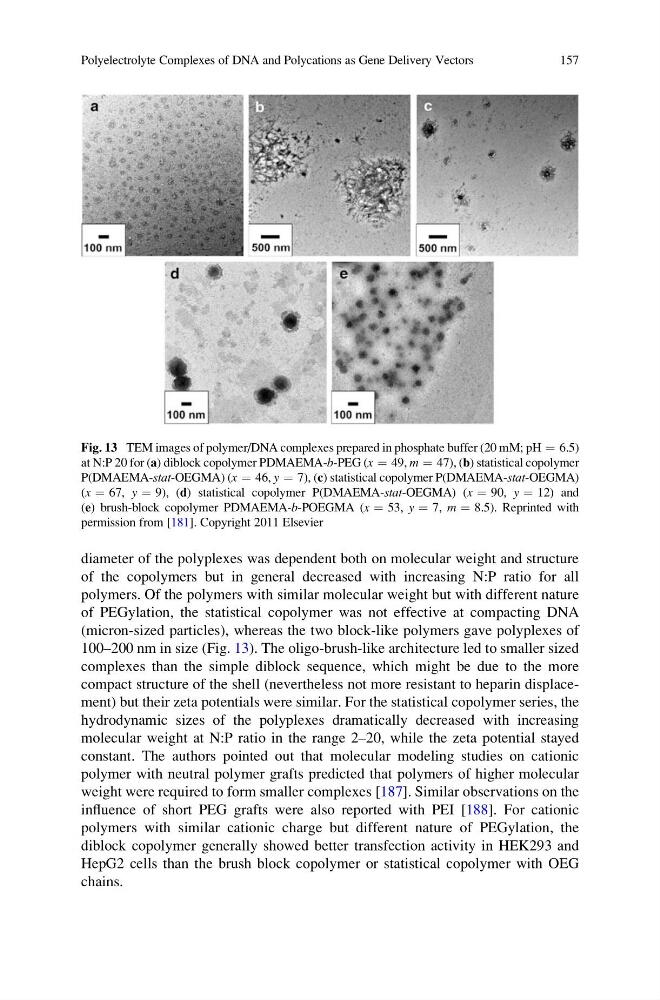
of PEGylation, the statistical copolymer was not effective at compacting DNA
(micron-sized particles), whereas the two block-like polymers gave polyplexes of
100–200 nm in size (Fig. 13). The oligo-brush-like architecture led to smaller sized
complexes than the simple diblock sequence, which might be due to the more
compact structure of the shell (nevertheless not more resistant to heparin displacement) but their zeta potentials were similar. For the statistical copolymer series, the
hydrodynamic sizes of the polyplexes dramatically decreased with increasing
molecular weight at N:P ratio in the range 2–20, while the zeta potential stayed
constant. The authors pointed out that molecular modeling studies on cationic
polymer with neutral polymer grafts predicted that polymers of higher molecular
weight were required to form smaller complexes [187]. Similar observations on the
influence of short PEG grafts were also reported with PEI [188]. For cationic
polymers with similar cationic charge but different nature of PEGylation, the
diblock copolymer generally showed better transfection activity in HEK293 and
HepG2 cells than the brush block copolymer or statistical copolymer with OEG
chains.
Fig. 13 TEM images of polymer/DNA complexes prepared in phosphate buffer (20 mM; pH ¼ 6.5)
at N:P 20 for (a) diblock copolymer PDMAEMA-b-PEG (x ¼ 49, m ¼ 47), (b) statistical copolymer
P(DMAEMA-stat-OEGMA) (x ¼ 46, y ¼ 7), (c) statistical copolymer P(DMAEMA-stat-OEGMA)
(x ¼ 67, y ¼ 9), (d) statistical copolymer P(DMAEMA-stat-OEGMA) (x ¼ 90, y ¼ 12) and
(e) brush-block copolymer PDMAEMA-b-POEGMA (x ¼ 53, y ¼ 7, m ¼ 8.5). Reprinted with
permission from [181]. Copyright 2011 Elsevier
Polyelectrolyte Complexes of DNA and Polycations as Gene Delivery Vectors
157
of the copolymers but in general decreased with increasing N:P ratio for all
polymers. Of the polymers with similar molecular weight but with different nature
of PEGylation, the statistical copolymer was not effective at compacting DNA
(micron-sized particles), whereas the two block-like polymers gave polyplexes of
100–200 nm in size (Fig. 13). The oligo-brush-like architecture led to smaller sized
complexes than the simple diblock sequence, which might be due to the more
compact structure of the shell (nevertheless not more resistant to heparin displacement) but their zeta potentials were similar. For the statistical copolymer series, the
hydrodynamic sizes of the polyplexes dramatically decreased with increasing
molecular weight at N:P ratio in the range 2–20, while the zeta potential stayed
constant. The authors pointed out that molecular modeling studies on cationic
polymer with neutral polymer grafts predicted that polymers of higher molecular
weight were required to form smaller complexes [187]. Similar observations on the
influence of short PEG grafts were also reported with PEI [188]. For cationic
polymers with similar cationic charge but different nature of PEGylation, the
diblock copolymer generally showed better transfection activity in HEK293 and
HepG2 cells than the brush block copolymer or statistical copolymer with OEG
chains.
Fig. 13 TEM images of polymer/DNA complexes prepared in phosphate buffer (20 mM; pH ¼ 6.5)
at N:P 20 for (a) diblock copolymer PDMAEMA-b-PEG (x ¼ 49, m ¼ 47), (b) statistical copolymer
P(DMAEMA-stat-OEGMA) (x ¼ 46, y ¼ 7), (c) statistical copolymer P(DMAEMA-stat-OEGMA)
(x ¼ 67, y ¼ 9), (d) statistical copolymer P(DMAEMA-stat-OEGMA) (x ¼ 90, y ¼ 12) and
(e) brush-block copolymer PDMAEMA-b-POEGMA (x ¼ 53, y ¼ 7, m ¼ 8.5). Reprinted with
permission from [181]. Copyright 2011 Elsevier
Polyelectrolyte Complexes of DNA and Polycations as Gene Delivery Vectors
157