

Polymers with longer chains showed better performances until a certain chain
length, given that when the flexibility of the chains was sufficient, no further
improvements were observed (zeta potentials had the same profile). These
results showed that these poly(amidoamine)s with pendant primary amines were a
bit less efficient than polyaspartamide derivatives of comparable length regarding
full retardation of DNA migration. Indeed, DNA was fully retarded at N:P ¼ 5
for PA-AE, 3 for PA-AB, and 2 for PA-AH; this could be explained by the
absence of secondary amines in the side chains. Despite the better performances
of PA-AH, its transfection efficiency in 293T cells was lower than that of PA-AB,
probably due to its higher cytotoxicity or its slightly lower buffering capacity. It is
important to note that the transfection efficiency of these polymers was dependent
on the cell type (low transfection efficiency in COS-7 cells compared to 293T).
Comparable bioreducible [138] poly(amidoamine)s with oligoamine side chains
(ethyleneimine or spermine type) were studied by Engbersen and coworkers
[139]. The introduction of disulfide linkages in the backbone is a way to reduce
the cytotoxicity by promoting its biodegradability in the reducing intracellular
environment, in contrast to the last example [137]. Moreover, the cleavage of
the backbone is supposed to promote DNA release intracellularly, thus improving
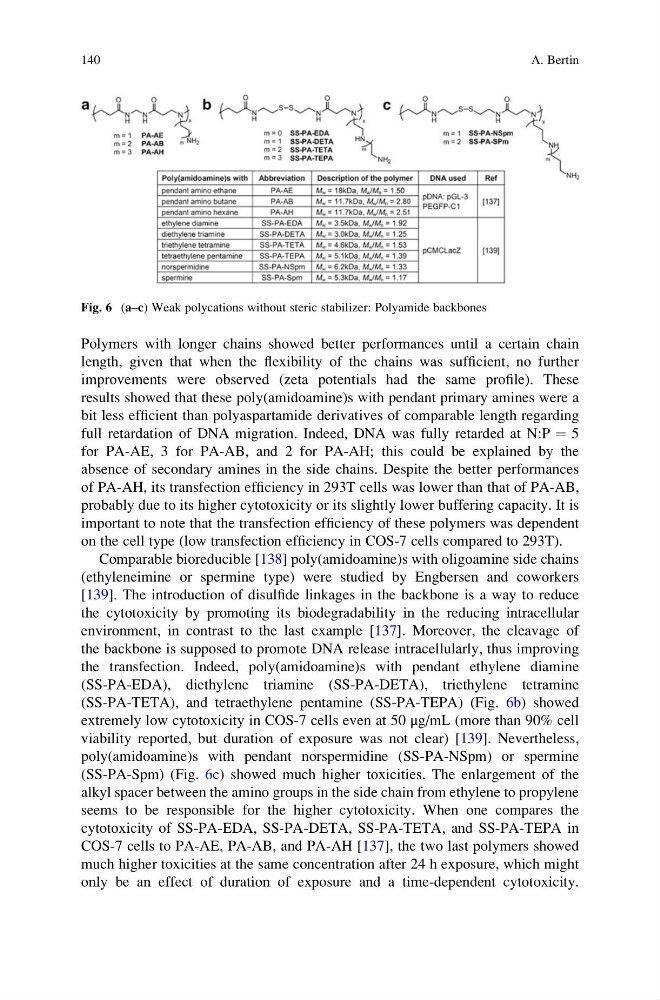
the transfection. Indeed, poly(amidoamine)s with pendant ethylene diamine
(SS-PA-EDA), diethylene triamine (SS-PA-DETA), triethylene tetramine
(SS-PA-TETA), and tetraethylene pentamine (SS-PA-TEPA) (Fig. 6b) showed
extremely low cytotoxicity in COS-7 cells even at 50 μg/mL (more than 90% cell
viability reported, but duration of exposure was not clear) [139]. Nevertheless,
poly(amidoamine)s with pendant norspermidine (SS-PA-NSpm) or spermine
(SS-PA-Spm) (Fig. 6c) showed much higher toxicities. The enlargement of the
alkyl spacer between the amino groups in the side chain from ethylene to propylene
seems to be responsible for the higher cytotoxicity. When one compares the
cytotoxicity of SS-PA-EDA, SS-PA-DETA, SS-PA-TETA, and SS-PA-TEPA in
COS-7 cells to PA-AE, PA-AB, and PA-AH [137], the two last polymers showed
much higher toxicities at the same concentration after 24 h exposure, which might
only be an effect of duration of exposure and a time-dependent cytotoxicity.
Fig. 6 (a–c) Weak polycations without steric stabilizer: Polyamide backbones
140
A. Bertin
length, given that when the flexibility of the chains was sufficient, no further
improvements were observed (zeta potentials had the same profile). These
results showed that these poly(amidoamine)s with pendant primary amines were a
bit less efficient than polyaspartamide derivatives of comparable length regarding
full retardation of DNA migration. Indeed, DNA was fully retarded at N:P ¼ 5
for PA-AE, 3 for PA-AB, and 2 for PA-AH; this could be explained by the
absence of secondary amines in the side chains. Despite the better performances
of PA-AH, its transfection efficiency in 293T cells was lower than that of PA-AB,
probably due to its higher cytotoxicity or its slightly lower buffering capacity. It is
important to note that the transfection efficiency of these polymers was dependent
on the cell type (low transfection efficiency in COS-7 cells compared to 293T).
Comparable bioreducible [138] poly(amidoamine)s with oligoamine side chains
(ethyleneimine or spermine type) were studied by Engbersen and coworkers
[139]. The introduction of disulfide linkages in the backbone is a way to reduce
the cytotoxicity by promoting its biodegradability in the reducing intracellular
environment, in contrast to the last example [137]. Moreover, the cleavage of
the backbone is supposed to promote DNA release intracellularly, thus improving
the transfection. Indeed, poly(amidoamine)s with pendant ethylene diamine
(SS-PA-EDA), diethylene triamine (SS-PA-DETA), triethylene tetramine
(SS-PA-TETA), and tetraethylene pentamine (SS-PA-TEPA) (Fig. 6b) showed
extremely low cytotoxicity in COS-7 cells even at 50 μg/mL (more than 90% cell
viability reported, but duration of exposure was not clear) [139]. Nevertheless,
poly(amidoamine)s with pendant norspermidine (SS-PA-NSpm) or spermine
(SS-PA-Spm) (Fig. 6c) showed much higher toxicities. The enlargement of the
alkyl spacer between the amino groups in the side chain from ethylene to propylene
seems to be responsible for the higher cytotoxicity. When one compares the
cytotoxicity of SS-PA-EDA, SS-PA-DETA, SS-PA-TETA, and SS-PA-TEPA in
COS-7 cells to PA-AE, PA-AB, and PA-AH [137], the two last polymers showed
much higher toxicities at the same concentration after 24 h exposure, which might
only be an effect of duration of exposure and a time-dependent cytotoxicity.
Fig. 6 (a–c) Weak polycations without steric stabilizer: Polyamide backbones
140
A. Bertin