

With Side Chains Containing Quaternary Ammoniums
In regular DNA/polycation systems, at a charge ratio close to unity, macroscopic
phase separation occurs: the cationic units of the polymers will form ion pairs with
the anionic phosphate groups of DNA to yield charge-neutralized complexes. By
the introduction of a sufficient amount of steric stabilizer such as PEG in
the polycation (as block copolymer or grafts), this macroscopic phase separation
can be avoided due to the lyophilizing effect of the PEG segments and the
complexes will remain stable in solution. This was observed for P(TMAEMA-coOEMA), M w ¼ 2.8 Â 10
5 g mol
À1 , 15 mol% oligo(ethylene glycol) grafts (OE),
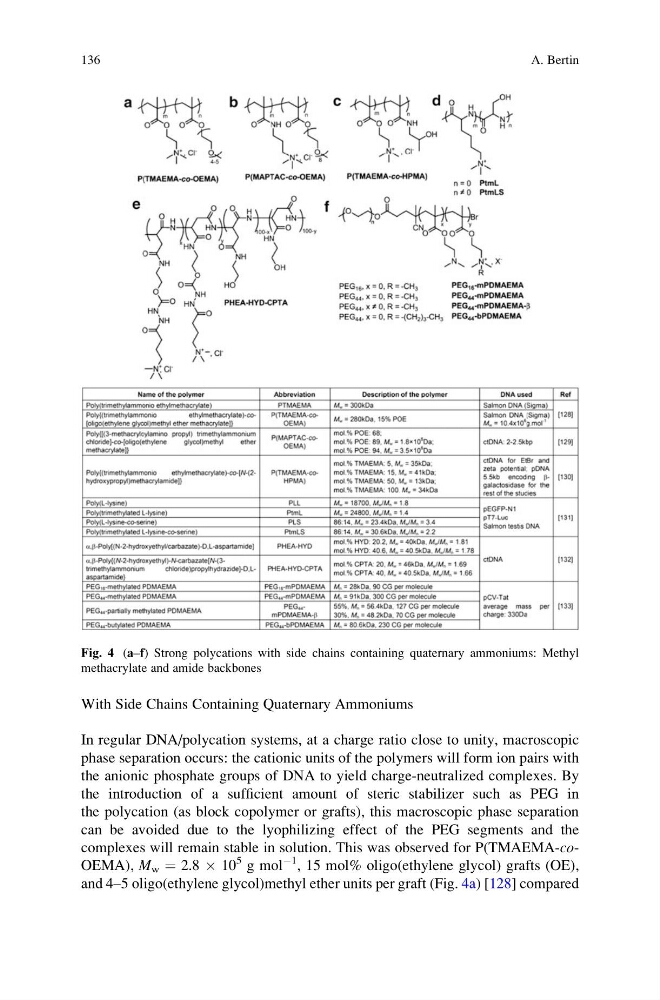
and 4–5 oligo(ethylene glycol)methyl ether units per graft (Fig. 4a) [128] compared
Fig. 4 (a–f) Strong polycations with side chains containing quaternary ammoniums: Methyl
methacrylate and amide backbones
136
A. Bertin
In regular DNA/polycation systems, at a charge ratio close to unity, macroscopic
phase separation occurs: the cationic units of the polymers will form ion pairs with
the anionic phosphate groups of DNA to yield charge-neutralized complexes. By
the introduction of a sufficient amount of steric stabilizer such as PEG in
the polycation (as block copolymer or grafts), this macroscopic phase separation
can be avoided due to the lyophilizing effect of the PEG segments and the
complexes will remain stable in solution. This was observed for P(TMAEMA-coOEMA), M w ¼ 2.8 Â 10
5 g mol
À1 , 15 mol% oligo(ethylene glycol) grafts (OE),
and 4–5 oligo(ethylene glycol)methyl ether units per graft (Fig. 4a) [128] compared
Fig. 4 (a–f) Strong polycations with side chains containing quaternary ammoniums: Methyl
methacrylate and amide backbones
136
A. Bertin