

In the schemes included hereafter DNA is represented as linear (but can have
other topologies and is compacted within the polyplexes), and the type of binding
(cooperative or not) is not taken into account, except if mentioned.
Water-Soluble Polyplexes
Soluble polyplexes are macroscopically homogeneous systems containing
small PEC aggregates. Due to the strong polyanionic nature of DNA, water-soluble
polyplexes are formed when the polycation is present in non-stoichiometric
proportions under certain concentration (dilute) and/or salt conditions and with
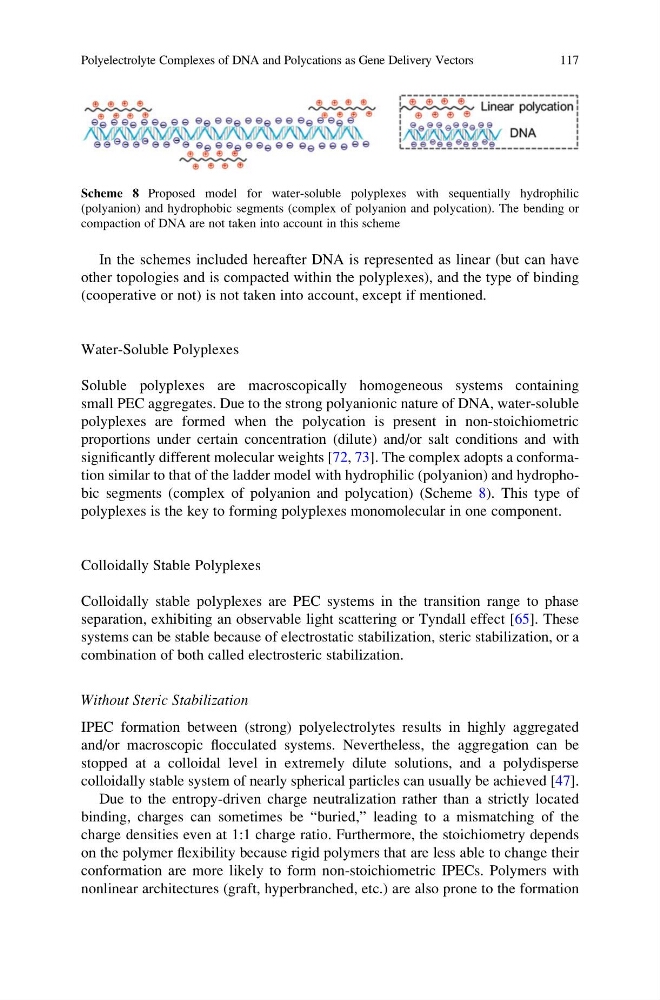
significantly different molecular weights [72, 73]. The complex adopts a conformation similar to that of the ladder model with hydrophilic (polyanion) and hydrophobic segments (complex of polyanion and polycation) (Scheme 8). This type of
polyplexes is the key to forming polyplexes monomolecular in one component.
Colloidally Stable Polyplexes
Colloidally stable polyplexes are PEC systems in the transition range to phase
separation, exhibiting an observable light scattering or Tyndall effect [65]. These
systems can be stable because of electrostatic stabilization, steric stabilization, or a
combination of both called electrosteric stabilization.
Without Steric Stabilization
IPEC formation between (strong) polyelectrolytes results in highly aggregated
and/or macroscopic flocculated systems. Nevertheless, the aggregation can be
stopped at a colloidal level in extremely dilute solutions, and a polydisperse
colloidally stable system of nearly spherical particles can usually be achieved [47].
Due to the entropy-driven charge neutralization rather than a strictly located
binding, charges can sometimes be “buried,” leading to a mismatching of the
charge densities even at 1:1 charge ratio. Furthermore, the stoichiometry depends
on the polymer flexibility because rigid polymers that are less able to change their
conformation are more likely to form non-stoichiometric IPECs. Polymers with
nonlinear architectures (graft, hyperbranched, etc.) are also prone to the formation
Scheme 8 Proposed model for water-soluble polyplexes with sequentially hydrophilic
(polyanion) and hydrophobic segments (complex of polyanion and polycation). The bending or
compaction of DNA are not taken into account in this scheme
Polyelectrolyte Complexes of DNA and Polycations as Gene Delivery Vectors
117
other topologies and is compacted within the polyplexes), and the type of binding
(cooperative or not) is not taken into account, except if mentioned.
Water-Soluble Polyplexes
Soluble polyplexes are macroscopically homogeneous systems containing
small PEC aggregates. Due to the strong polyanionic nature of DNA, water-soluble
polyplexes are formed when the polycation is present in non-stoichiometric
proportions under certain concentration (dilute) and/or salt conditions and with
significantly different molecular weights [72, 73]. The complex adopts a conformation similar to that of the ladder model with hydrophilic (polyanion) and hydrophobic segments (complex of polyanion and polycation) (Scheme 8). This type of
polyplexes is the key to forming polyplexes monomolecular in one component.
Colloidally Stable Polyplexes
Colloidally stable polyplexes are PEC systems in the transition range to phase
separation, exhibiting an observable light scattering or Tyndall effect [65]. These
systems can be stable because of electrostatic stabilization, steric stabilization, or a
combination of both called electrosteric stabilization.
Without Steric Stabilization
IPEC formation between (strong) polyelectrolytes results in highly aggregated
and/or macroscopic flocculated systems. Nevertheless, the aggregation can be
stopped at a colloidal level in extremely dilute solutions, and a polydisperse
colloidally stable system of nearly spherical particles can usually be achieved [47].
Due to the entropy-driven charge neutralization rather than a strictly located
binding, charges can sometimes be “buried,” leading to a mismatching of the
charge densities even at 1:1 charge ratio. Furthermore, the stoichiometry depends
on the polymer flexibility because rigid polymers that are less able to change their
conformation are more likely to form non-stoichiometric IPECs. Polymers with
nonlinear architectures (graft, hyperbranched, etc.) are also prone to the formation
Scheme 8 Proposed model for water-soluble polyplexes with sequentially hydrophilic
(polyanion) and hydrophobic segments (complex of polyanion and polycation). The bending or
compaction of DNA are not taken into account in this scheme
Polyelectrolyte Complexes of DNA and Polycations as Gene Delivery Vectors
117