

1.1 DNA
1.1.1 Structure of DNA
DNA (deoxyribonucleic acid) is a biopolymer containing the genetic information [26,
27]. Deoxyribonucleotides are the monomers of DNA and are all composed of three
parts: a nitrogenous base also called nucleobase, a deoxyribose sugar, and one
phosphate group (negatively charged at physiological pH). The nucleobase is always
bound to the 1
0 -carbon of the deoxyribose and the phosphate groups bind to the
5
0 -carbon of the sugar. There are four different nucleobases: two purines [adenine (A)
and guanine (G)], and two pyrimidines [cytosine (C) and thymine (T)]. The
deoxyribonucleotides are linked with one another via 3
0 –5
0 -phosphodiester bounds.
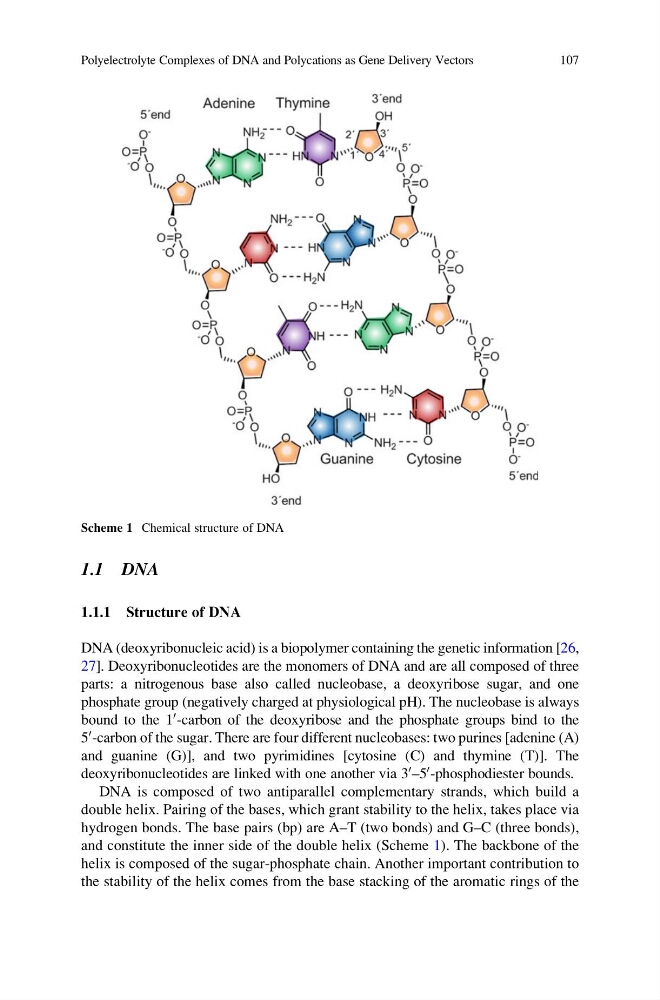
DNA is composed of two antiparallel complementary strands, which build a
double helix. Pairing of the bases, which grant stability to the helix, takes place via
hydrogen bonds. The base pairs (bp) are A–T (two bonds) and G–C (three bonds),
and constitute the inner side of the double helix (Scheme 1). The backbone of the
helix is composed of the sugar-phosphate chain. Another important contribution to
the stability of the helix comes from the base stacking of the aromatic rings of the
Scheme 1 Chemical structure of DNA
Polyelectrolyte Complexes of DNA and Polycations as Gene Delivery Vectors
107
1.1.1 Structure of DNA
DNA (deoxyribonucleic acid) is a biopolymer containing the genetic information [26,
27]. Deoxyribonucleotides are the monomers of DNA and are all composed of three
parts: a nitrogenous base also called nucleobase, a deoxyribose sugar, and one
phosphate group (negatively charged at physiological pH). The nucleobase is always
bound to the 1
0 -carbon of the deoxyribose and the phosphate groups bind to the
5
0 -carbon of the sugar. There are four different nucleobases: two purines [adenine (A)
and guanine (G)], and two pyrimidines [cytosine (C) and thymine (T)]. The
deoxyribonucleotides are linked with one another via 3
0 –5
0 -phosphodiester bounds.
DNA is composed of two antiparallel complementary strands, which build a
double helix. Pairing of the bases, which grant stability to the helix, takes place via
hydrogen bonds. The base pairs (bp) are A–T (two bonds) and G–C (three bonds),
and constitute the inner side of the double helix (Scheme 1). The backbone of the
helix is composed of the sugar-phosphate chain. Another important contribution to
the stability of the helix comes from the base stacking of the aromatic rings of the
Scheme 1 Chemical structure of DNA
Polyelectrolyte Complexes of DNA and Polycations as Gene Delivery Vectors
107