

macromolecules from basic blocks. At the thermodynamic level, assembly into
structures with spherical shape is advantageous because the process is controlled by
the surface tension at the interface between the solution and the condensed phase.
Sphere formation leads to surface energy gain throughout the minimisation of the
overall surface of the particles [144].
5 Conclusion
The application of fundamental physicochemical concepts for rational design of
functional assemblies from food materials constitute, first, a response to the growing
trend toward the development of new and innovative food products and, second, an
opportunity to generate new structures with new applications. Food proteins are
particularly interesting substrates because they are biocompatible and biodegradable.
They can be manipulated to create either irreversible or, more recently, reversible
supramolecular assemblies. Irreversible supramolecular structures, involving covalent bonds, are induced throughout processing (i.e. energy input), which mimes the
industrial practices such as heat treatment, high shear, high pressure, chemical and
enzymatic cross-linking or degradation, etc. Stable dispersions of self-assembled
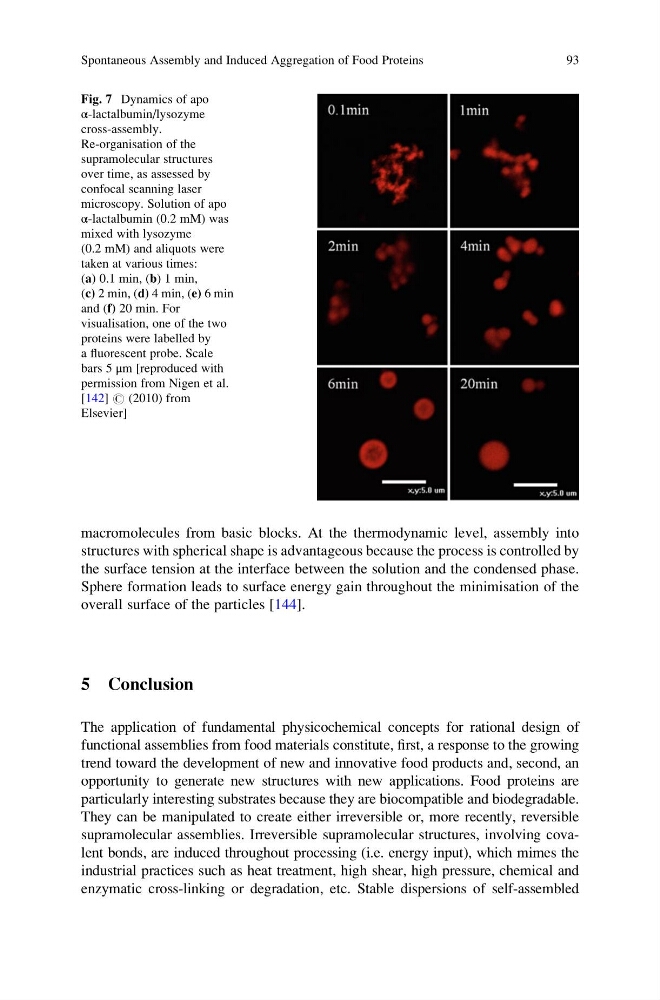
Fig. 7 Dynamics of apo
α-lactalbumin/lysozyme
cross-assembly.
Re-organisation of the
supramolecular structures
over time, as assessed by
confocal scanning laser
microscopy. Solution of apo
α-lactalbumin (0.2 mM) was
mixed with lysozyme
(0.2 mM) and aliquots were
taken at various times:
(a) 0.1 min, (b) 1 min,
(c) 2 min, (d) 4 min, (e) 6 min
and (f) 20 min. For
visualisation, one of the two
proteins were labelled by
a fluorescent probe. Scale
bars 5 μm [reproduced with
permission from Nigen et al.
[142] # (2010) from
Elsevier]
Spontaneous Assembly and Induced Aggregation of Food Proteins
93
structures with spherical shape is advantageous because the process is controlled by
the surface tension at the interface between the solution and the condensed phase.
Sphere formation leads to surface energy gain throughout the minimisation of the
overall surface of the particles [144].
5 Conclusion
The application of fundamental physicochemical concepts for rational design of
functional assemblies from food materials constitute, first, a response to the growing
trend toward the development of new and innovative food products and, second, an
opportunity to generate new structures with new applications. Food proteins are
particularly interesting substrates because they are biocompatible and biodegradable.
They can be manipulated to create either irreversible or, more recently, reversible
supramolecular assemblies. Irreversible supramolecular structures, involving covalent bonds, are induced throughout processing (i.e. energy input), which mimes the
industrial practices such as heat treatment, high shear, high pressure, chemical and
enzymatic cross-linking or degradation, etc. Stable dispersions of self-assembled
Fig. 7 Dynamics of apo
α-lactalbumin/lysozyme
cross-assembly.
Re-organisation of the
supramolecular structures
over time, as assessed by
confocal scanning laser
microscopy. Solution of apo
α-lactalbumin (0.2 mM) was
mixed with lysozyme
(0.2 mM) and aliquots were
taken at various times:
(a) 0.1 min, (b) 1 min,
(c) 2 min, (d) 4 min, (e) 6 min
and (f) 20 min. For
visualisation, one of the two
proteins were labelled by
a fluorescent probe. Scale
bars 5 μm [reproduced with
permission from Nigen et al.
[142] # (2010) from
Elsevier]
Spontaneous Assembly and Induced Aggregation of Food Proteins
93