

name for freeze-dried products of inorganic gels, precipitates, and colloidal solutions, it is more correct to call such freeze-dried products “cryostructurates” or
“cryotexturates” rather than cryogels. However, as the term “cryogel” is most
commonly used for inorganic materials obtained by free-drying, it will also be
used in chapter “Inorganic Cryogels” to be consistent with previous studies in this
field.
The last two contributions in this volume provide an overview of the biotechnological and biomedical applications of cryogels. Cryogels with their large pores
open up a range of applications, e.g., isolation of microbial cells, capturing of
cancer cells, use as matrices for immobilized cell reactors, and environmental
separation. These applications of cryogels are reviewed in chapter “Cryogels for
Biotechnological Applications.” The unique mechanical properties of PVA
cryogels make them an attractive candidate for biomedical, and especially medical
device applications. In chapter “Poly(Vinyl Alcohol) Cryogels for Biomedical
Applications,” the formation process and processing parameters of PVA cryogels
and their application in orthopedic and cardiovascular devices are reviewed and
discussed.
The editor believes that the present volume covering a broad range of topics in
the field of cryogels will contribute to a better understanding of the developments
achieved during the past two decades in the synthesis and applications of cryogels.
I also hope that this work will promote research in this rapidly developing area.
I would like to thank all the authors who have contributed to this exciting volume on
polymeric cryogels.
Istanbul, Turkey
Oguz Okay
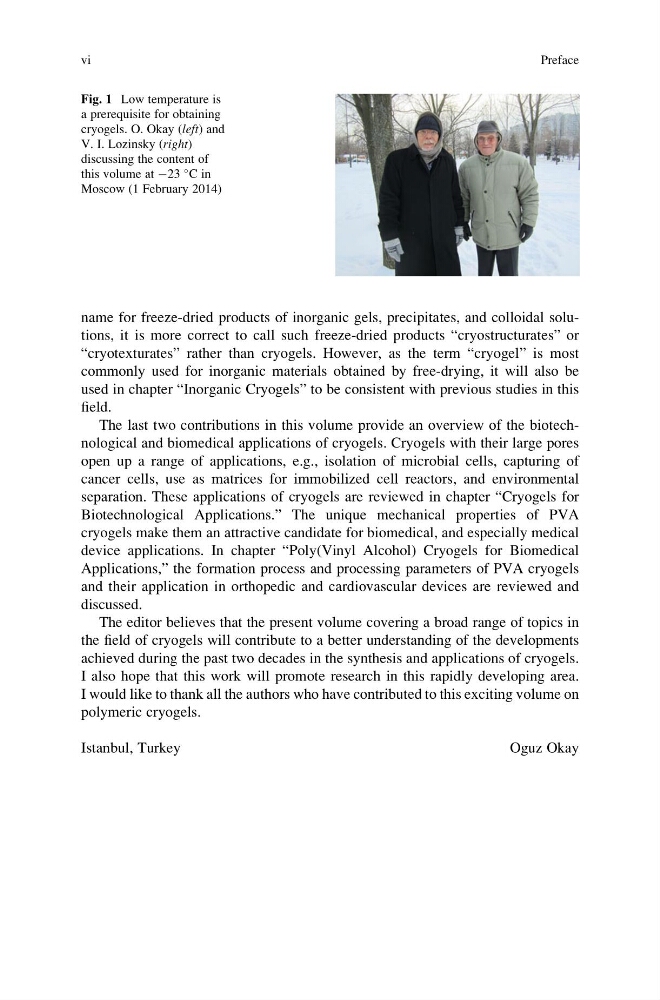
Fig. 1 Low temperature is
a prerequisite for obtaining
cryogels. O. Okay (left) and
V. I. Lozinsky (right)
discussing the content of
this volume at À23
C in
Moscow (1 February 2014)
vi
Preface
“cryotexturates” rather than cryogels. However, as the term “cryogel” is most
commonly used for inorganic materials obtained by free-drying, it will also be
used in chapter “Inorganic Cryogels” to be consistent with previous studies in this
field.
The last two contributions in this volume provide an overview of the biotechnological and biomedical applications of cryogels. Cryogels with their large pores
open up a range of applications, e.g., isolation of microbial cells, capturing of
cancer cells, use as matrices for immobilized cell reactors, and environmental
separation. These applications of cryogels are reviewed in chapter “Cryogels for
Biotechnological Applications.” The unique mechanical properties of PVA
cryogels make them an attractive candidate for biomedical, and especially medical
device applications. In chapter “Poly(Vinyl Alcohol) Cryogels for Biomedical
Applications,” the formation process and processing parameters of PVA cryogels
and their application in orthopedic and cardiovascular devices are reviewed and
discussed.
The editor believes that the present volume covering a broad range of topics in
the field of cryogels will contribute to a better understanding of the developments
achieved during the past two decades in the synthesis and applications of cryogels.
I also hope that this work will promote research in this rapidly developing area.
I would like to thank all the authors who have contributed to this exciting volume on
polymeric cryogels.
Istanbul, Turkey
Oguz Okay
Fig. 1 Low temperature is
a prerequisite for obtaining
cryogels. O. Okay (left) and
V. I. Lozinsky (right)
discussing the content of
this volume at À23
C in
Moscow (1 February 2014)
vi
Preface