

2. The concentration of solutes or dispersed colloid-size particles is increased
because of their expulsion into the volume of UFLMP as the solvent is crystallized. This cryo-concentration effect is one of the major factors responsible for
the increase in the rate of the chemical reactions and intensification of
intermolecular interactions inside the unfrozen inclusions, which act as
microreactors. Provided the reactants are easily soluble compounds and are
completely concentrated within the UFLMP, the concentrating extent β at a
certain negative temperature T can be estimated using the following formula
[54]:
β ¼
T 0 À T
Δ
X
C i
ð1Þ
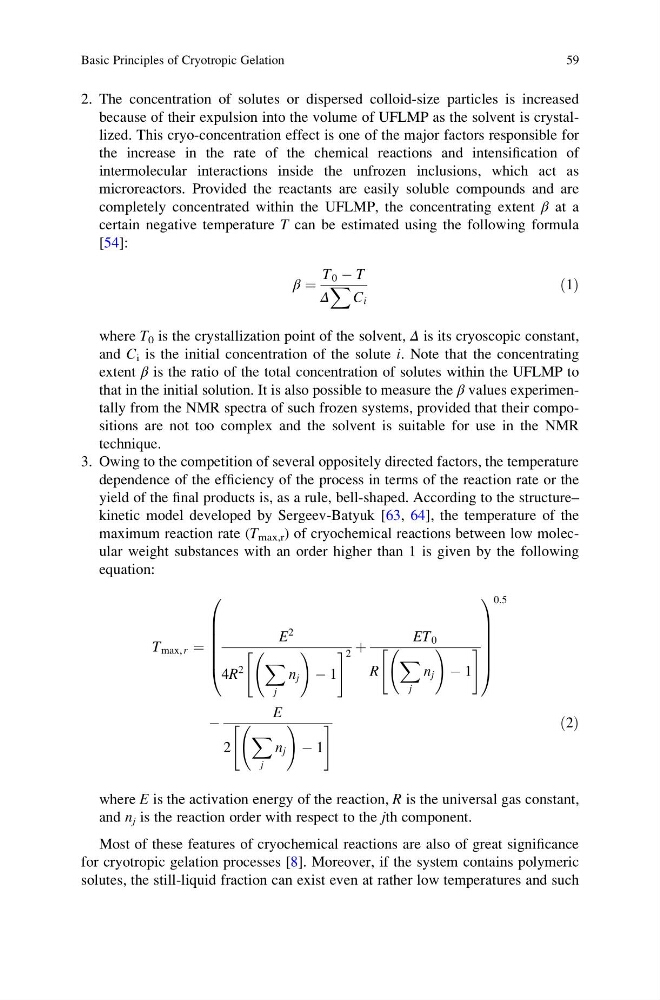
where T 0 is the crystallization point of the solvent, Δ is its cryoscopic constant,
and C i is the initial concentration of the solute i. Note that the concentrating
extent β is the ratio of the total concentration of solutes within the UFLMP to
that in the initial solution. It is also possible to measure the β values experimentally from the NMR spectra of such frozen systems, provided that their compositions are not too complex and the solvent is suitable for use in the NMR
technique.
3. Owing to the competition of several oppositely directed factors, the temperature
dependence of the efficiency of the process in terms of the reaction rate or the
yield of the final products is, as a rule, bell-shaped. According to the structure–
kinetic model developed by Sergeev-Batyuk [63, 64], the temperature of the
maximum reaction rate (T max,r ) of cryochemical reactions between low molecular weight substances with an order higher than 1 is given by the following
equation:
T max, r ¼
E
2
4R
2
X
j
n j
!
À 1
"
# 2 þ
ET 0
R
X
j
n j
!
À 1
"
#
0
B
B
B
B
B
@
1
C
C
C
C
C
A
0:5
À
E
2
X
j
n j
!
À 1
"
#
ð2Þ
where E is the activation energy of the reaction, R is the universal gas constant,
and n j is the reaction order with respect to the jth component.
Most of these features of cryochemical reactions are also of great significance
for cryotropic gelation processes [8]. Moreover, if the system contains polymeric
solutes, the still-liquid fraction can exist even at rather low temperatures and such
Basic Principles of Cryotropic Gelation
59
because of their expulsion into the volume of UFLMP as the solvent is crystallized. This cryo-concentration effect is one of the major factors responsible for
the increase in the rate of the chemical reactions and intensification of
intermolecular interactions inside the unfrozen inclusions, which act as
microreactors. Provided the reactants are easily soluble compounds and are
completely concentrated within the UFLMP, the concentrating extent β at a
certain negative temperature T can be estimated using the following formula
[54]:
β ¼
T 0 À T
Δ
X
C i
ð1Þ
where T 0 is the crystallization point of the solvent, Δ is its cryoscopic constant,
and C i is the initial concentration of the solute i. Note that the concentrating
extent β is the ratio of the total concentration of solutes within the UFLMP to
that in the initial solution. It is also possible to measure the β values experimentally from the NMR spectra of such frozen systems, provided that their compositions are not too complex and the solvent is suitable for use in the NMR
technique.
3. Owing to the competition of several oppositely directed factors, the temperature
dependence of the efficiency of the process in terms of the reaction rate or the
yield of the final products is, as a rule, bell-shaped. According to the structure–
kinetic model developed by Sergeev-Batyuk [63, 64], the temperature of the
maximum reaction rate (T max,r ) of cryochemical reactions between low molecular weight substances with an order higher than 1 is given by the following
equation:
T max, r ¼
E
2
4R
2
X
j
n j
!
À 1
"
# 2 þ
ET 0
R
X
j
n j
!
À 1
"
#
0
B
B
B
B
B
@
1
C
C
C
C
C
A
0:5
À
E
2
X
j
n j
!
À 1
"
#
ð2Þ
where E is the activation energy of the reaction, R is the universal gas constant,
and n j is the reaction order with respect to the jth component.
Most of these features of cryochemical reactions are also of great significance
for cryotropic gelation processes [8]. Moreover, if the system contains polymeric
solutes, the still-liquid fraction can exist even at rather low temperatures and such
Basic Principles of Cryotropic Gelation
59