

variant can be subdivided into two techniques utilizing different freezing profiles,
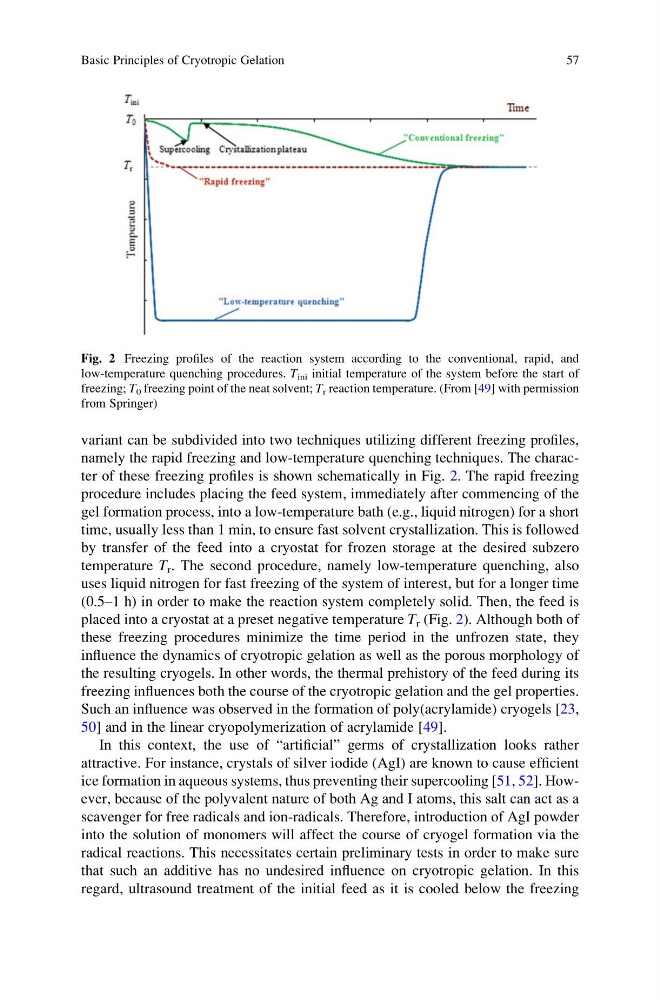
namely the rapid freezing and low-temperature quenching techniques. The character of these freezing profiles is shown schematically in Fig. 2. The rapid freezing
procedure includes placing the feed system, immediately after commencing of the
gel formation process, into a low-temperature bath (e.g., liquid nitrogen) for a short
time, usually less than 1 min, to ensure fast solvent crystallization. This is followed
by transfer of the feed into a cryostat for frozen storage at the desired subzero
temperature T r . The second procedure, namely low-temperature quenching, also
uses liquid nitrogen for fast freezing of the system of interest, but for a longer time
(0.5–1 h) in order to make the reaction system completely solid. Then, the feed is
placed into a cryostat at a preset negative temperature T r (Fig. 2). Although both of
these freezing procedures minimize the time period in the unfrozen state, they
influence the dynamics of cryotropic gelation as well as the porous morphology of
the resulting cryogels. In other words, the thermal prehistory of the feed during its
freezing influences both the course of the cryotropic gelation and the gel properties.
Such an influence was observed in the formation of poly(acrylamide) cryogels [23,
50] and in the linear cryopolymerization of acrylamide [49].
In this context, the use of “artificial” germs of crystallization looks rather
attractive. For instance, crystals of silver iodide (AgI) are known to cause efficient
ice formation in aqueous systems, thus preventing their supercooling [51, 52]. However, because of the polyvalent nature of both Ag and I atoms, this salt can act as a
scavenger for free radicals and ion-radicals. Therefore, introduction of AgI powder
into the solution of monomers will affect the course of cryogel formation via the
radical reactions. This necessitates certain preliminary tests in order to make sure
that such an additive has no undesired influence on cryotropic gelation. In this
regard, ultrasound treatment of the initial feed as it is cooled below the freezing
Fig. 2 Freezing profiles of the reaction system according to the conventional, rapid, and
low-temperature quenching procedures. T ini initial temperature of the system before the start of
freezing; T 0 freezing point of the neat solvent; T r reaction temperature. (From [49] with permission
from Springer)
Basic Principles of Cryotropic Gelation
57
namely the rapid freezing and low-temperature quenching techniques. The character of these freezing profiles is shown schematically in Fig. 2. The rapid freezing
procedure includes placing the feed system, immediately after commencing of the
gel formation process, into a low-temperature bath (e.g., liquid nitrogen) for a short
time, usually less than 1 min, to ensure fast solvent crystallization. This is followed
by transfer of the feed into a cryostat for frozen storage at the desired subzero
temperature T r . The second procedure, namely low-temperature quenching, also
uses liquid nitrogen for fast freezing of the system of interest, but for a longer time
(0.5–1 h) in order to make the reaction system completely solid. Then, the feed is
placed into a cryostat at a preset negative temperature T r (Fig. 2). Although both of
these freezing procedures minimize the time period in the unfrozen state, they
influence the dynamics of cryotropic gelation as well as the porous morphology of
the resulting cryogels. In other words, the thermal prehistory of the feed during its
freezing influences both the course of the cryotropic gelation and the gel properties.
Such an influence was observed in the formation of poly(acrylamide) cryogels [23,
50] and in the linear cryopolymerization of acrylamide [49].
In this context, the use of “artificial” germs of crystallization looks rather
attractive. For instance, crystals of silver iodide (AgI) are known to cause efficient
ice formation in aqueous systems, thus preventing their supercooling [51, 52]. However, because of the polyvalent nature of both Ag and I atoms, this salt can act as a
scavenger for free radicals and ion-radicals. Therefore, introduction of AgI powder
into the solution of monomers will affect the course of cryogel formation via the
radical reactions. This necessitates certain preliminary tests in order to make sure
that such an additive has no undesired influence on cryotropic gelation. In this
regard, ultrasound treatment of the initial feed as it is cooled below the freezing
Fig. 2 Freezing profiles of the reaction system according to the conventional, rapid, and
low-temperature quenching procedures. T ini initial temperature of the system before the start of
freezing; T 0 freezing point of the neat solvent; T r reaction temperature. (From [49] with permission
from Springer)
Basic Principles of Cryotropic Gelation
57