

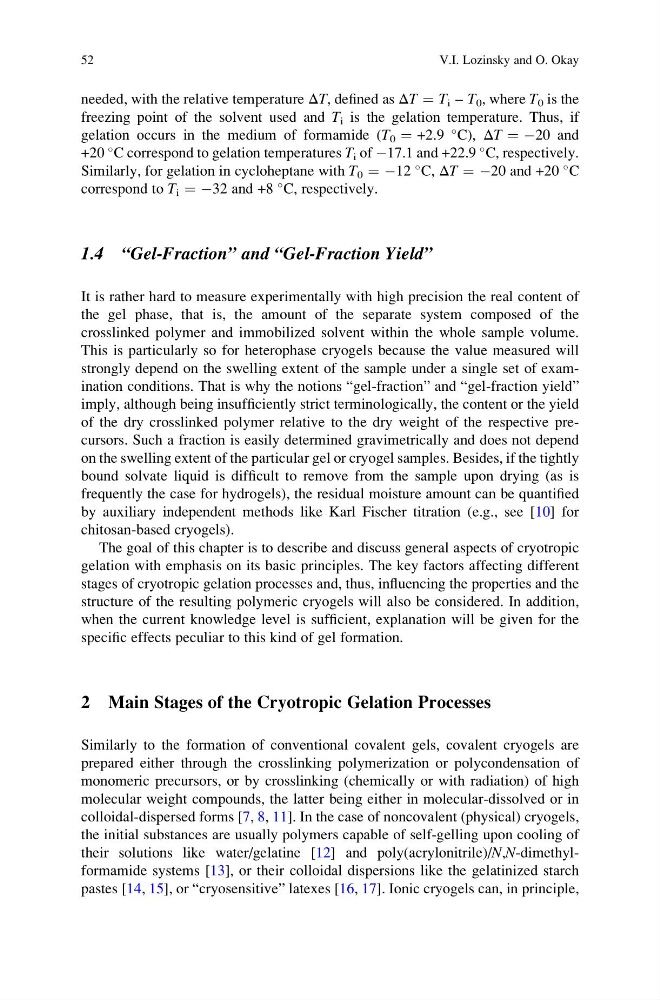
needed, with the relative temperature ΔT, defined as ΔT ¼ T i – T 0 , where T 0 is the
freezing point of the solvent used and T i is the gelation temperature. Thus, if
gelation occurs in the medium of formamide (T 0 ¼ +2.9
C), ΔT ¼ À20 and
+20
C correspond to gelation temperatures T i of À17.1 and +22.9
C, respectively.
Similarly, for gelation in cycloheptane with T 0 ¼ À12
C, ΔT ¼ À20 and +20
C
correspond to T i ¼ À32 and +8
C, respectively.
1.4 “Gel-Fraction” and “Gel-Fraction Yield”
It is rather hard to measure experimentally with high precision the real content of
the gel phase, that is, the amount of the separate system composed of the
crosslinked polymer and immobilized solvent within the whole sample volume.
This is particularly so for heterophase cryogels because the value measured will
strongly depend on the swelling extent of the sample under a single set of examination conditions. That is why the notions “gel-fraction” and “gel-fraction yield”
imply, although being insufficiently strict terminologically, the content or the yield
of the dry crosslinked polymer relative to the dry weight of the respective precursors. Such a fraction is easily determined gravimetrically and does not depend
on the swelling extent of the particular gel or cryogel samples. Besides, if the tightly
bound solvate liquid is difficult to remove from the sample upon drying (as is
frequently the case for hydrogels), the residual moisture amount can be quantified
by auxiliary independent methods like Karl Fischer titration (e.g., see [10] for
chitosan-based cryogels).
The goal of this chapter is to describe and discuss general aspects of cryotropic
gelation with emphasis on its basic principles. The key factors affecting different
stages of cryotropic gelation processes and, thus, influencing the properties and the
structure of the resulting polymeric cryogels will also be considered. In addition,
when the current knowledge level is sufficient, explanation will be given for the
specific effects peculiar to this kind of gel formation.
2 Main Stages of the Cryotropic Gelation Processes
Similarly to the formation of conventional covalent gels, covalent cryogels are
prepared either through the crosslinking polymerization or polycondensation of
monomeric precursors, or by crosslinking (chemically or with radiation) of high
molecular weight compounds, the latter being either in molecular-dissolved or in
colloidal-dispersed forms [7, 8, 11]. In the case of noncovalent (physical) cryogels,
the initial substances are usually polymers capable of self-gelling upon cooling of
their solutions like water/gelatine [12] and poly(acrylonitrile)/N,N-dimethylformamide systems [13], or their colloidal dispersions like the gelatinized starch
pastes [14, 15], or “cryosensitive” latexes [16, 17]. Ionic cryogels can, in principle,
52
V.I. Lozinsky and O. Okay
freezing point of the solvent used and T i is the gelation temperature. Thus, if
gelation occurs in the medium of formamide (T 0 ¼ +2.9
C), ΔT ¼ À20 and
+20
C correspond to gelation temperatures T i of À17.1 and +22.9
C, respectively.
Similarly, for gelation in cycloheptane with T 0 ¼ À12
C, ΔT ¼ À20 and +20
C
correspond to T i ¼ À32 and +8
C, respectively.
1.4 “Gel-Fraction” and “Gel-Fraction Yield”
It is rather hard to measure experimentally with high precision the real content of
the gel phase, that is, the amount of the separate system composed of the
crosslinked polymer and immobilized solvent within the whole sample volume.
This is particularly so for heterophase cryogels because the value measured will
strongly depend on the swelling extent of the sample under a single set of examination conditions. That is why the notions “gel-fraction” and “gel-fraction yield”
imply, although being insufficiently strict terminologically, the content or the yield
of the dry crosslinked polymer relative to the dry weight of the respective precursors. Such a fraction is easily determined gravimetrically and does not depend
on the swelling extent of the particular gel or cryogel samples. Besides, if the tightly
bound solvate liquid is difficult to remove from the sample upon drying (as is
frequently the case for hydrogels), the residual moisture amount can be quantified
by auxiliary independent methods like Karl Fischer titration (e.g., see [10] for
chitosan-based cryogels).
The goal of this chapter is to describe and discuss general aspects of cryotropic
gelation with emphasis on its basic principles. The key factors affecting different
stages of cryotropic gelation processes and, thus, influencing the properties and the
structure of the resulting polymeric cryogels will also be considered. In addition,
when the current knowledge level is sufficient, explanation will be given for the
specific effects peculiar to this kind of gel formation.
2 Main Stages of the Cryotropic Gelation Processes
Similarly to the formation of conventional covalent gels, covalent cryogels are
prepared either through the crosslinking polymerization or polycondensation of
monomeric precursors, or by crosslinking (chemically or with radiation) of high
molecular weight compounds, the latter being either in molecular-dissolved or in
colloidal-dispersed forms [7, 8, 11]. In the case of noncovalent (physical) cryogels,
the initial substances are usually polymers capable of self-gelling upon cooling of
their solutions like water/gelatine [12] and poly(acrylonitrile)/N,N-dimethylformamide systems [13], or their colloidal dispersions like the gelatinized starch
pastes [14, 15], or “cryosensitive” latexes [16, 17]. Ionic cryogels can, in principle,
52
V.I. Lozinsky and O. Okay