

anisotropic with a higher stiffness in the circumferential direction compared to the
axial direction [71–73]. For replacement of tissue such as this, or other soft tissue, a
composite material that possesses anisotropic properties could be extremely beneficial. Millon et al. prepared PVA-BC samples and found that, compared to the plain
PVA system [59], the addition of BC resulted in an almost doubled anisotropic
effect, with the overall mechanical properties of the composite material dominated
by changes in the longitudinal direction. This is probably due to the fact that the BC
crystallites act as nucleation sites during freeze–thaw cycling and therefore promote
formation of PVA crystallites around the BC fibers when strain is applied. Stiffness
in both directions was found to increase with an increase in the number of FTCs.
The anisotropic PVA-BC demonstrated stiffness and relaxation properties very
similar to those of the porcine aorta, proving to be an excellent material for
potential applications [59].
Following this work, Wan et al. conducted studies on the PVA-BC composite
cryogel material for potential use in total joint replacement. In this application, the
mechanical properties must be tuned to replicate the properties of the articular
cartilage, with its composition of collagen fibrils and proteoglycans. Through
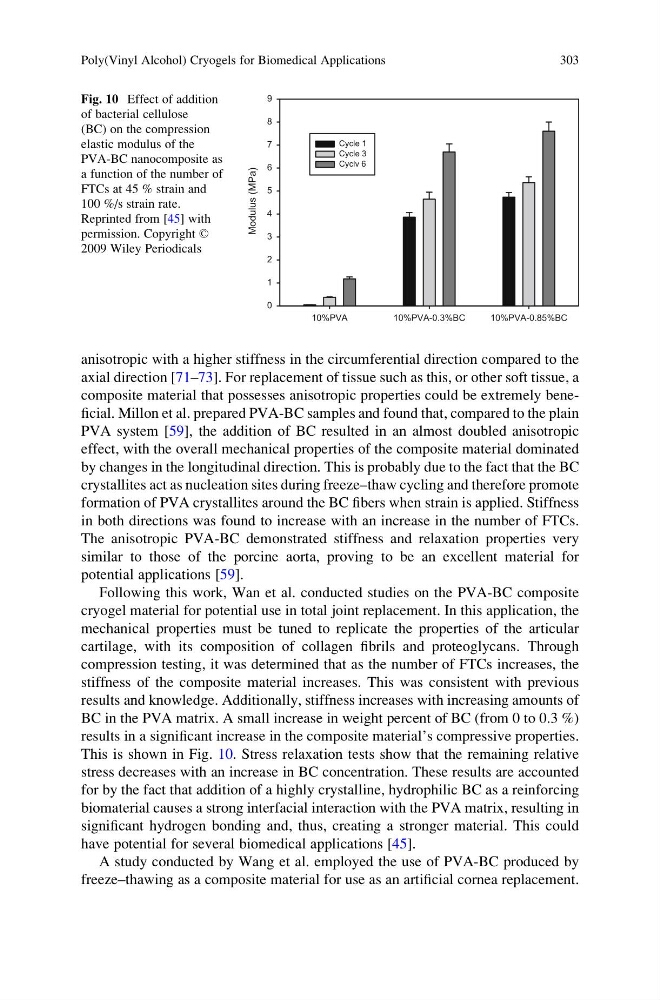
compression testing, it was determined that as the number of FTCs increases, the
stiffness of the composite material increases. This was consistent with previous
results and knowledge. Additionally, stiffness increases with increasing amounts of
BC in the PVA matrix. A small increase in weight percent of BC (from 0 to 0.3 %)
results in a significant increase in the composite material’s compressive properties.
This is shown in Fig. 10. Stress relaxation tests show that the remaining relative
stress decreases with an increase in BC concentration. These results are accounted
for by the fact that addition of a highly crystalline, hydrophilic BC as a reinforcing
biomaterial causes a strong interfacial interaction with the PVA matrix, resulting in
significant hydrogen bonding and, thus, creating a stronger material. This could
have potential for several biomedical applications [45].
A study conducted by Wang et al. employed the use of PVA-BC produced by
freeze–thawing as a composite material for use as an artificial cornea replacement.
10%PVA
10%PVA-0.3%BC
10%PVA-0.85%BC
Modulus (MPa)
0
1
2
3
4
5
6
7
8
9
Cycle 1
Cycle 3
Cyclv 6
Fig. 10 Effect of addition
of bacterial cellulose
(BC) on the compression
elastic modulus of the
PVA-BC nanocomposite as
a function of the number of
FTCs at 45 % strain and
100 %/s strain rate.
Reprinted from [45] with
permission. Copyright ©
2009 Wiley Periodicals
Poly(Vinyl Alcohol) Cryogels for Biomedical Applications
303
axial direction [71–73]. For replacement of tissue such as this, or other soft tissue, a
composite material that possesses anisotropic properties could be extremely beneficial. Millon et al. prepared PVA-BC samples and found that, compared to the plain
PVA system [59], the addition of BC resulted in an almost doubled anisotropic
effect, with the overall mechanical properties of the composite material dominated
by changes in the longitudinal direction. This is probably due to the fact that the BC
crystallites act as nucleation sites during freeze–thaw cycling and therefore promote
formation of PVA crystallites around the BC fibers when strain is applied. Stiffness
in both directions was found to increase with an increase in the number of FTCs.
The anisotropic PVA-BC demonstrated stiffness and relaxation properties very
similar to those of the porcine aorta, proving to be an excellent material for
potential applications [59].
Following this work, Wan et al. conducted studies on the PVA-BC composite
cryogel material for potential use in total joint replacement. In this application, the
mechanical properties must be tuned to replicate the properties of the articular
cartilage, with its composition of collagen fibrils and proteoglycans. Through
compression testing, it was determined that as the number of FTCs increases, the
stiffness of the composite material increases. This was consistent with previous
results and knowledge. Additionally, stiffness increases with increasing amounts of
BC in the PVA matrix. A small increase in weight percent of BC (from 0 to 0.3 %)
results in a significant increase in the composite material’s compressive properties.
This is shown in Fig. 10. Stress relaxation tests show that the remaining relative
stress decreases with an increase in BC concentration. These results are accounted
for by the fact that addition of a highly crystalline, hydrophilic BC as a reinforcing
biomaterial causes a strong interfacial interaction with the PVA matrix, resulting in
significant hydrogen bonding and, thus, creating a stronger material. This could
have potential for several biomedical applications [45].
A study conducted by Wang et al. employed the use of PVA-BC produced by
freeze–thawing as a composite material for use as an artificial cornea replacement.
10%PVA
10%PVA-0.3%BC
10%PVA-0.85%BC
Modulus (MPa)
0
1
2
3
4
5
6
7
8
9
Cycle 1
Cycle 3
Cyclv 6
Fig. 10 Effect of addition
of bacterial cellulose
(BC) on the compression
elastic modulus of the
PVA-BC nanocomposite as
a function of the number of
FTCs at 45 % strain and
100 %/s strain rate.
Reprinted from [45] with
permission. Copyright ©
2009 Wiley Periodicals
Poly(Vinyl Alcohol) Cryogels for Biomedical Applications
303