

in a cryogel offers an attractive arrangement because good accessibility is offered
by the cryogel and low back-pressure is maintained. Applications in environmental
biotechnology are obvious, but also other areas of utilization seem realistic
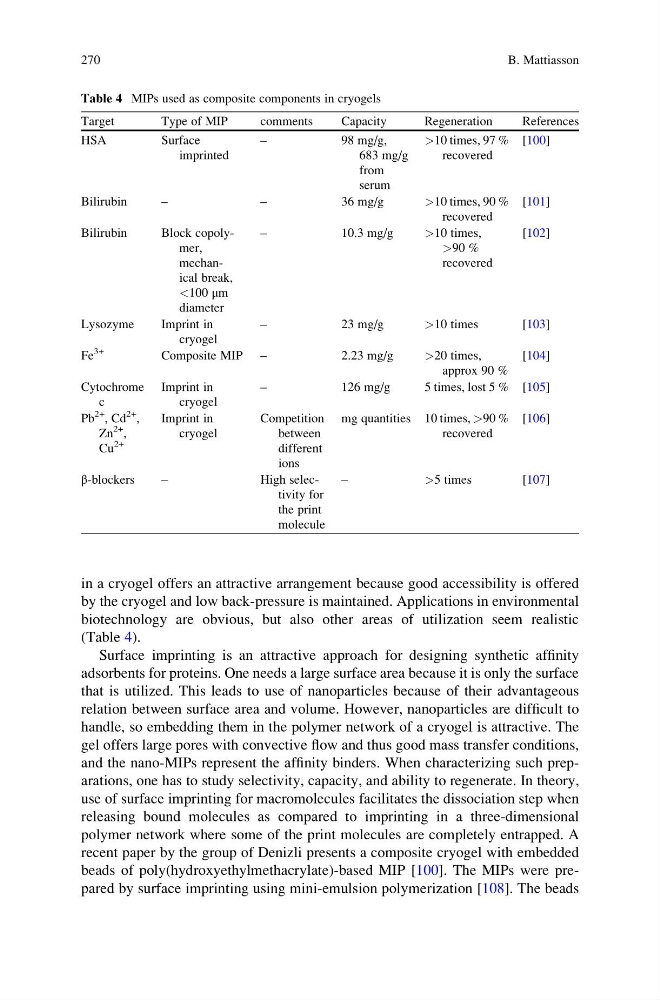
(Table 4).
Surface imprinting is an attractive approach for designing synthetic affinity
adsorbents for proteins. One needs a large surface area because it is only the surface
that is utilized. This leads to use of nanoparticles because of their advantageous
relation between surface area and volume. However, nanoparticles are difficult to
handle, so embedding them in the polymer network of a cryogel is attractive. The
gel offers large pores with convective flow and thus good mass transfer conditions,
and the nano-MIPs represent the affinity binders. When characterizing such preparations, one has to study selectivity, capacity, and ability to regenerate. In theory,
use of surface imprinting for macromolecules facilitates the dissociation step when
releasing bound molecules as compared to imprinting in a three-dimensional
polymer network where some of the print molecules are completely entrapped. A
recent paper by the group of Denizli presents a composite cryogel with embedded
beads of poly(hydroxyethylmethacrylate)-based MIP [100]. The MIPs were prepared by surface imprinting using mini-emulsion polymerization [108]. The beads
Table 4 MIPs used as composite components in cryogels
Target
Type of MIP
comments
Capacity
Regeneration
References
HSA
Surface
imprinted
–
98 mg/g,
683 mg/g
from
serum
>10 times, 97 %
recovered
[100]
Bilirubin
–
–
36 mg/g
>10 times, 90 %
recovered
[101]
Bilirubin
Block copolymer,
mechanical break,
<100 μm
diameter
–
10.3 mg/g
>10 times,
>90 %
recovered
[102]
Lysozyme
Imprint in
cryogel
–
23 mg/g
>10 times
[103]
Fe
3+
Composite MIP –
2.23 mg/g
>20 times,
approx 90 %
[104]
Cytochrome
c
Imprint in
cryogel
–
126 mg/g
5 times, lost 5 % [105]
Pb
2+ , Cd
2+ ,
Zn
2+ ,
Cu
2+
Imprint in
cryogel
Competition
between
different
ions
mg quantities 10 times, >90 %
recovered
[106]
β-blockers
–
High selectivity for
the print
molecule
–
>5 times
[107]
270
B. Mattiasson
by the cryogel and low back-pressure is maintained. Applications in environmental
biotechnology are obvious, but also other areas of utilization seem realistic
(Table 4).
Surface imprinting is an attractive approach for designing synthetic affinity
adsorbents for proteins. One needs a large surface area because it is only the surface
that is utilized. This leads to use of nanoparticles because of their advantageous
relation between surface area and volume. However, nanoparticles are difficult to
handle, so embedding them in the polymer network of a cryogel is attractive. The
gel offers large pores with convective flow and thus good mass transfer conditions,
and the nano-MIPs represent the affinity binders. When characterizing such preparations, one has to study selectivity, capacity, and ability to regenerate. In theory,
use of surface imprinting for macromolecules facilitates the dissociation step when
releasing bound molecules as compared to imprinting in a three-dimensional
polymer network where some of the print molecules are completely entrapped. A
recent paper by the group of Denizli presents a composite cryogel with embedded
beads of poly(hydroxyethylmethacrylate)-based MIP [100]. The MIPs were prepared by surface imprinting using mini-emulsion polymerization [108]. The beads
Table 4 MIPs used as composite components in cryogels
Target
Type of MIP
comments
Capacity
Regeneration
References
HSA
Surface
imprinted
–
98 mg/g,
683 mg/g
from
serum
>10 times, 97 %
recovered
[100]
Bilirubin
–
–
36 mg/g
>10 times, 90 %
recovered
[101]
Bilirubin
Block copolymer,
mechanical break,
<100 μm
diameter
–
10.3 mg/g
>10 times,
>90 %
recovered
[102]
Lysozyme
Imprint in
cryogel
–
23 mg/g
>10 times
[103]
Fe
3+
Composite MIP –
2.23 mg/g
>20 times,
approx 90 %
[104]
Cytochrome
c
Imprint in
cryogel
–
126 mg/g
5 times, lost 5 % [105]
Pb
2+ , Cd
2+ ,
Zn
2+ ,
Cu
2+
Imprint in
cryogel
Competition
between
different
ions
mg quantities 10 times, >90 %
recovered
[106]
β-blockers
–
High selectivity for
the print
molecule
–
>5 times
[107]
270
B. Mattiasson