

It is important when open systems are treated in environmental applications that
the polymer systems used are not easily degraded by organisms present in the
environment. Up to now, PVA seems to be the most popular polymer for this type of
application.
Chromatography is to a large extent focused on adsorption/desorption processes.
The main emphasis has been on separation of various cell components, especially
proteins. The introduction of selective affinity ligands has meant a dramatic simplification and increased efficiency of the separation processes. It is also possible to
enrich compounds present at very low concentrations in an efficient way using
chromatography. It is tempting to apply this technology in environmental science
where many of the emerging pollutants are present at submicromolar concentrations in a complex medium with varying composition over time.
The low concentrations mean that the capacity of the adsorbent is of less
importance than factors such as robustness, ability to function in the presence of
particulate matter, risk of fouling, etc. Cryogels seem to have suitable properties for
addressing these challenges.
10 Cryogels in Housings
Adsorbents are normally used in columns, where they are exposed to a relatively
well-controlled feed stream from which some substances are adsorbed. However, it
would be useful to be able to use adsorbents under harsher conditions, e.g.,
processes with vigorous stirring or in media that are complex and with a composition that varies over time. An example of the latter is the use of adsorbents in
environmental technology to capture, e.g., environmental pollutants.
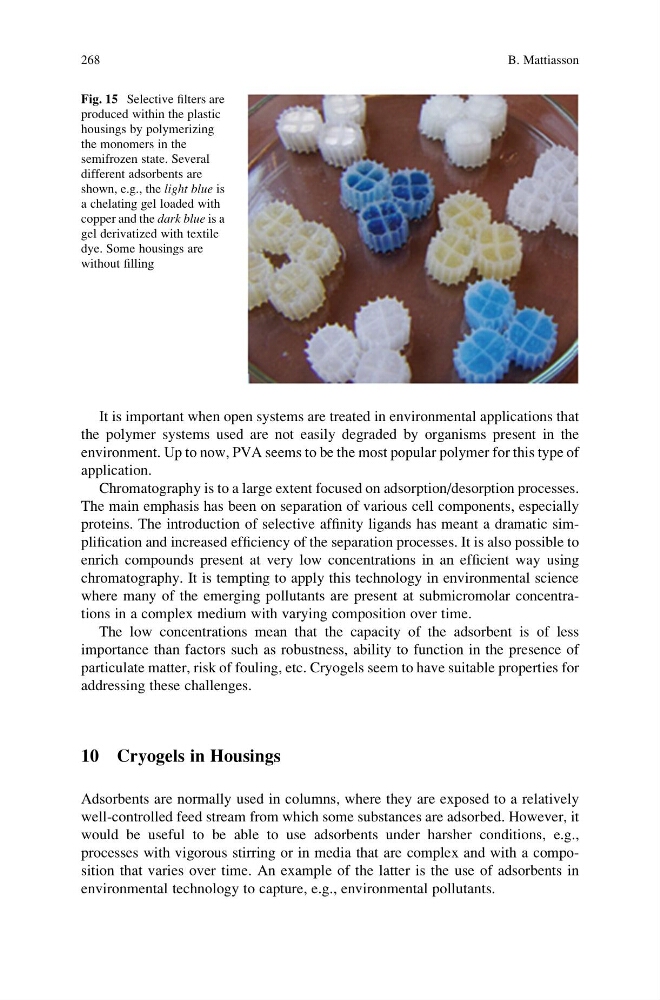
Fig. 15 Selective filters are
produced within the plastic
housings by polymerizing
the monomers in the
semifrozen state. Several
different adsorbents are
shown, e.g., the light blue is
a chelating gel loaded with
copper and the dark blue is a
gel derivatized with textile
dye. Some housings are
without filling
268
B. Mattiasson
the polymer systems used are not easily degraded by organisms present in the
environment. Up to now, PVA seems to be the most popular polymer for this type of
application.
Chromatography is to a large extent focused on adsorption/desorption processes.
The main emphasis has been on separation of various cell components, especially
proteins. The introduction of selective affinity ligands has meant a dramatic simplification and increased efficiency of the separation processes. It is also possible to
enrich compounds present at very low concentrations in an efficient way using
chromatography. It is tempting to apply this technology in environmental science
where many of the emerging pollutants are present at submicromolar concentrations in a complex medium with varying composition over time.
The low concentrations mean that the capacity of the adsorbent is of less
importance than factors such as robustness, ability to function in the presence of
particulate matter, risk of fouling, etc. Cryogels seem to have suitable properties for
addressing these challenges.
10 Cryogels in Housings
Adsorbents are normally used in columns, where they are exposed to a relatively
well-controlled feed stream from which some substances are adsorbed. However, it
would be useful to be able to use adsorbents under harsher conditions, e.g.,
processes with vigorous stirring or in media that are complex and with a composition that varies over time. An example of the latter is the use of adsorbents in
environmental technology to capture, e.g., environmental pollutants.
Fig. 15 Selective filters are
produced within the plastic
housings by polymerizing
the monomers in the
semifrozen state. Several
different adsorbents are
shown, e.g., the light blue is
a chelating gel loaded with
copper and the dark blue is a
gel derivatized with textile
dye. Some housings are
without filling
268
B. Mattiasson