

the polycondensation of resorcinol and formaldehyde in aqueous solutions in the
presence of a basic catalyst, usually Na 2 CO 3 . Further processing of as-obtained
polymer hydrogel by freezing and freeze-drying results in the formation of a
polymer precursor with micron-sized pores formed by ice crystallization. Thermal
processing of the precursor at elevated temperatures results in, along with the
carbonization of polymer, the formation of a number of mesopores in the walls of
larger pores. The essentially bimodal character of the porosity makes this material
similar to metal oxide cryogels [181–185].
It was shown that the method of drying of resorcinol-formaldehyde (RF) gels
influences the morphology of the resulting networks as well as their carbonized
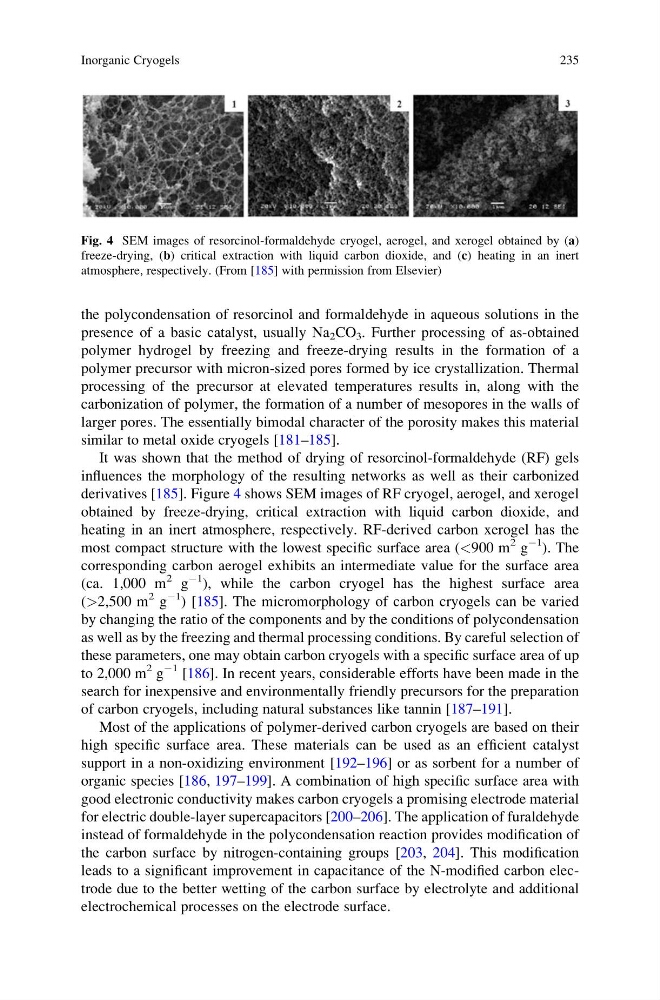
derivatives [185]. Figure 4 shows SEM images of RF cryogel, aerogel, and xerogel
obtained by freeze-drying, critical extraction with liquid carbon dioxide, and
heating in an inert atmosphere, respectively. RF-derived carbon xerogel has the
most compact structure with the lowest specific surface area (<900 m
2 g
À1 ). The
corresponding carbon aerogel exhibits an intermediate value for the surface area
(ca. 1,000 m
2 g
À1 ), while the carbon cryogel has the highest surface area
(>2,500 m
2 g
À1 ) [185]. The micromorphology of carbon cryogels can be varied
by changing the ratio of the components and by the conditions of polycondensation
as well as by the freezing and thermal processing conditions. By careful selection of
these parameters, one may obtain carbon cryogels with a specific surface area of up
to 2,000 m
2 g
À1 [186]. In recent years, considerable efforts have been made in the
search for inexpensive and environmentally friendly precursors for the preparation
of carbon cryogels, including natural substances like tannin [187–191].
Most of the applications of polymer-derived carbon cryogels are based on their
high specific surface area. These materials can be used as an efficient catalyst
support in a non-oxidizing environment [192–196] or as sorbent for a number of
organic species [186, 197–199]. A combination of high specific surface area with
good electronic conductivity makes carbon cryogels a promising electrode material
for electric double-layer supercapacitors [200–206]. The application of furaldehyde
instead of formaldehyde in the polycondensation reaction provides modification of
the carbon surface by nitrogen-containing groups [203, 204]. This modification
leads to a significant improvement in capacitance of the N-modified carbon electrode due to the better wetting of the carbon surface by electrolyte and additional
electrochemical processes on the electrode surface.
Fig. 4 SEM images of resorcinol-formaldehyde cryogel, aerogel, and xerogel obtained by (a)
freeze-drying, (b) critical extraction with liquid carbon dioxide, and (c) heating in an inert
atmosphere, respectively. (From [185] with permission from Elsevier)
Inorganic Cryogels
235
presence of a basic catalyst, usually Na 2 CO 3 . Further processing of as-obtained
polymer hydrogel by freezing and freeze-drying results in the formation of a
polymer precursor with micron-sized pores formed by ice crystallization. Thermal
processing of the precursor at elevated temperatures results in, along with the
carbonization of polymer, the formation of a number of mesopores in the walls of
larger pores. The essentially bimodal character of the porosity makes this material
similar to metal oxide cryogels [181–185].
It was shown that the method of drying of resorcinol-formaldehyde (RF) gels
influences the morphology of the resulting networks as well as their carbonized
derivatives [185]. Figure 4 shows SEM images of RF cryogel, aerogel, and xerogel
obtained by freeze-drying, critical extraction with liquid carbon dioxide, and
heating in an inert atmosphere, respectively. RF-derived carbon xerogel has the
most compact structure with the lowest specific surface area (<900 m
2 g
À1 ). The
corresponding carbon aerogel exhibits an intermediate value for the surface area
(ca. 1,000 m
2 g
À1 ), while the carbon cryogel has the highest surface area
(>2,500 m
2 g
À1 ) [185]. The micromorphology of carbon cryogels can be varied
by changing the ratio of the components and by the conditions of polycondensation
as well as by the freezing and thermal processing conditions. By careful selection of
these parameters, one may obtain carbon cryogels with a specific surface area of up
to 2,000 m
2 g
À1 [186]. In recent years, considerable efforts have been made in the
search for inexpensive and environmentally friendly precursors for the preparation
of carbon cryogels, including natural substances like tannin [187–191].
Most of the applications of polymer-derived carbon cryogels are based on their
high specific surface area. These materials can be used as an efficient catalyst
support in a non-oxidizing environment [192–196] or as sorbent for a number of
organic species [186, 197–199]. A combination of high specific surface area with
good electronic conductivity makes carbon cryogels a promising electrode material
for electric double-layer supercapacitors [200–206]. The application of furaldehyde
instead of formaldehyde in the polycondensation reaction provides modification of
the carbon surface by nitrogen-containing groups [203, 204]. This modification
leads to a significant improvement in capacitance of the N-modified carbon electrode due to the better wetting of the carbon surface by electrolyte and additional
electrochemical processes on the electrode surface.
Fig. 4 SEM images of resorcinol-formaldehyde cryogel, aerogel, and xerogel obtained by (a)
freeze-drying, (b) critical extraction with liquid carbon dioxide, and (c) heating in an inert
atmosphere, respectively. (From [185] with permission from Elsevier)
Inorganic Cryogels
235