

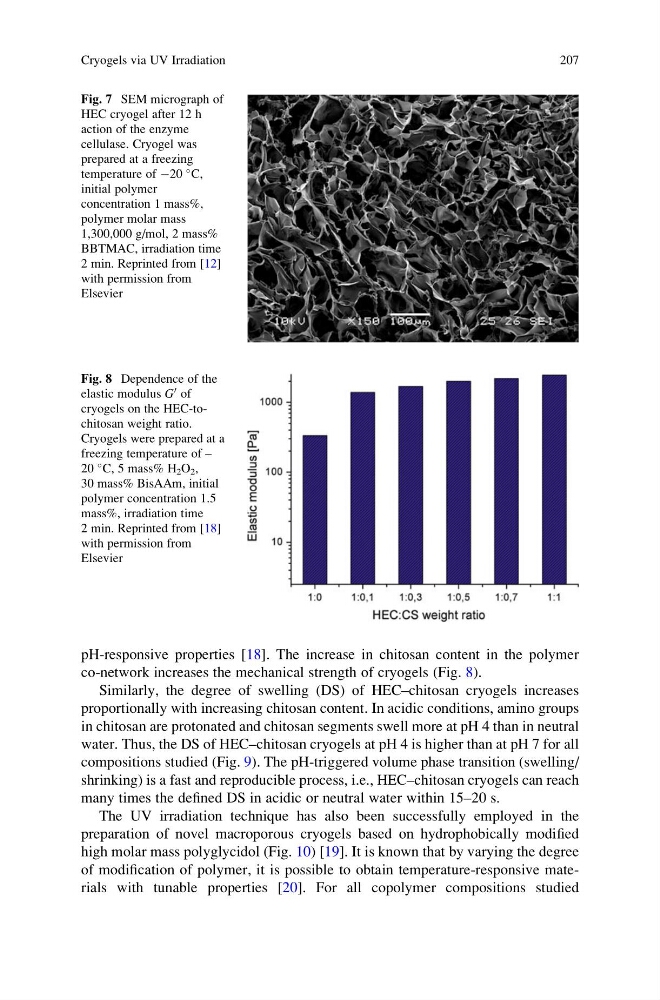
pH-responsive properties [18]. The increase in chitosan content in the polymer
co-network increases the mechanical strength of cryogels (Fig. 8).
Similarly, the degree of swelling (DS) of HEC–chitosan cryogels increases
proportionally with increasing chitosan content. In acidic conditions, amino groups
in chitosan are protonated and chitosan segments swell more at pH 4 than in neutral
water. Thus, the DS of HEC–chitosan cryogels at pH 4 is higher than at pH 7 for all
compositions studied (Fig. 9). The pH-triggered volume phase transition (swelling/
shrinking) is a fast and reproducible process, i.e., HEC–chitosan cryogels can reach
many times the defined DS in acidic or neutral water within 15–20 s.
The UV irradiation technique has also been successfully employed in the
preparation of novel macroporous cryogels based on hydrophobically modified
high molar mass polyglycidol (Fig. 10) [19]. It is known that by varying the degree
of modification of polymer, it is possible to obtain temperature-responsive materials with tunable properties [20]. For all copolymer compositions studied
Fig. 7 SEM micrograph of
HEC cryogel after 12 h
action of the enzyme
cellulase. Cryogel was
prepared at a freezing
temperature of À20
C,
initial polymer
concentration 1 mass%,
polymer molar mass
1,300,000 g/mol, 2 mass%
BBTMAC, irradiation time
2 min. Reprinted from [12]
with permission from
Elsevier
Fig. 8 Dependence of the
elastic modulus G
0 of
cryogels on the HEC-tochitosan weight ratio.
Cryogels were prepared at a
freezing temperature of –
20
C, 5 mass% H 2 O 2 ,
30 mass% BisAAm, initial
polymer concentration 1.5
mass%, irradiation time
2 min. Reprinted from [18]
with permission from
Elsevier
Cryogels via UV Irradiation
207
co-network increases the mechanical strength of cryogels (Fig. 8).
Similarly, the degree of swelling (DS) of HEC–chitosan cryogels increases
proportionally with increasing chitosan content. In acidic conditions, amino groups
in chitosan are protonated and chitosan segments swell more at pH 4 than in neutral
water. Thus, the DS of HEC–chitosan cryogels at pH 4 is higher than at pH 7 for all
compositions studied (Fig. 9). The pH-triggered volume phase transition (swelling/
shrinking) is a fast and reproducible process, i.e., HEC–chitosan cryogels can reach
many times the defined DS in acidic or neutral water within 15–20 s.
The UV irradiation technique has also been successfully employed in the
preparation of novel macroporous cryogels based on hydrophobically modified
high molar mass polyglycidol (Fig. 10) [19]. It is known that by varying the degree
of modification of polymer, it is possible to obtain temperature-responsive materials with tunable properties [20]. For all copolymer compositions studied
Fig. 7 SEM micrograph of
HEC cryogel after 12 h
action of the enzyme
cellulase. Cryogel was
prepared at a freezing
temperature of À20
C,
initial polymer
concentration 1 mass%,
polymer molar mass
1,300,000 g/mol, 2 mass%
BBTMAC, irradiation time
2 min. Reprinted from [12]
with permission from
Elsevier
Fig. 8 Dependence of the
elastic modulus G
0 of
cryogels on the HEC-tochitosan weight ratio.
Cryogels were prepared at a
freezing temperature of –
20
C, 5 mass% H 2 O 2 ,
30 mass% BisAAm, initial
polymer concentration 1.5
mass%, irradiation time
2 min. Reprinted from [18]
with permission from
Elsevier
Cryogels via UV Irradiation
207