

3.3 PVA Cryogels
In water/PVA systems, gelation may also be induced by cryogenic treatments, i.e.,
at temperatures where the formation of ice crystals takes place [1–7]. Cryogelation
was introduced at the beginning of the 1970s as a new technique for the preparation
of PVA physical hydrogels having improved mechanical properties [2, 48] with
respect to those obtained using more conventional methods. As already stated in the
“Introduction,” this cryogenic process consists in submitting a PVA aqueous
solution to repeated cycles of freezing at subzero temperature (T < À4
C) and
thawing to room temperature. In PVA hydrogels prepared by the freeze–thaw
technique and having a rather high PVA content, the junctions in the stable
supramolecular network are crystallites [1, 49].
Peppas made the first attempts to understand the freeze–thaw process of PVA
solutions to form hydrogels by performing turbidimetric measurements [1,
2]. Peppas studied the gelation mechanism on water solutions with PVA content
in the range 2.5–15 wt%, frozen at À20
C for 45–150 min, and then thawed at
23
C for long periods of time (up to 12 h). He explained the appearance of turbidity
after freezing in terms of a partial crystallization of chain segments into microcrystalline aggregates. Moreover, Peppas demonstrated that crystallinity increases with
increasing freezing time as well as with increasing PVA concentration [2].
Yokoyama and coworkers [49] performed X-ray diffraction experiments on
PVA hydrogels. The X-ray diffraction patterns of these gels showed the presence
of crystalline reflections. However, a deeper analysis of diffraction data was not
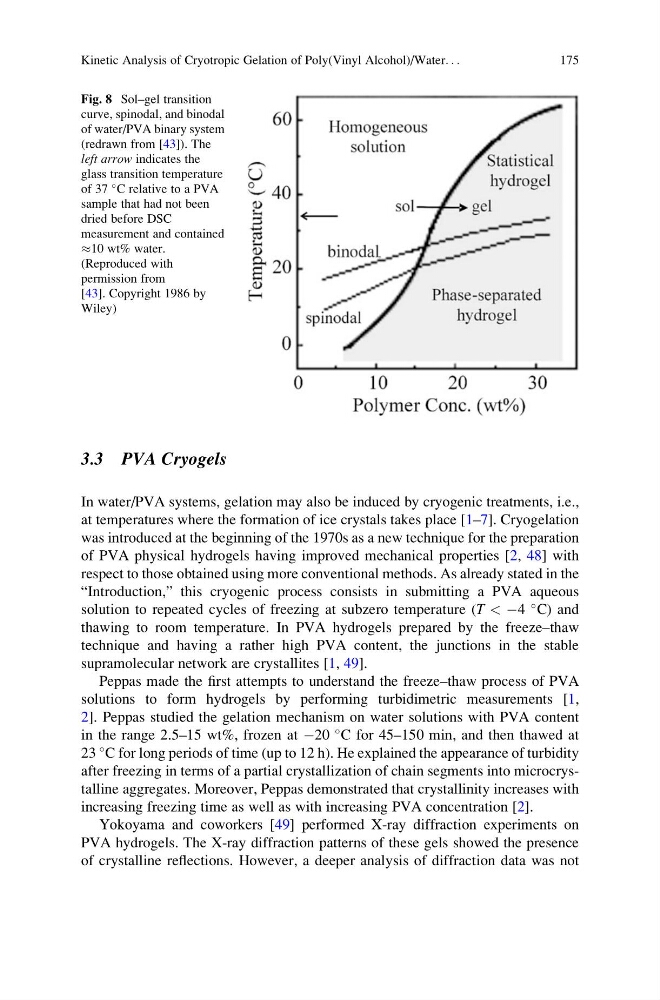
Fig. 8 Sol–gel transition
curve, spinodal, and binodal
of water/PVA binary system
(redrawn from [43]). The
left arrow indicates the
glass transition temperature
of 37
C relative to a PVA
sample that had not been
dried before DSC
measurement and contained
%10 wt% water.
(Reproduced with
permission from
[43]. Copyright 1986 by
Wiley)
Kinetic Analysis of Cryotropic Gelation of Poly(Vinyl Alcohol)/Water. . .
175
In water/PVA systems, gelation may also be induced by cryogenic treatments, i.e.,
at temperatures where the formation of ice crystals takes place [1–7]. Cryogelation
was introduced at the beginning of the 1970s as a new technique for the preparation
of PVA physical hydrogels having improved mechanical properties [2, 48] with
respect to those obtained using more conventional methods. As already stated in the
“Introduction,” this cryogenic process consists in submitting a PVA aqueous
solution to repeated cycles of freezing at subzero temperature (T < À4
C) and
thawing to room temperature. In PVA hydrogels prepared by the freeze–thaw
technique and having a rather high PVA content, the junctions in the stable
supramolecular network are crystallites [1, 49].
Peppas made the first attempts to understand the freeze–thaw process of PVA
solutions to form hydrogels by performing turbidimetric measurements [1,
2]. Peppas studied the gelation mechanism on water solutions with PVA content
in the range 2.5–15 wt%, frozen at À20
C for 45–150 min, and then thawed at
23
C for long periods of time (up to 12 h). He explained the appearance of turbidity
after freezing in terms of a partial crystallization of chain segments into microcrystalline aggregates. Moreover, Peppas demonstrated that crystallinity increases with
increasing freezing time as well as with increasing PVA concentration [2].
Yokoyama and coworkers [49] performed X-ray diffraction experiments on
PVA hydrogels. The X-ray diffraction patterns of these gels showed the presence
of crystalline reflections. However, a deeper analysis of diffraction data was not
Fig. 8 Sol–gel transition
curve, spinodal, and binodal
of water/PVA binary system
(redrawn from [43]). The
left arrow indicates the
glass transition temperature
of 37
C relative to a PVA
sample that had not been
dried before DSC
measurement and contained
%10 wt% water.
(Reproduced with
permission from
[43]. Copyright 1986 by
Wiley)
Kinetic Analysis of Cryotropic Gelation of Poly(Vinyl Alcohol)/Water. . .
175