

The melting temperature of PVA ranges between 220 and 240
C. The glass
transition temperature is 85
C in dried PVA samples [1], and decreases with the
amount of water adsorbed by PVA due to plasticization effects. For instance, the
glass transition temperature of PVA containing 10 wt% of water is %37
C.
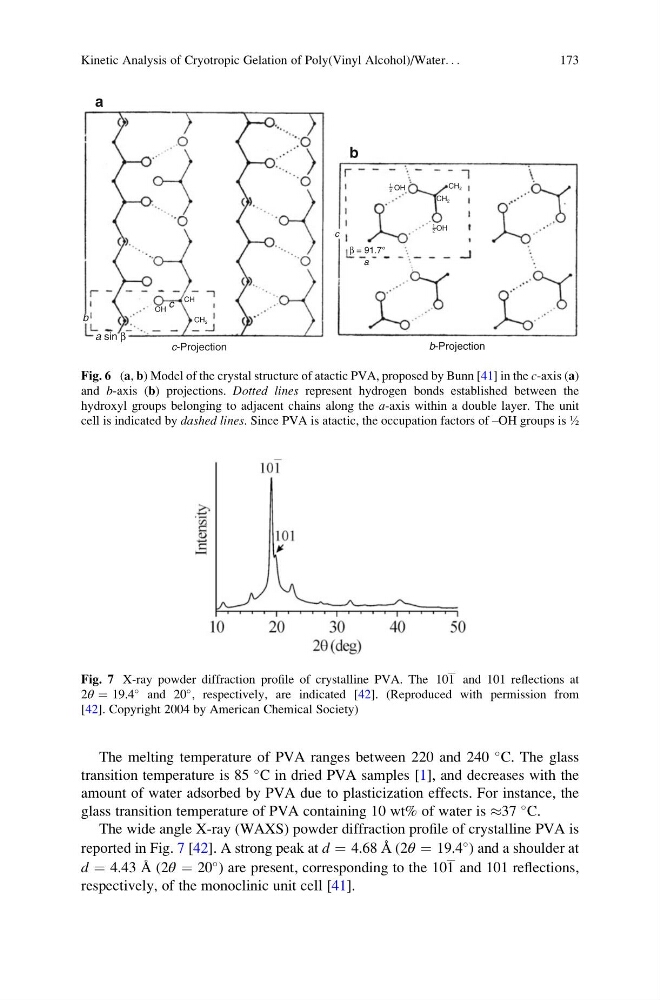
The wide angle X-ray (WAXS) powder diffraction profile of crystalline PVA is
reported in Fig. 7 [42]. A strong peak at d ¼ 4.68 Å (2θ ¼ 19.4
) and a shoulder at
d ¼ 4.43 Å (2θ ¼ 20
) are present, corresponding to the 101 and 101 reflections,
respectively, of the monoclinic unit cell [41].
c
a
β = 91.7°
CH2
CH2
OH
OH
a sin β
b
c
c-Projection
b-Projection
OH
CH2
CH
1
2
2
1
a
b
Fig. 6 (a, b) Model of the crystal structure of atactic PVA, proposed by Bunn [41] in the c-axis (a)
and b-axis (b) projections. Dotted lines represent hydrogen bonds established between the
hydroxyl groups belonging to adjacent chains along the a-axis within a double layer. The unit
cell is indicated by dashed lines. Since PVA is atactic, the occupation factors of –OH groups is ½
Fig. 7 X-ray powder diffraction profile of crystalline PVA. The 101 and 101 reflections at
2θ ¼ 19.4
and 20
, respectively, are indicated [42]. (Reproduced with permission from
[42]. Copyright 2004 by American Chemical Society)
Kinetic Analysis of Cryotropic Gelation of Poly(Vinyl Alcohol)/Water. . .
173
C. The glass
transition temperature is 85
C in dried PVA samples [1], and decreases with the
amount of water adsorbed by PVA due to plasticization effects. For instance, the
glass transition temperature of PVA containing 10 wt% of water is %37
C.
The wide angle X-ray (WAXS) powder diffraction profile of crystalline PVA is
reported in Fig. 7 [42]. A strong peak at d ¼ 4.68 Å (2θ ¼ 19.4
) and a shoulder at
d ¼ 4.43 Å (2θ ¼ 20
) are present, corresponding to the 101 and 101 reflections,
respectively, of the monoclinic unit cell [41].
c
a
β = 91.7°
CH2
CH2
OH
OH
a sin β
b
c
c-Projection
b-Projection
OH
CH2
CH
1
2
2
1
a
b
Fig. 6 (a, b) Model of the crystal structure of atactic PVA, proposed by Bunn [41] in the c-axis (a)
and b-axis (b) projections. Dotted lines represent hydrogen bonds established between the
hydroxyl groups belonging to adjacent chains along the a-axis within a double layer. The unit
cell is indicated by dashed lines. Since PVA is atactic, the occupation factors of –OH groups is ½
Fig. 7 X-ray powder diffraction profile of crystalline PVA. The 101 and 101 reflections at
2θ ¼ 19.4
and 20
, respectively, are indicated [42]. (Reproduced with permission from
[42]. Copyright 2004 by American Chemical Society)
Kinetic Analysis of Cryotropic Gelation of Poly(Vinyl Alcohol)/Water. . .
173