

de-mixing and crystallization processes are arrested by vitrification. In both cases,
gels may be formed only if the degree of connectivity in the polymer-rich phase
achieves a threshold value. Furthermore, regardless of undercooling depth, the
above hierarchy of metastability may become accessible only if the initial homogeneous solution is cooled to the target temperature at high rates. For low cooling
rates, crystallization is likely to occur during the cooling process before the
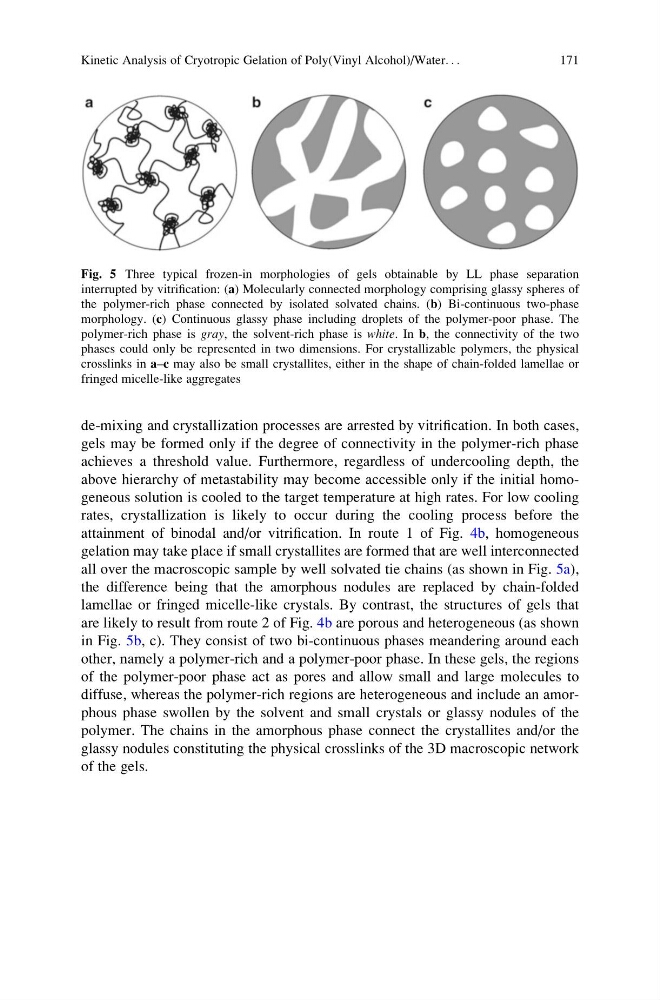
attainment of binodal and/or vitrification. In route 1 of Fig. 4b, homogeneous
gelation may take place if small crystallites are formed that are well interconnected
all over the macroscopic sample by well solvated tie chains (as shown in Fig. 5a),
the difference being that the amorphous nodules are replaced by chain-folded
lamellae or fringed micelle-like crystals. By contrast, the structures of gels that
are likely to result from route 2 of Fig. 4b are porous and heterogeneous (as shown
in Fig. 5b, c). They consist of two bi-continuous phases meandering around each
other, namely a polymer-rich and a polymer-poor phase. In these gels, the regions
of the polymer-poor phase act as pores and allow small and large molecules to
diffuse, whereas the polymer-rich regions are heterogeneous and include an amorphous phase swollen by the solvent and small crystals or glassy nodules of the
polymer. The chains in the amorphous phase connect the crystallites and/or the
glassy nodules constituting the physical crosslinks of the 3D macroscopic network
of the gels.
Fig. 5 Three typical frozen-in morphologies of gels obtainable by LL phase separation
interrupted by vitrification: (a) Molecularly connected morphology comprising glassy spheres of
the polymer-rich phase connected by isolated solvated chains. (b) Bi-continuous two-phase
morphology. (c) Continuous glassy phase including droplets of the polymer-poor phase. The
polymer-rich phase is gray, the solvent-rich phase is white. In b, the connectivity of the two
phases could only be represented in two dimensions. For crystallizable polymers, the physical
crosslinks in a–c may also be small crystallites, either in the shape of chain-folded lamellae or
fringed micelle-like aggregates
Kinetic Analysis of Cryotropic Gelation of Poly(Vinyl Alcohol)/Water. . .
171
gels may be formed only if the degree of connectivity in the polymer-rich phase
achieves a threshold value. Furthermore, regardless of undercooling depth, the
above hierarchy of metastability may become accessible only if the initial homogeneous solution is cooled to the target temperature at high rates. For low cooling
rates, crystallization is likely to occur during the cooling process before the
attainment of binodal and/or vitrification. In route 1 of Fig. 4b, homogeneous
gelation may take place if small crystallites are formed that are well interconnected
all over the macroscopic sample by well solvated tie chains (as shown in Fig. 5a),
the difference being that the amorphous nodules are replaced by chain-folded
lamellae or fringed micelle-like crystals. By contrast, the structures of gels that
are likely to result from route 2 of Fig. 4b are porous and heterogeneous (as shown
in Fig. 5b, c). They consist of two bi-continuous phases meandering around each
other, namely a polymer-rich and a polymer-poor phase. In these gels, the regions
of the polymer-poor phase act as pores and allow small and large molecules to
diffuse, whereas the polymer-rich regions are heterogeneous and include an amorphous phase swollen by the solvent and small crystals or glassy nodules of the
polymer. The chains in the amorphous phase connect the crystallites and/or the
glassy nodules constituting the physical crosslinks of the 3D macroscopic network
of the gels.
Fig. 5 Three typical frozen-in morphologies of gels obtainable by LL phase separation
interrupted by vitrification: (a) Molecularly connected morphology comprising glassy spheres of
the polymer-rich phase connected by isolated solvated chains. (b) Bi-continuous two-phase
morphology. (c) Continuous glassy phase including droplets of the polymer-poor phase. The
polymer-rich phase is gray, the solvent-rich phase is white. In b, the connectivity of the two
phases could only be represented in two dimensions. For crystallizable polymers, the physical
crosslinks in a–c may also be small crystallites, either in the shape of chain-folded lamellae or
fringed micelle-like aggregates
Kinetic Analysis of Cryotropic Gelation of Poly(Vinyl Alcohol)/Water. . .
171