

constant for the number of cycles larger than six; for example, it is equal to
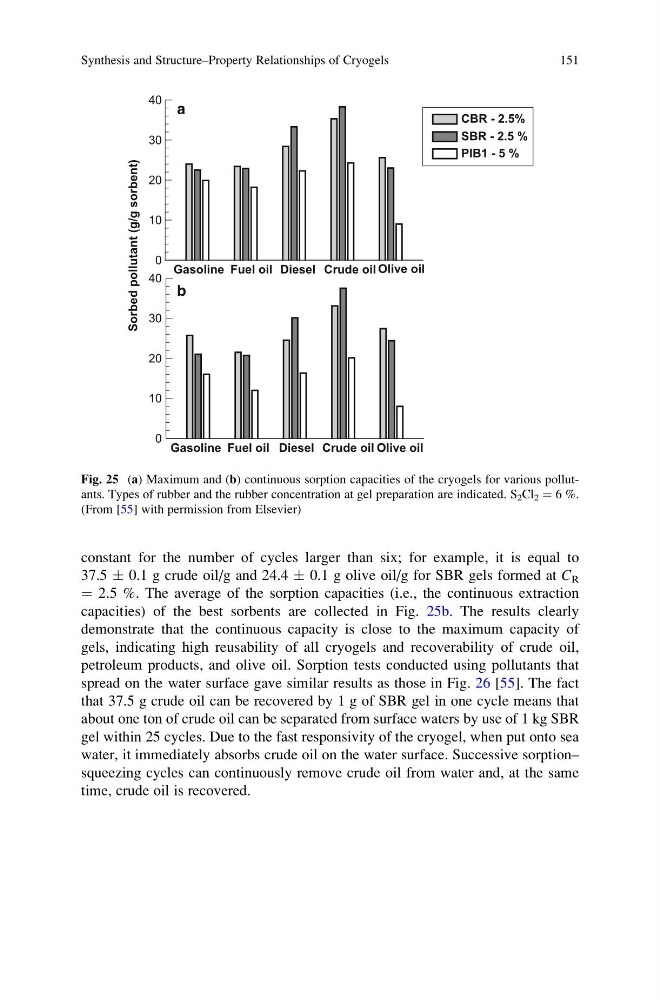
37.5 Æ 0.1 g crude oil/g and 24.4 Æ 0.1 g olive oil/g for SBR gels formed at C R
¼ 2.5 %. The average of the sorption capacities (i.e., the continuous extraction
capacities) of the best sorbents are collected in Fig. 25b. The results clearly
demonstrate that the continuous capacity is close to the maximum capacity of
gels, indicating high reusability of all cryogels and recoverability of crude oil,
petroleum products, and olive oil. Sorption tests conducted using pollutants that
spread on the water surface gave similar results as those in Fig. 26 [55]. The fact
that 37.5 g crude oil can be recovered by 1 g of SBR gel in one cycle means that
about one ton of crude oil can be separated from surface waters by use of 1 kg SBR
gel within 25 cycles. Due to the fast responsivity of the cryogel, when put onto sea
water, it immediately absorbs crude oil on the water surface. Successive sorption–
squeezing cycles can continuously remove crude oil from water and, at the same
time, crude oil is recovered.
Gasoline
Diesel Crude oil Olive oil
Fuel oil
Sorbed pollutant (g/g sorbent)
0
10
20
30
40
CBR - 2.5%
SBR - 2.5 %
PIB1 - 5 %
0
10
20
30
40
a
b
Gasoline
Diesel Crude oil Olive oil
Fuel oil
Fig. 25 (a) Maximum and (b) continuous sorption capacities of the cryogels for various pollutants. Types of rubber and the rubber concentration at gel preparation are indicated. S 2 Cl 2 ¼ 6 %.
(From [55] with permission from Elsevier)
Synthesis and Structure–Property Relationships of Cryogels
151
37.5 Æ 0.1 g crude oil/g and 24.4 Æ 0.1 g olive oil/g for SBR gels formed at C R
¼ 2.5 %. The average of the sorption capacities (i.e., the continuous extraction
capacities) of the best sorbents are collected in Fig. 25b. The results clearly
demonstrate that the continuous capacity is close to the maximum capacity of
gels, indicating high reusability of all cryogels and recoverability of crude oil,
petroleum products, and olive oil. Sorption tests conducted using pollutants that
spread on the water surface gave similar results as those in Fig. 26 [55]. The fact
that 37.5 g crude oil can be recovered by 1 g of SBR gel in one cycle means that
about one ton of crude oil can be separated from surface waters by use of 1 kg SBR
gel within 25 cycles. Due to the fast responsivity of the cryogel, when put onto sea
water, it immediately absorbs crude oil on the water surface. Successive sorption–
squeezing cycles can continuously remove crude oil from water and, at the same
time, crude oil is recovered.
Gasoline
Diesel Crude oil Olive oil
Fuel oil
Sorbed pollutant (g/g sorbent)
0
10
20
30
40
CBR - 2.5%
SBR - 2.5 %
PIB1 - 5 %
0
10
20
30
40
a
b
Gasoline
Diesel Crude oil Olive oil
Fuel oil
Fig. 25 (a) Maximum and (b) continuous sorption capacities of the cryogels for various pollutants. Types of rubber and the rubber concentration at gel preparation are indicated. S 2 Cl 2 ¼ 6 %.
(From [55] with permission from Elsevier)
Synthesis and Structure–Property Relationships of Cryogels
151