

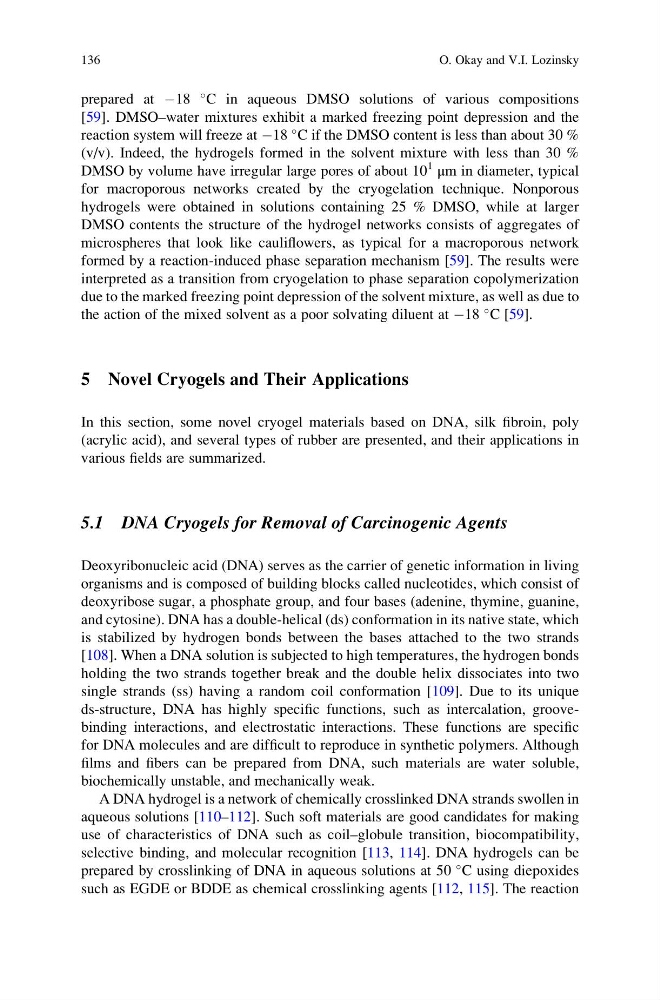
prepared at À18
C in aqueous DMSO solutions of various compositions
[59]. DMSO–water mixtures exhibit a marked freezing point depression and the
reaction system will freeze at À18
C if the DMSO content is less than about 30 %
(v/v). Indeed, the hydrogels formed in the solvent mixture with less than 30 %
DMSO by volume have irregular large pores of about 10
1
μm in diameter, typical
for macroporous networks created by the cryogelation technique. Nonporous
hydrogels were obtained in solutions containing 25 % DMSO, while at larger
DMSO contents the structure of the hydrogel networks consists of aggregates of
microspheres that look like cauliflowers, as typical for a macroporous network
formed by a reaction-induced phase separation mechanism [59]. The results were
interpreted as a transition from cryogelation to phase separation copolymerization
due to the marked freezing point depression of the solvent mixture, as well as due to
the action of the mixed solvent as a poor solvating diluent at À18
C [59].
5 Novel Cryogels and Their Applications
In this section, some novel cryogel materials based on DNA, silk fibroin, poly
(acrylic acid), and several types of rubber are presented, and their applications in
various fields are summarized.
5.1 DNA Cryogels for Removal of Carcinogenic Agents
Deoxyribonucleic acid (DNA) serves as the carrier of genetic information in living
organisms and is composed of building blocks called nucleotides, which consist of
deoxyribose sugar, a phosphate group, and four bases (adenine, thymine, guanine,
and cytosine). DNA has a double-helical (ds) conformation in its native state, which
is stabilized by hydrogen bonds between the bases attached to the two strands
[108]. When a DNA solution is subjected to high temperatures, the hydrogen bonds
holding the two strands together break and the double helix dissociates into two
single strands (ss) having a random coil conformation [109]. Due to its unique
ds-structure, DNA has highly specific functions, such as intercalation, groovebinding interactions, and electrostatic interactions. These functions are specific
for DNA molecules and are difficult to reproduce in synthetic polymers. Although
films and fibers can be prepared from DNA, such materials are water soluble,
biochemically unstable, and mechanically weak.
A DNA hydrogel is a network of chemically crosslinked DNA strands swollen in
aqueous solutions [110–112]. Such soft materials are good candidates for making
use of characteristics of DNA such as coil–globule transition, biocompatibility,
selective binding, and molecular recognition [113, 114]. DNA hydrogels can be
prepared by crosslinking of DNA in aqueous solutions at 50
C using diepoxides
such as EGDE or BDDE as chemical crosslinking agents [112, 115]. The reaction
136
O. Okay and V.I. Lozinsky
C in aqueous DMSO solutions of various compositions
[59]. DMSO–water mixtures exhibit a marked freezing point depression and the
reaction system will freeze at À18
C if the DMSO content is less than about 30 %
(v/v). Indeed, the hydrogels formed in the solvent mixture with less than 30 %
DMSO by volume have irregular large pores of about 10
1
μm in diameter, typical
for macroporous networks created by the cryogelation technique. Nonporous
hydrogels were obtained in solutions containing 25 % DMSO, while at larger
DMSO contents the structure of the hydrogel networks consists of aggregates of
microspheres that look like cauliflowers, as typical for a macroporous network
formed by a reaction-induced phase separation mechanism [59]. The results were
interpreted as a transition from cryogelation to phase separation copolymerization
due to the marked freezing point depression of the solvent mixture, as well as due to
the action of the mixed solvent as a poor solvating diluent at À18
C [59].
5 Novel Cryogels and Their Applications
In this section, some novel cryogel materials based on DNA, silk fibroin, poly
(acrylic acid), and several types of rubber are presented, and their applications in
various fields are summarized.
5.1 DNA Cryogels for Removal of Carcinogenic Agents
Deoxyribonucleic acid (DNA) serves as the carrier of genetic information in living
organisms and is composed of building blocks called nucleotides, which consist of
deoxyribose sugar, a phosphate group, and four bases (adenine, thymine, guanine,
and cytosine). DNA has a double-helical (ds) conformation in its native state, which
is stabilized by hydrogen bonds between the bases attached to the two strands
[108]. When a DNA solution is subjected to high temperatures, the hydrogen bonds
holding the two strands together break and the double helix dissociates into two
single strands (ss) having a random coil conformation [109]. Due to its unique
ds-structure, DNA has highly specific functions, such as intercalation, groovebinding interactions, and electrostatic interactions. These functions are specific
for DNA molecules and are difficult to reproduce in synthetic polymers. Although
films and fibers can be prepared from DNA, such materials are water soluble,
biochemically unstable, and mechanically weak.
A DNA hydrogel is a network of chemically crosslinked DNA strands swollen in
aqueous solutions [110–112]. Such soft materials are good candidates for making
use of characteristics of DNA such as coil–globule transition, biocompatibility,
selective binding, and molecular recognition [113, 114]. DNA hydrogels can be
prepared by crosslinking of DNA in aqueous solutions at 50
C using diepoxides
such as EGDE or BDDE as chemical crosslinking agents [112, 115]. The reaction
136
O. Okay and V.I. Lozinsky