

cryogel volume). According to (8), the nominal monomer concentration C o does not
influence the monomer concentration C in the unfrozen phase; however, decreasing
C o , i.e., increasing water content, increases the porosity of cryogels at a given
temperature T prep .
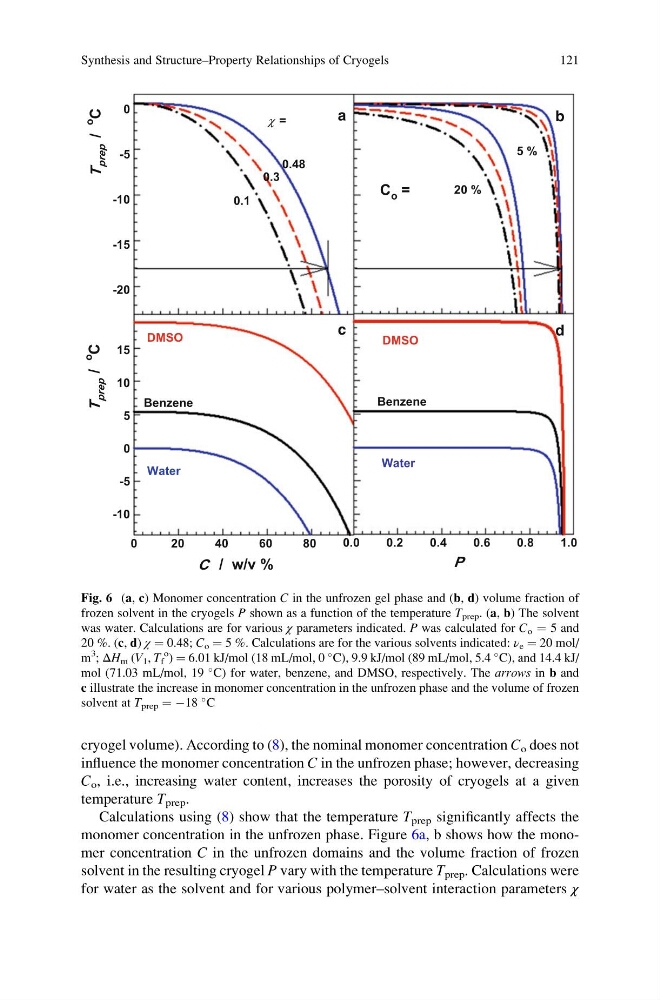
Calculations using (8) show that the temperature T prep significantly affects the
monomer concentration in the unfrozen phase. Figure 6a, b shows how the monomer concentration C in the unfrozen domains and the volume fraction of frozen
solvent in the resulting cryogel P vary with the temperature T prep . Calculations were
for water as the solvent and for various polymer–solvent interaction parameters χ
T
prep /
o
C
-20
-15
-10
-5
0
0.48
0.3
0.1
χ =
C / w/v %
0
2 0
4 0
6 0
8 0
T
prep /
o
C
-10
-5
0
5
10
15
P
0.0
0.2
0.4
0.6
0.8
1.0
5 %
20 %
Benzene
Water
DMSO
Benzene
Water
DMSO
C o =
c
d
a
b
Fig. 6 (a, c) Monomer concentration C in the unfrozen gel phase and (b, d) volume fraction of
frozen solvent in the cryogels P shown as a function of the temperature T prep . (a, b) The solvent
was water. Calculations are for various χ parameters indicated. P was calculated for C o ¼ 5 and
20 %. (c, d) χ ¼ 0.48; C o ¼ 5 %. Calculations are for the various solvents indicated: ν e ¼ 20 mol/
m
3
; ΔH m (V 1 , T f
o
) ¼ 6.01 kJ/mol (18 mL/mol, 0
C), 9.9 kJ/mol (89 mL/mol, 5.4
C), and 14.4 kJ/
mol (71.03 mL/mol, 19
C) for water, benzene, and DMSO, respectively. The arrows in b and
c illustrate the increase in monomer concentration in the unfrozen phase and the volume of frozen
solvent at T prep ¼ À18
C
Synthesis and Structure–Property Relationships of Cryogels
121
influence the monomer concentration C in the unfrozen phase; however, decreasing
C o , i.e., increasing water content, increases the porosity of cryogels at a given
temperature T prep .
Calculations using (8) show that the temperature T prep significantly affects the
monomer concentration in the unfrozen phase. Figure 6a, b shows how the monomer concentration C in the unfrozen domains and the volume fraction of frozen
solvent in the resulting cryogel P vary with the temperature T prep . Calculations were
for water as the solvent and for various polymer–solvent interaction parameters χ
T
prep /
o
C
-20
-15
-10
-5
0
0.48
0.3
0.1
χ =
C / w/v %
0
2 0
4 0
6 0
8 0
T
prep /
o
C
-10
-5
0
5
10
15
P
0.0
0.2
0.4
0.6
0.8
1.0
5 %
20 %
Benzene
Water
DMSO
Benzene
Water
DMSO
C o =
c
d
a
b
Fig. 6 (a, c) Monomer concentration C in the unfrozen gel phase and (b, d) volume fraction of
frozen solvent in the cryogels P shown as a function of the temperature T prep . (a, b) The solvent
was water. Calculations are for various χ parameters indicated. P was calculated for C o ¼ 5 and
20 %. (c, d) χ ¼ 0.48; C o ¼ 5 %. Calculations are for the various solvents indicated: ν e ¼ 20 mol/
m
3
; ΔH m (V 1 , T f
o
) ¼ 6.01 kJ/mol (18 mL/mol, 0
C), 9.9 kJ/mol (89 mL/mol, 5.4
C), and 14.4 kJ/
mol (71.03 mL/mol, 19
C) for water, benzene, and DMSO, respectively. The arrows in b and
c illustrate the increase in monomer concentration in the unfrozen phase and the volume of frozen
solvent at T prep ¼ À18
C
Synthesis and Structure–Property Relationships of Cryogels
121