

structure was discovered at the end of the 1950s [11–13]. This technique involves
the free-radical crosslinking copolymerization of the monomer–crosslinker mixture
in the presence of an inert substance (the diluent or porogen), which is soluble in the
monomer mixture. In order to obtain macroporous structures, a phase separation
must occur during the course of the network formation process so that the
two-phase structure formed is fixed by the formation of additional crosslinks
[12]. After the polymerization, the diluent is removed from the network, leaving
a porous structure within the highly crosslinked polymer network. This mechanism
of porosity formation known as “reaction-induced phase separation” leads to the
formation of macroporous gels consisting of agglomerates of polymer particles of
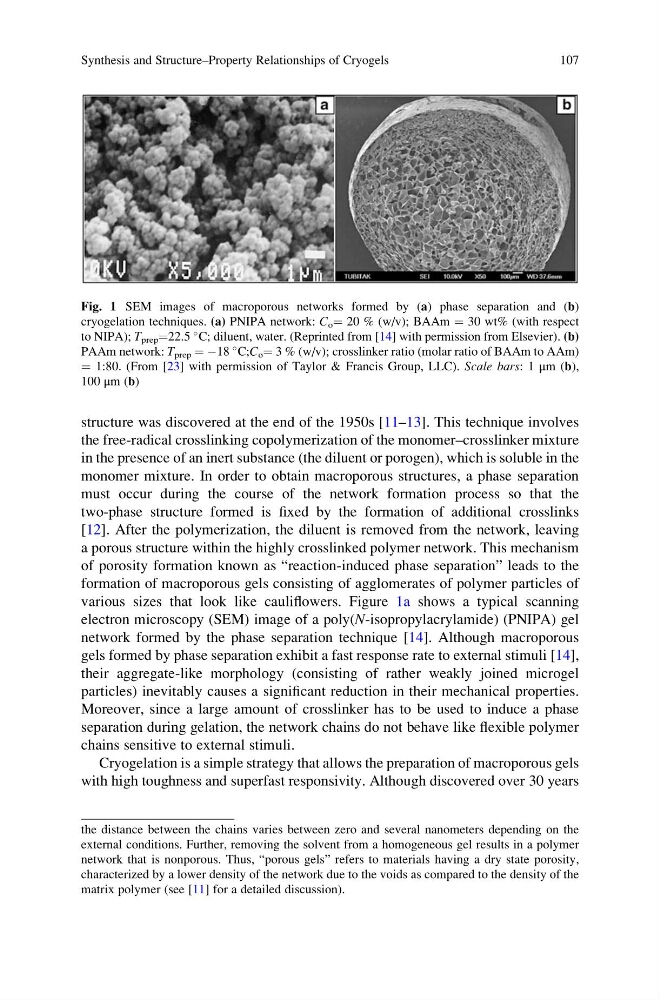
various sizes that look like cauliflowers. Figure 1a shows a typical scanning
electron microscopy (SEM) image of a poly(N-isopropylacrylamide) (PNIPA) gel
network formed by the phase separation technique [14]. Although macroporous
gels formed by phase separation exhibit a fast response rate to external stimuli [14],
their aggregate-like morphology (consisting of rather weakly joined microgel
particles) inevitably causes a significant reduction in their mechanical properties.
Moreover, since a large amount of crosslinker has to be used to induce a phase
separation during gelation, the network chains do not behave like flexible polymer
chains sensitive to external stimuli.
Cryogelation is a simple strategy that allows the preparation of macroporous gels
with high toughness and superfast responsivity. Although discovered over 30 years
the distance between the chains varies between zero and several nanometers depending on the
external conditions. Further, removing the solvent from a homogeneous gel results in a polymer
network that is nonporous. Thus, “porous gels” refers to materials having a dry state porosity,
characterized by a lower density of the network due to the voids as compared to the density of the
matrix polymer (see [11] for a detailed discussion).
Fig. 1 SEM images of macroporous networks formed by (a) phase separation and (b)
cryogelation techniques. (a) PNIPA network: C o ¼ 20 % (w/v); BAAm ¼ 30 wt% (with respect
to NIPA); T prep ¼22.5
C; diluent, water. (Reprinted from [14] with permission from Elsevier). (b)
PAAm network: T prep ¼ À18
C;C o ¼ 3 % (w/v); crosslinker ratio (molar ratio of BAAm to AAm)
¼ 1:80. (From [23] with permission of Taylor & Francis Group, LLC). Scale bars: 1 μm (b),
100 μm (b)
Synthesis and Structure–Property Relationships of Cryogels
107
the free-radical crosslinking copolymerization of the monomer–crosslinker mixture
in the presence of an inert substance (the diluent or porogen), which is soluble in the
monomer mixture. In order to obtain macroporous structures, a phase separation
must occur during the course of the network formation process so that the
two-phase structure formed is fixed by the formation of additional crosslinks
[12]. After the polymerization, the diluent is removed from the network, leaving
a porous structure within the highly crosslinked polymer network. This mechanism
of porosity formation known as “reaction-induced phase separation” leads to the
formation of macroporous gels consisting of agglomerates of polymer particles of
various sizes that look like cauliflowers. Figure 1a shows a typical scanning
electron microscopy (SEM) image of a poly(N-isopropylacrylamide) (PNIPA) gel
network formed by the phase separation technique [14]. Although macroporous
gels formed by phase separation exhibit a fast response rate to external stimuli [14],
their aggregate-like morphology (consisting of rather weakly joined microgel
particles) inevitably causes a significant reduction in their mechanical properties.
Moreover, since a large amount of crosslinker has to be used to induce a phase
separation during gelation, the network chains do not behave like flexible polymer
chains sensitive to external stimuli.
Cryogelation is a simple strategy that allows the preparation of macroporous gels
with high toughness and superfast responsivity. Although discovered over 30 years
the distance between the chains varies between zero and several nanometers depending on the
external conditions. Further, removing the solvent from a homogeneous gel results in a polymer
network that is nonporous. Thus, “porous gels” refers to materials having a dry state porosity,
characterized by a lower density of the network due to the voids as compared to the density of the
matrix polymer (see [11] for a detailed discussion).
Fig. 1 SEM images of macroporous networks formed by (a) phase separation and (b)
cryogelation techniques. (a) PNIPA network: C o ¼ 20 % (w/v); BAAm ¼ 30 wt% (with respect
to NIPA); T prep ¼22.5
C; diluent, water. (Reprinted from [14] with permission from Elsevier). (b)
PAAm network: T prep ¼ À18
C;C o ¼ 3 % (w/v); crosslinker ratio (molar ratio of BAAm to AAm)
¼ 1:80. (From [23] with permission of Taylor & Francis Group, LLC). Scale bars: 1 μm (b),
100 μm (b)
Synthesis and Structure–Property Relationships of Cryogels
107