

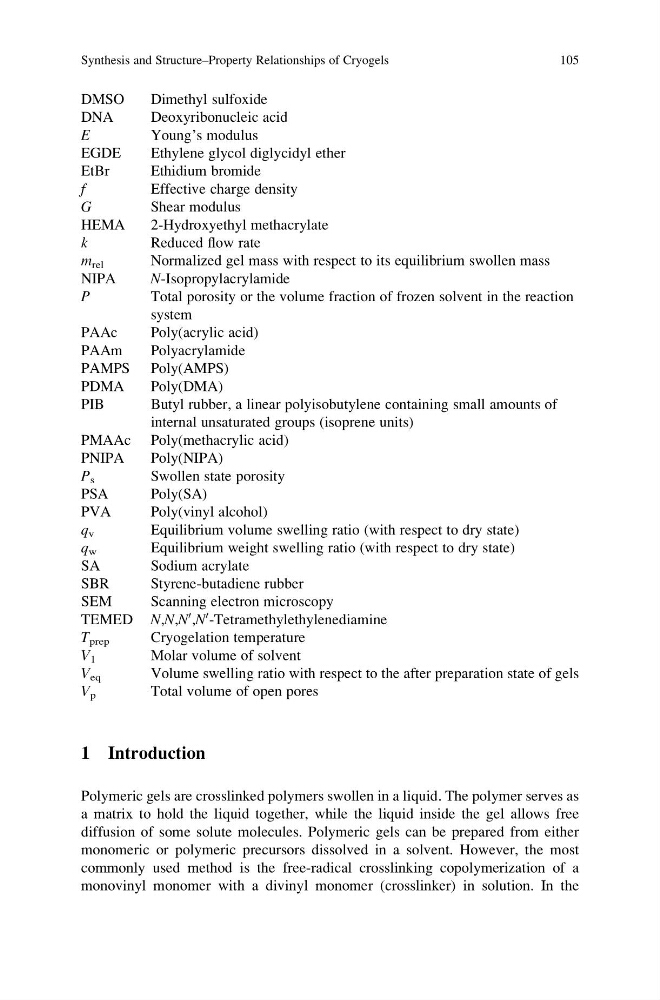
DMSO
Dimethyl sulfoxide
DNA
Deoxyribonucleic acid
E
Young’s modulus
EGDE
Ethylene glycol diglycidyl ether
EtBr
Ethidium bromide
f
Effective charge density
G
Shear modulus
HEMA
2-Hydroxyethyl methacrylate
k
Reduced flow rate
m rel
Normalized gel mass with respect to its equilibrium swollen mass
NIPA
N-Isopropylacrylamide
P
Total porosity or the volume fraction of frozen solvent in the reaction
system
PAAc
Poly(acrylic acid)
PAAm
Polyacrylamide
PAMPS Poly(AMPS)
PDMA
Poly(DMA)
PIB
Butyl rubber, a linear polyisobutylene containing small amounts of
internal unsaturated groups (isoprene units)
PMAAc Poly(methacrylic acid)
PNIPA
Poly(NIPA)
P s
Swollen state porosity
PSA
Poly(SA)
PVA
Poly(vinyl alcohol)
q v
Equilibrium volume swelling ratio (with respect to dry state)
q w
Equilibrium weight swelling ratio (with respect to dry state)
SA
Sodium acrylate
SBR
Styrene-butadiene rubber
SEM
Scanning electron microscopy
TEMED N,N,N
0 ,N
0 -Tetramethylethylenediamine
T prep
Cryogelation temperature
V 1
Molar volume of solvent
V eq
Volume swelling ratio with respect to the after preparation state of gels
V p
Total volume of open pores
1 Introduction
Polymeric gels are crosslinked polymers swollen in a liquid. The polymer serves as
a matrix to hold the liquid together, while the liquid inside the gel allows free
diffusion of some solute molecules. Polymeric gels can be prepared from either
monomeric or polymeric precursors dissolved in a solvent. However, the most
commonly used method is the free-radical crosslinking copolymerization of a
monovinyl monomer with a divinyl monomer (crosslinker) in solution. In the
Synthesis and Structure–Property Relationships of Cryogels
105
Dimethyl sulfoxide
DNA
Deoxyribonucleic acid
E
Young’s modulus
EGDE
Ethylene glycol diglycidyl ether
EtBr
Ethidium bromide
f
Effective charge density
G
Shear modulus
HEMA
2-Hydroxyethyl methacrylate
k
Reduced flow rate
m rel
Normalized gel mass with respect to its equilibrium swollen mass
NIPA
N-Isopropylacrylamide
P
Total porosity or the volume fraction of frozen solvent in the reaction
system
PAAc
Poly(acrylic acid)
PAAm
Polyacrylamide
PAMPS Poly(AMPS)
PDMA
Poly(DMA)
PIB
Butyl rubber, a linear polyisobutylene containing small amounts of
internal unsaturated groups (isoprene units)
PMAAc Poly(methacrylic acid)
PNIPA
Poly(NIPA)
P s
Swollen state porosity
PSA
Poly(SA)
PVA
Poly(vinyl alcohol)
q v
Equilibrium volume swelling ratio (with respect to dry state)
q w
Equilibrium weight swelling ratio (with respect to dry state)
SA
Sodium acrylate
SBR
Styrene-butadiene rubber
SEM
Scanning electron microscopy
TEMED N,N,N
0 ,N
0 -Tetramethylethylenediamine
T prep
Cryogelation temperature
V 1
Molar volume of solvent
V eq
Volume swelling ratio with respect to the after preparation state of gels
V p
Total volume of open pores
1 Introduction
Polymeric gels are crosslinked polymers swollen in a liquid. The polymer serves as
a matrix to hold the liquid together, while the liquid inside the gel allows free
diffusion of some solute molecules. Polymeric gels can be prepared from either
monomeric or polymeric precursors dissolved in a solvent. However, the most
commonly used method is the free-radical crosslinking copolymerization of a
monovinyl monomer with a divinyl monomer (crosslinker) in solution. In the
Synthesis and Structure–Property Relationships of Cryogels
105