

the air bubbles. The second type are smaller prolate pores with a cross-section of
around 1–3 μm within the gel phase in the space between the bubbles. The pores of
the latter type are typical of cryogenically induced pores in conventional PVA
cryogels (e.g., see Figs. 5 and 6), and these pores are filled with water rather than
gas. The microbubble-type pores generated by simple whipping or by the barbotage
of a gas through a porous filter to the initial polymer solution have a wide size
distribution. In this respect, a recently developed microfluidic foaming technique is
attractive because it allows a rather narrow, practically monodisperse distribution
of pore dimensions [197]. The air bubbles entrapped in the PVA cryogel matrix
decrease its density down to values smaller than that of water, thus imparting
buoyancy to such cryogels, i.e., foamed cryogels can float in water for a long
time and do not sink [193].
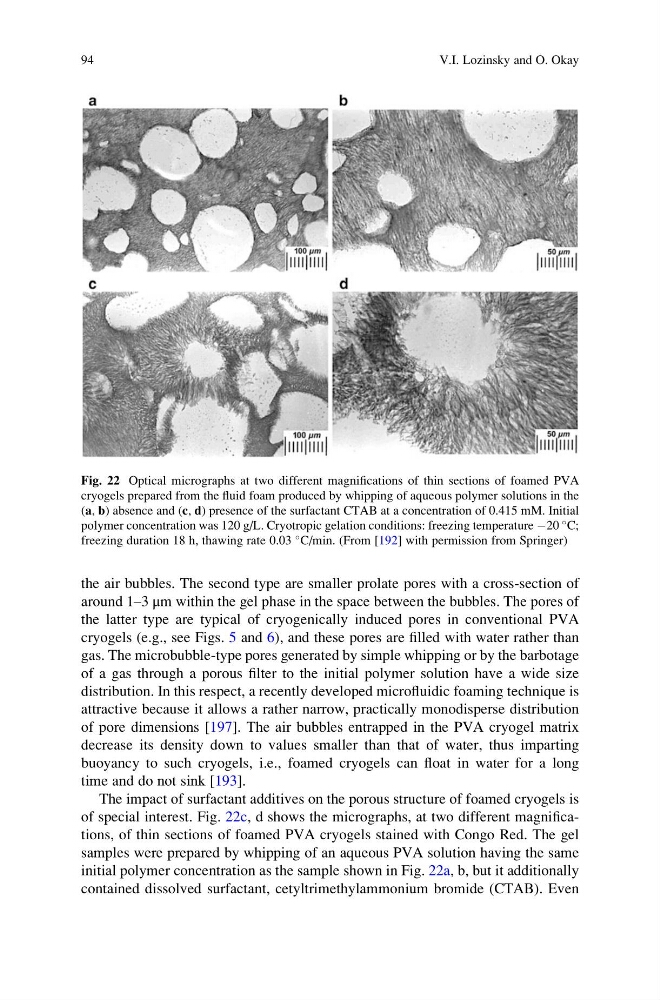
The impact of surfactant additives on the porous structure of foamed cryogels is
of special interest. Fig. 22c, d shows the micrographs, at two different magnifications, of thin sections of foamed PVA cryogels stained with Congo Red. The gel
samples were prepared by whipping of an aqueous PVA solution having the same
initial polymer concentration as the sample shown in Fig. 22a, b, but it additionally
contained dissolved surfactant, cetyltrimethylammonium bromide (CTAB). Even
Fig. 22 Optical micrographs at two different magnifications of thin sections of foamed PVA
cryogels prepared from the fluid foam produced by whipping of aqueous polymer solutions in the
(a, b) absence and (c, d) presence of the surfactant CTAB at a concentration of 0.415 mM. Initial
polymer concentration was 120 g/L. Cryotropic gelation conditions: freezing temperature À20
C;
freezing duration 18 h, thawing rate 0.03
C/min. (From [192] with permission from Springer)
94
V.I. Lozinsky and O. Okay
around 1–3 μm within the gel phase in the space between the bubbles. The pores of
the latter type are typical of cryogenically induced pores in conventional PVA
cryogels (e.g., see Figs. 5 and 6), and these pores are filled with water rather than
gas. The microbubble-type pores generated by simple whipping or by the barbotage
of a gas through a porous filter to the initial polymer solution have a wide size
distribution. In this respect, a recently developed microfluidic foaming technique is
attractive because it allows a rather narrow, practically monodisperse distribution
of pore dimensions [197]. The air bubbles entrapped in the PVA cryogel matrix
decrease its density down to values smaller than that of water, thus imparting
buoyancy to such cryogels, i.e., foamed cryogels can float in water for a long
time and do not sink [193].
The impact of surfactant additives on the porous structure of foamed cryogels is
of special interest. Fig. 22c, d shows the micrographs, at two different magnifications, of thin sections of foamed PVA cryogels stained with Congo Red. The gel
samples were prepared by whipping of an aqueous PVA solution having the same
initial polymer concentration as the sample shown in Fig. 22a, b, but it additionally
contained dissolved surfactant, cetyltrimethylammonium bromide (CTAB). Even
Fig. 22 Optical micrographs at two different magnifications of thin sections of foamed PVA
cryogels prepared from the fluid foam produced by whipping of aqueous polymer solutions in the
(a, b) absence and (c, d) presence of the surfactant CTAB at a concentration of 0.415 mM. Initial
polymer concentration was 120 g/L. Cryotropic gelation conditions: freezing temperature À20
C;
freezing duration 18 h, thawing rate 0.03
C/min. (From [192] with permission from Springer)
94
V.I. Lozinsky and O. Okay