

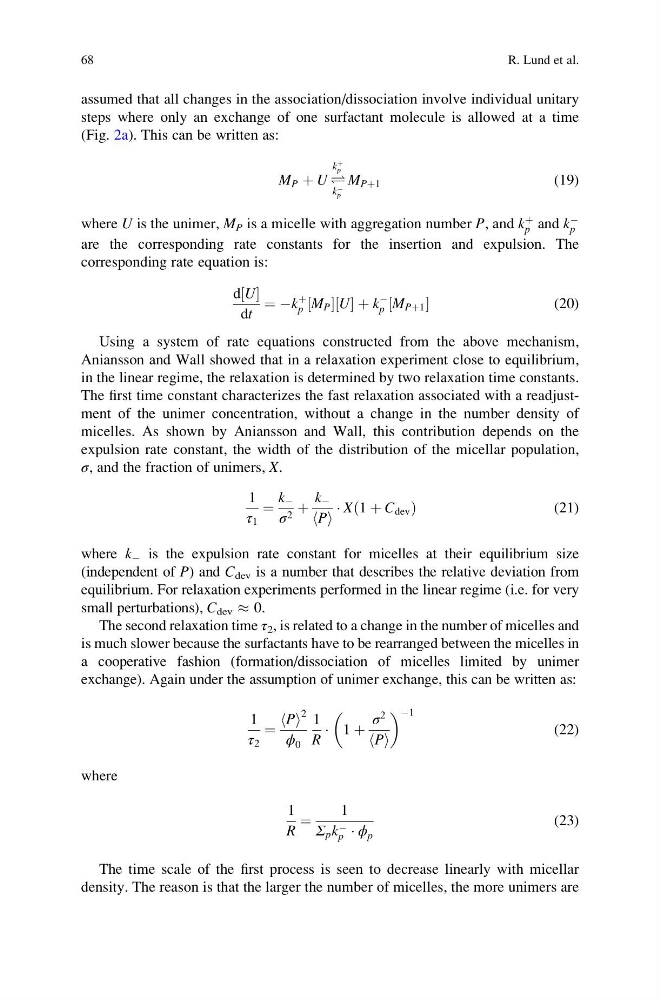
assumed that all changes in the association/dissociation involve individual unitary
steps where only an exchange of one surfactant molecule is allowed at a time
(Fig. 2a). This can be written as:
M P þ U Ð
k
þ
p
k À
p
M Pþ1
(19)
where U is the unimer, M P is a micelle with aggregation number P, and k
þ
p and k
À
p
are the corresponding rate constants for the insertion and expulsion. The
corresponding rate equation is:
d½U
dt
¼ Àk
þ
p ½M P ½U þ k
À
p ½M Pþ1
(20)
Using a system of rate equations constructed from the above mechanism,
Aniansson and Wall showed that in a relaxation experiment close to equilibrium,
in the linear regime, the relaxation is determined by two relaxation time constants.
The first time constant characterizes the fast relaxation associated with a readjustment of the unimer concentration, without a change in the number density of
micelles. As shown by Aniansson and Wall, this contribution depends on the
expulsion rate constant, the width of the distribution of the micellar population,
σ, and the fraction of unimers, X.
1
τ 1
¼
k À
σ 2 þ
k À
P
h i
Á Xð1 þ C dev Þ
(21)
where k À is the expulsion rate constant for micelles at their equilibrium size
(independent of P) and C dev is a number that describes the relative deviation from
equilibrium. For relaxation experiments performed in the linear regime (i.e. for very
small perturbations), C dev % 0.
The second relaxation time τ 2 , is related to a change in the number of micelles and
is much slower because the surfactants have to be rearranged between the micelles in
a cooperative fashion (formation/dissociation of micelles limited by unimer
exchange). Again under the assumption of unimer exchange, this can be written as:
1
τ 2
¼
P
h i
2
ϕ 0
1
R
Á 1 þ
σ
2
P
h i
À1
(22)
where
1
R
¼
1
Σ p k À
p Á ϕ p
(23)
The time scale of the first process is seen to decrease linearly with micellar
density. The reason is that the larger the number of micelles, the more unimers are
68
R. Lund et al.
steps where only an exchange of one surfactant molecule is allowed at a time
(Fig. 2a). This can be written as:
M P þ U Ð
k
þ
p
k À
p
M Pþ1
(19)
where U is the unimer, M P is a micelle with aggregation number P, and k
þ
p and k
À
p
are the corresponding rate constants for the insertion and expulsion. The
corresponding rate equation is:
d½U
dt
¼ Àk
þ
p ½M P ½U þ k
À
p ½M Pþ1
(20)
Using a system of rate equations constructed from the above mechanism,
Aniansson and Wall showed that in a relaxation experiment close to equilibrium,
in the linear regime, the relaxation is determined by two relaxation time constants.
The first time constant characterizes the fast relaxation associated with a readjustment of the unimer concentration, without a change in the number density of
micelles. As shown by Aniansson and Wall, this contribution depends on the
expulsion rate constant, the width of the distribution of the micellar population,
σ, and the fraction of unimers, X.
1
τ 1
¼
k À
σ 2 þ
k À
P
h i
Á Xð1 þ C dev Þ
(21)
where k À is the expulsion rate constant for micelles at their equilibrium size
(independent of P) and C dev is a number that describes the relative deviation from
equilibrium. For relaxation experiments performed in the linear regime (i.e. for very
small perturbations), C dev % 0.
The second relaxation time τ 2 , is related to a change in the number of micelles and
is much slower because the surfactants have to be rearranged between the micelles in
a cooperative fashion (formation/dissociation of micelles limited by unimer
exchange). Again under the assumption of unimer exchange, this can be written as:
1
τ 2
¼
P
h i
2
ϕ 0
1
R
Á 1 þ
σ
2
P
h i
À1
(22)
where
1
R
¼
1
Σ p k À
p Á ϕ p
(23)
The time scale of the first process is seen to decrease linearly with micellar
density. The reason is that the larger the number of micelles, the more unimers are
68
R. Lund et al.